
Camponotus vicinus
Mayr, 1870
Bicolored Carpenter Ant
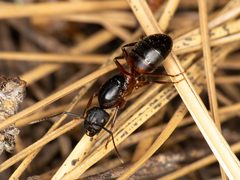
Camponotus vicinus is a large, conspicuous carpenter ant distributed across western North America from Alaska to Mexico and east to Texas and Manitoba. Unlike many carpenter ants that nest in wood, this typically nests in soil under stones and other objects, though it also uses fallen, decomposing logs in higher elevation conifer forests. It is a prominent scavenger and in terrestrial and is one of the most abundant ground-dwelling arthropods in California's higher elevation conifer forests. The species belongs to a genetically diverse with cryptic diversity, including localized of conservation interest such as an undescribed species to the Channel Islands.
Pronunciation
How to pronounce Camponotus vicinus: /ˌkæmpəˈnoʊtəs vɪˈsaɪnəs/
These audio files are automatically generated. While they are not always 100% accurate, they are a good starting point.
Identification
Bicolored carpenter ant with contrasting coloration; typically nests in soil under stones rather than wood, distinguishing it from wood-nesting relatives such as Camponotus pennsylvanicus. Distinguished from similar Camponotus modoc by coloration—C. vicinus shows more reddish tones on legs and . Part of a with unresolved cryptic diversity; precise identification may require genetic analysis.
Images
Habitat
Soil under stones and other objects; fallen, decomposing logs in higher elevation conifer forests; Pseudotsuga-Quercus forest. Found across wide range of elevations and latitudes.
Distribution
Western North America from Alaska south to Mexico and east to Texas and Manitoba; all ecoregions of California except Colorado and Sonoran Deserts; type locality near Calistoga, Sonoma County, California. Channel Islands cryptic undescribed species.
Diet
Scavenger and . Laboratory studies indicate colonies can be maintained on chemically defined diets containing , vitamins, minerals, and sucrose, with development affected by specific nutrient deletions.
Life Cycle
Colony contains single dealate , numerous , queens, alate males, , larvae, and pupae. development studied through third- and fourth-instar larval stages in laboratory colonies.
Behavior
Excavates rotting wood for nesting in forest ; forages as scavenger and . maintain infrabuccal pockets—specialized structures for filtering food particles. Colonies can be maintained on artificial diets for laboratory study. Heat and chemical defaunation processes significantly affect development, indicating sensitivity to microbial disruption.
Ecological Role
Abundant and ecologically influential in terrestrial ; prominent scavenger and ; one of the most abundant ground-dwelling arthropods in higher elevation conifer forests of California.
Human Relevance
Occasionally enters structures but less associated with structural damage than wood-nesting carpenter ants due to ground-nesting habit. Subject of laboratory nutritional research for developing chemically defined diets. sequenced as reference for studying evolutionary and clarifying cryptic diversity within the .
Similar Taxa
- Camponotus modocSimilar size and distribution; distinguished by coloration with C. vicinus showing more reddish tones on legs and
- Camponotus pennsylvanicusWood-nesting carpenter ant; C. vicinus distinguished by ground-nesting habit under stones
- Camponotus sericeiventrisNeotropical golden carpenter ant with similar characteristics but distinct distribution and appearance
Sources and further reading
- BugGuide
- Wikipedia
- GBIF taxonomy match
- iNaturalist taxon
- NCBI Taxonomy
- Pismire Puzzle | Beetles In The Bush
- Carpenter ants here and there: Camponotus spp. — Bug of the Week
- The “silky-bellied humpbacked” ant | Beetles In The Bush
- Reference genome of the bicolored carpenter ant, Camponotus vicinus
- Reference genome of the bicolored carpenter ant, Camponotus vicinus
- Yeasts associated with the infrabuccal pocket and colonies of the carpenter antCamponotus vicinus
- Effects of B Vitamin Deletion in Chemically Defined Diets on Brood Development in Camponotus vicinus (Hymenoptera: Formicidae)
- Effects on Brood Development in the Carpenter Ant Camponotus vicinus Mayr after Exposure to the Yeast Associate Schwanniomyces polymorphus Kloecker