
Camponotus modoc
Wheeler, 1910
Western Carpenter Ant, Western Black Carpenter Ant
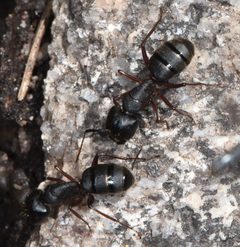
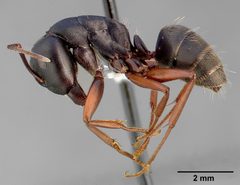
Camponotus modoc, the western carpenter ant, is a large black native to western North America. exhibit , ranging from 7 to 13 mm in length, with dark red legs contrasting against a black body. The species constructs nests in dead wood, including forest logs and human structures, and is known for its mutualistic associations with aphids, particularly Cinara occidentalis on white fir. Research demonstrates trail fidelity and colony recognition abilities, with workers returning to specific colonies even after displacement.
Pronunciation
How to pronounce Camponotus modoc: //ˌkæmpəˈnoʊtəs ˈmoʊˌdɔk//
These audio files are automatically generated. While they are not always 100% accurate, they are a good starting point.
Identification
are entirely black with dark red legs, distinguishing them from other western Camponotus . Size ranges from 7 to 13 mm. The smooth, evenly rounded thoracic profile in lateral view separates carpenter ants from field ants (Formica), which possess a distinct mesonotal constriction. is pronounced, with major workers substantially larger than minors.
Images
Habitat
Found in western North American forests, particularly giant sequoia forests. Nests in dead wood including fallen logs, stumps, and standing dead trees. Moisture-dependent; primary colonies occur in high-humidity decaying wood. Satellite colonies establish in damp structural wood of human dwellings.
Distribution
Western North America, including California (Sierra Nevada, Sequoia-Kings Canyon National Park), Nevada, and adjacent regions.
Diet
. Consumes solid food items and honeydew from aphids. demonstrate size-based dietary specialization: smaller workers more frequently transport solid food and attend aphids, while larger workers specialize in honeydew collection.
Host Associations
- Cinara occidentalis - mutualist on white fir (Abies concolor); attendance essential for aphid survival and protection
- Cinara spp. - mutualistMultiple tended on conifers
Behavior
exhibit strong trail fidelity, returning to identical trunk trails and specific colonies after removal. Colony recognition allows workers to identify original aphid colonies among up to eight alternatives on the same tree. Long-term site fidelity observed, with individual workers remaining at aphid colonies for extended periods. Foraging decisions mediated by and glyceride chemical cues on object surfaces. Alarm communication involves bimodal signal modulation.
Ecological Role
Keystone mutualist in conifer forest . Protects colonies from including Neomysia oblonguttata, Deraeocoris brevis, Passaloecus cuspidatus, and Pityophyphantes spiders. Attendance alters aphid , reducing production and improving colony survival to oviparae stage. Contributes to nutrient cycling through wood excavation and aphid honeydew processing.
Human Relevance
Significant structural pest. Satellite colonies in homes cause damage by excavating galleries in damp wood for larval and pupal development. indicated by accumulation, regular presence of large indoors, and spring of winged reproductives. Control requires colony location and elimination, moisture source remediation, and barrier maintenance between vegetation and structures.
Similar Taxa
- Camponotus vicinusOverlapping western range and similar size; distinguished by coloration and leg
- Camponotus pennsylvanicusEastern counterpart with similar ; distribution separates
- Formica subsericeaSimilar size and coloration; distinguished by thoracic profile with mesonotal constriction versus smooth carpenter ant
Sources and further reading
- BugGuide
- Wikipedia
- GBIF taxonomy match
- iNaturalist taxon
- NCBI Taxonomy
- Pismire Puzzle | Beetles In The Bush
- Predator or Prey? | Beetles In The Bush
- Carpenter ants here and there: Camponotus spp. — Bug of the Week
- Big black ants in the home: Carpenter ants, Camponotus spp. — Bug of the Week
- The “silky-bellied humpbacked” ant | Beetles In The Bush
- Swim Lessons: How Two Land-Dwelling Ant Species Paddle Through Water
- FORAGING BEHAVIOR OF THE CARPENTER ANT, CAMPONOTUS MODOC (HYMENOPTERA: FORMICIDAE), IN A GIANT SEQUOIA FOREST,
- Fatty acids and glycerides are object recognition and carrying cues for foraging Camponotus modoc carpenter ants
- THE INFLUENCE OF CARPENTER ANT (CAMPONOTUS MODOC) (HYMENOPTERA: FORMICIDAE) ATTENDANCE ON THE DEVELOPMENT AND SURVIVAL OF APHIDS (CINARA SPP.) (HOMOPTERA: APHIDIDAE) IN A GIANT SEQUOIA FOREST
- Bimodal alarm signals modulate responses to monomodal alarm signals in Camponotus modoc carpenter ants.