
Celastrina neglecta
(W.H.Edwards, 1862)
Summer Azure
Celastrina neglecta, the summer azure, is a small North American in the Lycaenidae. It is distinguished from similar Celastrina by its late-season period, pale blue upper surface with extensive white scaling, and specific wing pattern details. The species has undergone taxonomic revision, previously treated as a synonym of C. argiolus lucia.
Pronunciation
How to pronounce Celastrina neglecta: /sɛˈlæstrɪnə nɪˈɡlɛktə/
These audio files are automatically generated. While they are not always 100% accurate, they are a good starting point.
Identification
Distinguished from spring azure (C. ladon) by later season (mid-June onward versus spring). Differs from cherry gall azure (C. serotina), holly azure (C. idella), Lucia azure (C. lucia), and Iryna's azure (C. iryna) by combination of pale blue ground color, extensive white scaling, and specific pattern elements. Females with heavy white scaling and dark forewing band are particularly distinctive.
Images
Appearance
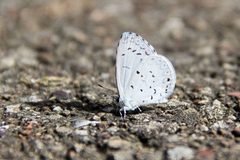
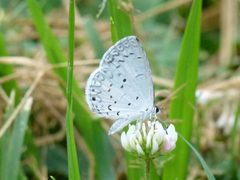
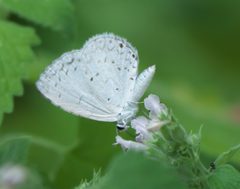
Wingspan 23–29 mm. Upper surface pale blue with extensive white scaling, especially on hindwing; females often have blue replaced by white with only small blue patches near wing bases, plus a broad blackish-grey band on outer third and of forewing. Underside chalky white to pale grey with tiny dark grey spots and zigzagged submarginal line on hindwing.
Habitat
Occurs in diverse open including meadows, forest edges, and gardens. Associated with plant availability.
Distribution
Eastern and central United States, southern Canada from Nova Scotia to southern Saskatchewan.
Seasonality
fly from mid-June until early October. Two or three per year in southern part of range.
Diet
Larval plants: New Jersey tea (Ceanothus americanus), dogwoods (Cornus spp.), and meadowsweet (Spiraea spp.). nectar sources include vetch, yarrow, meadowsweet, rough-fruited cinquefoil, Anne's lace, wild oregano, narrow-leaved mountain mint, Joe-pye weed, and goldenrods.
Host Associations
- New Jersey tea - larval Ceanothus americanus
- dogwoods - larval Cornus spp.
- meadowsweet - larval Spiraea spp.
Life Cycle
Multivoltine with two or three annually in southern range. Complete with , larva, pupa, and stages. Specific duration of stages not documented.
Behavior
nectar at flowers. period distinctly separated from spring-flying .
Ecological Role
of diverse flowering plants. Larvae function as herbivores on specific shrubs.
Human Relevance
Subject of citizen science observation (28,120+ iNaturalist records). Occasionally encountered in gardens due to plant .
Similar Taxa
- Celastrina ladonSpring azure; flies earlier in season (spring), generally darker blue with less white scaling
- Celastrina serotinaCherry gall azure; distinct and associations
- Celastrina idellaHolly azure; restricted distribution and specificity
- Celastrina luciaLucia azure; historically confused taxonomically, distinct range and pattern
- Celastrina irynaIryna's azure; recently described, limited range
Misconceptions
Historically treated as a synonym of Celastrina argiolus lucia, leading to confusion in older literature. Taxonomic status clarified in modern treatments.
More Details
Taxonomic history
Originally described as Lycaena neglecta Edwards, 1862. Long treated as synonym of Celastrina argiolus lucia; subsequently recognized as distinct .
Sources and further reading
- BugGuide
- Wikipedia
- GBIF taxonomy match
- iNaturalist taxon
- NCBI Taxonomy
- Spring beetles on Coreopsis flowers | Beetles In The Bush
- Rare, protected orchid thrives in a military base in Corsica
- A flower visiting jewel beetle that is not an Acmaeodera | Beetles In The Bush
- orchid | Blog
- Springtime Acmaeodera | Beetles In The Bush