
Celastrina
Tutt, 1906
Holarctic Azures
Species Guides
9- Celastrina asheri(Asher's Blue)
- Celastrina echo(Echo Azure)
- Celastrina humulus(Hops Azure)
- Celastrina idella(American holly azure)
- Celastrina ladon(spring azure)
- Celastrina lucia(lucia azure)
- Celastrina neglecta(Summer Azure)
- Celastrina neglectamajor(Appalachian Azure)
- Celastrina serotina(Cherry Gall Azure)
Celastrina is a of small butterflies in the Lycaenidae, commonly known as the Holarctic Azures. The genus is distributed across the Palearctic, Nearctic, Indomalayan, and Australasian realms. within this genus are typically associated with specific plants, with larvae showing varying degrees of dietary specialization. Several species have been studied in detail for their ecological relationships, including facultative mutualisms with ants.
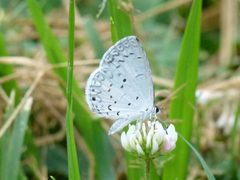
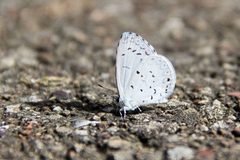
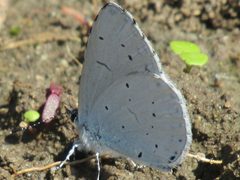
Pronunciation
How to pronounce Celastrina: /sɛˈlæstrɪnə/
These audio files are automatically generated. While they are not always 100% accurate, they are a good starting point.
Images
Habitat
Varies by . Celastrina humulus is associated with riparian areas supporting its plant wild hops (Humulus lupulus). Celastrina gigas has been recorded from riverbed in the eastern Himalayas.
Distribution
Palearctic, Nearctic, Indomalayan, and Australasian realms. Specific records include: North America (Colorado, Montana, California, Oregon, eastern United States), Europe, Japan, Korea, China (including Tibet and Taiwan), Nepal, northeast India, Burma, Philippines, Borneo, Papua New Guinea, and the western Himalayas.
Seasonality
Spring activity documented for some North American . Celastrina ladon (spring azure) and Celastrina lucia (Lucia azure) are among the earliest-emerging butterflies in spring in their respective ranges. Celastrina humulus larvae have been monitored during plant flowering from 2020–2022.
Diet
Larvae of Celastrina humulus feed on pollen-bearing inflorescences of Humulus lupulus var. neomexicanus. Larvae of Celastrina argiolus (holly blue) have been documented utilizing plants in 19 different , showing exceptional dietary breadth within the .
Host Associations
- Humulus lupulus - larval plantwild hops; specific association documented for C. humulus
Life Cycle
Complete with , larval, pupal, and stages. Larval development of Celastrina humulus occurs on plant inflorescences, with performance varying by phenological stage of the host plant.
Behavior
Celastrina humulus larvae engage in a facultative mutualism with ants, where the likelihood of tending varies with plant flowering . Ant recruitment is reduced on early-stage host plant inflorescences despite these stages enabling greater larval weight gain. butterflies are described as small, active, and difficult to photograph due to persistent flitting and skittish .
More Details
Ant-plant-herbivore interactions
Research on Celastrina humulus demonstrates that -plant can indirectly mediate herbivore through effects on mutualist recruitment. Early-stage host plant inflorescences contain higher concentrations of soluble proteins and α-acids, which enhance larval growth but simultaneously reduce ant attraction.
Conservation status
Celastrina humulus is considered rare in Colorado and Montana despite being locally abundant at specific sites such as the U.S. Air Force Academy. Patch extinction and probabilities for this are extremely low, suggesting stable where suitable exists.
Sources and further reading
- BugGuide
- Wikipedia
- GBIF taxonomy match
- iNaturalist taxon
- NCBI Taxonomy
- Catalogue of Life
- Provisional checklist of European butterfly larval foodplants
- Oedemeridae | Beetles In The Bush
- Multi-year occupancy of the hops blue butterfly (Celastrina humulus): habitat patch colonization and extinction
- First occurrence of Silvery Hedge Blue Celastrina gigas (Hemming, 1928) (Insecta: Lepidoptera: Polyommatinae) in West Bengal, India
- Patch occupancy and habitat of the hops azure (Celastrina humulus), a rare North American endemic butterfly: insights for monitoring and conservation
- Host-plant phenology mediates facultative ant mutualism in the rare butterfly, Celastrina humulus (Lepidoptera: Lycaenidae)