
Celastrina serotina
Pavulaan & Wright, 2005
Cherry Gall Azure
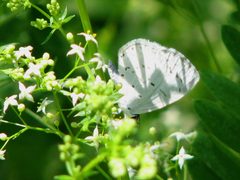
Celastrina serotina is a small in the Lycaenidae, commonly known as the cherry gall azure. It occurs across North America from the treeline southward. The is notable for its unusual larval diet: caterpillars feed on galls produced by eriophyid mites (particularly Eriophyes cerasicrumena) on cherry, and have been reported to consume the mites themselves—one of the few documented cases of carnivory in Lepidoptera. fly in a narrow window between mid-May and mid-June in eastern North America, emerging after the spring azure (C. ladon) and before the summer azure (C. neglecta).
Pronunciation
How to pronounce Celastrina serotina: /sɛˈlæstrɪnə sɛˈroʊtɪnə/
These audio files are automatically generated. While they are not always 100% accurate, they are a good starting point.
Identification
Distinguished from similar Celastrina primarily by : in eastern Ontario, C. serotina flies between mid-May and mid-June, after C. ladon (spring azure) and before C. neglecta (summer azure). Overlapping periods with other azure species may occur in some regions; precise identification may require examination of genitalia or molecular analysis where phenology is ambiguous. The species is part of a cryptic complex of blue butterflies that are difficult to separate based on wing pattern alone.
Images
Habitat
Commonly found in upland mixed deciduous hardwood forests, particularly along woodland roads. Associated are frequently surrounded by wetlands. Occupies forest edge and open woodland situations where mite galls on cherry are available.
Distribution
North America, ranging from the treeline southward across the continent. Documented in Canada (including Ontario, Quebec) and the United States. GBIF records indicate presence in Vermont and broader North American distribution.
Seasonality
period is mid-May to mid-June in eastern Ontario; timing varies geographically but generally represents a narrow spring window. Emerges after spring azure and before summer azure in areas where these co-occur.
Diet
Larvae feed on galls produced by eriophyid mites (Eriophyes cerasicrumena and related ) on cherry (Prunus spp.), and have been reported to consume the mites themselves. This represents one of the few documented cases of carnivory in Lepidoptera. diet not specified in sources.
Host Associations
- Eriophyes cerasicrumena - prey/food sourceeriophyid mite; larvae feed on mite galls and reportedly on mites themselves
- Prunus serotina - indirect black cherry; plant of mite that produces galls consumed by larvae
Life Cycle
Complete with , larva, pupa, and stages. Larval stage specialized for feeding on mite galls. Specific details of oviposition , site, and voltinism not documented in available sources.
Behavior
active during daylight hours in spring. Larvae exhibit specialized feeding on mite galls, with reported consumption of mites themselves—unusual for Lepidoptera. Specific mating, territorial, or other behaviors not documented.
Ecological Role
Specialized consumer of eriophyid mite galls; may function as a regulator of these mites in forest . Part of the spring-flying in deciduous forests. Ecological role of (pollination, etc.) not documented.
Human Relevance
Of interest to lepidopterists and ecologists due to its unusual larval diet. Not known to be of economic importance. May serve as an indicator of healthy forest supporting mite gall .
Similar Taxa
- Celastrina ladonSpring azure; flies earlier in spring, typically before C. serotina where sympatric
- Celastrina neglectaSummer azure; flies later in season, typically after C. serotina where sympatric
- Celastrina idellaHolly azure; similar wing pattern, different and preferences
- Celastrina luciaLucia azure; similar wing pattern, different geographic distribution and
More Details
Taxonomic history
Described by Pavulaan and Wright in 2005, representing a split from the formerly broader Celastrina ladon complex. Recognition as a distinct based on phenological, ecological, and morphological differences.
Conservation status
Not assessed by IUCN; appears to be locally common within its range but specialized requirements may make it vulnerable to forest fragmentation and loss of wetland-buffered forest habitats.
Sources and further reading
- BugGuide
- Wikipedia
- GBIF taxonomy match
- iNaturalist taxon
- NCBI Taxonomy
- Listen to the trees: a detective work on the origin of invasive species
- And then there were 10 – unexpected diversity in New Zealand kanuka genus Kunzea | Blog
- Provisional checklist of European butterfly larval foodplants
- “62nd” Annual “Season-Opener-Birthday-Bug-Collecting-Trip” | Beetles In The Bush
- Megalopygidae | Beetles In The Bush
- Adoxaceae | Beetles In The Bush