
Celastrina ladon
(Cramer, 1782)
spring azure, echo blue
Celastrina ladon, commonly known as the spring azure or echo blue, is a small in the Lycaenidae. It is one of the earliest-emerging butterflies in North America, appearing in late winter to early spring. The has a complex taxonomic history, with some authorities treating it as a of the Holarctic C. argiolus while others maintain it as a distinct species. Its early period and distinctive blue coloration make it a notable indicator of spring in temperate North America.
Pronunciation
How to pronounce Celastrina ladon: //sɛˈlæstɹɪnə ˈlædɒn//
These audio files are automatically generated. While they are not always 100% accurate, they are a good starting point.
Identification
Distinguished from other Celastrina primarily by ( period) and geographic range. C. ladon is the earliest-flying azure in most of its range, emerging in late winter to early spring. C. neglecta (summer azure) flies later, primarily in summer. C. serotina (cherry gall azure) and C. idella (holly azure) have more restricted plant associations and geographic ranges. C. lucia (Lucia azure) occurs in northeastern North America. Precise identification often requires examination of larval host plant, flight date, and genitalia; field identification to species level is challenging and frequently tentative.
Images
Appearance
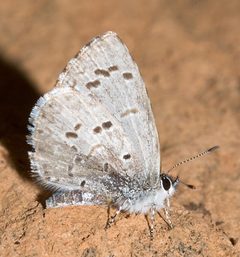
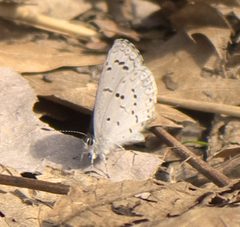
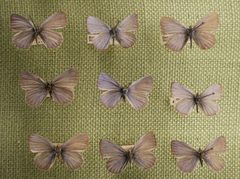
Small with wingspan of 22–35 mm. Upper wing surfaces are metallic blue in males; females have metallic blue wings with black margins. Undersides of wings are white with dark speckling. The overall appearance is delicate with relatively rounded wing margins compared to some related .
Habitat
Occurs in diverse open including woodlands, forest edges, meadows, prairies, fens, and riparian areas. Observed in both dry and moist environments, from limestone glades to calcareous wet meadows. Shows adaptability to varied vegetation structure provided suitable plants are present.
Distribution
North America from Alaska and Canada south of the tundra, through most of the United States except the Texas coast, southern plains, and peninsular Florida. Extends south in mountainous regions to Colombia. Also recorded from Molokai Island, Hawaii. Absent from Arctic tundra and the hottest, driest parts of the southern United States.
Seasonality
active from late winter through spring, with peak activity varying by latitude and elevation. In Missouri, observed active in early April. In California's Central Valley, recorded flying in late January during warm years. period precedes that of C. neglecta (summer azure) by several months in areas where both occur.
Behavior
exhibit persistent, rapid low over vegetation, making them difficult to photograph or approach closely. Males patrol for females in open areas. Adults nectar at flowers of early-blooming plants including serviceberry (Amelanchier), radish (Raphanus), and other spring flora. Skittish characteristic; individuals rarely settle for extended periods.
Ecological Role
serve as of early spring flowering plants. As one of the first butterflies to emerge in spring, they provide a food source for early-season insectivorous birds and other . Larval poorly documented but likely involves association with specific plants in the Celastraceae and possibly others.
Human Relevance
Valued as an indicator of spring arrival in temperate North America. Subject of long-term monitoring studies, including Art Shapiro's 42-year survey in California's Central Valley, where its early dates provide data on climate change effects. Taxonomic status debated among lepidopterists, affecting regional lists and conservation assessments.
Similar Taxa
- Celastrina neglectaSummer azure, flies later in the season (primarily summer) and often lacks the extensive dark marginal markings on female uppersides seen in C. ladon; ranges overlap broadly but separates them
- Celastrina serotinaCherry gall azure, associated with black cherry (Prunus serotina) galls, has later and more restricted period in eastern North America
- Celastrina idellaHolly azure, associated with holly (Ilex) , restricted to southeastern United States coastal plain
- Celastrina luciaLucia azure, occurs in northeastern North America, and range generally separate it from C. ladon though some overlap exists
More Details
Taxonomic Uncertainty
Since Eliot & Kawazoe's 1983 monograph on the Lycaenopsis group, some authorities have treated C. ladon as a of the Holarctic C. argiolus. Other authorities maintain C. ladon, C. neglecta, and C. serotina as full . This taxonomic instability affects conservation status assessments and regional biodiversity documentation.
Climate Sensitivity
Long-term monitoring data from California's Central Valley shows C. ladon responding to winter temperature and precipitation patterns. In drought years with warm late winters, can occur remarkably early (late January), while cold or wet springs delay activity.