
Aceria
Keifer, 1944
gall mites, eriophyid mites, four-legged mites
Species Guides
29- Aceria aceris(maple gall mite)
- Aceria baccharices(Mule Fat Blister Mite)
- Aceria baccharipha(Baccharis Leaf Blister Mite)
- Aceria brachytarsus(pouch gall mite)
- Aceria calaceris(Rocky Mountain maple felt mite)
- Aceria campestricola(Elm Leaf Gall Mite)
- Aceria caryae(Pecan Leafroll Mite)
- Aceria caulis(Black Walnut Petiole Gall Mite)
- Aceria celtis(Witches' Broom Mite)
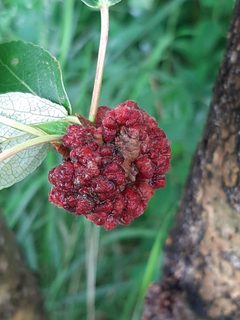
Aceria is a large of eriophyid mites ( Eriophyidae) containing over 900 described . These microscopic, worm-like arachnids are obligate plant that induce distinctive plant growth including galls, erinea, and witches' brooms. Some species are economically significant agricultural pests, while others have been deployed as agents against weeds. The genus exhibits extreme specificity, with most species restricted to a single plant species or genus.


Pronunciation
How to pronounce Aceria: //əˈsɪəriə//
These audio files are automatically generated. While they are not always 100% accurate, they are a good starting point.
Identification
Identification to level requires microscopic examination and expertise. Distinguished from other eriophyid by specific morphological characters of the gnathosoma and leg chaetotaxy. Presence of associated plant (galls, erinea, witches' brooms) provides clues to species identity due to strong specificity. Molecular markers increasingly used to resolve cryptic diversity within the genus. Syntopic coexistence with other eriophyid genera (e.g., Cisaberoptus) has been documented, requiring careful discrimination.
Images
Appearance
Microscopic, (worm-like) arachnids with elongated, annulated bodies. possess only two pairs of legs (four legs total), located anteriorly. Body length typically under 0.2 mm; some less than 0.1 mm. Body surface lined with annular ridges. Banana-shaped or sausage-shaped overall . Coloration varies by species and ; often pale or translucent. Reduced segmentation and loss of certain body setae compared to other mites.
Habitat
Obligate of vascular plants. Occupies diverse plant microhabitats including leaf surfaces, leaf grooves, under leaf , within folded leaves, flower buds, and developing fruits. Some induce enclosed feeding structures (galls, erinea) that serve as protected microhabitats. Development occurs primarily within plant tissues or on plant surfaces. Over-summering occurs on alternative host plants or volunteer crops for multivoltine species.
Distribution
distribution spanning all continents with suitable plants. Particularly diverse in tropical and temperate regions with high vascular plant diversity. Individual distributions tightly correlated with host plant ranges. Some species outside native ranges (e.g., Aceria litchii in Florida, USA; in coconut-growing regions).
Seasonality
Activity patterns tightly coupled to plant . increases correlate with periods of active host growth (flushing, flowering). Some exhibit multivoltine with continuous under favorable conditions. Development periods as short as 7–10 days under optimal temperatures (75–80°F for some species). strategies vary by species and climate.
Diet
Obligate . Feeds on plant cellular contents, inducing tissue and that creates specialized feeding structures (galls, erinea). Specific feeding sites vary by : leaf , parenchyma, meristematic tissue, or reproductive structures.
Host Associations
- Litchi chinensis - of Aceria litchii; leaves, petioles, flower buds, fruitlets
- Mangifera indica - of multiple Aceria including A. aegyptindicae
- Cynodon dactylon - of Aceria cynodoniensis (bermudagrass mite)
- Zoysia species - of Aceria zoysiae
- Cocos nucifera - of (coconut mite)
- Chondrilla juncea - target for rush skeletonweed
- Cirsium arvense - target for creeping thistle
- Convolvulus arvensis - target for field bindweed
Life Cycle
Development includes , larva, nymph, and stages. All life stages typically coexist in protected plant locations. Short times (7–10 days reported for some ) enable rapid increase. Some species produce specialized erineum or gall structures that progress through developmental stages (hyaline hairs → white erineum → amber → dark-brown/dead tissue over 69–88 days in Aceria litchii). strategies include persistence on alternative , volunteer plants, or stages in plant debris.
Behavior
Sedentary lifestyle with limited ambulatory movement; primarily disperses via wind. Some exhibit phoretic on (documented for Aceria litchii on honeybees). Silk webbing documented in some species (e.g., Aceria aegyptindicae), producing protective nests on leaf surfaces. Frequently coexists with other eriophyid species in syntopy, with possible cooperative behaviors (e.g., shared web-spinning with Cisaberoptus kenyae). Cryptic habits within plant tissues or protective structures reduce exposure to and environmental extremes.
Ecological Role
Major lineage of plant-parasitic arthropods representing one of the largest adaptive radiations in this guild. Gall and erineum formation alters plant , physiology, and resource allocation. Some serve as for plant viruses (e.g., vectors wheat streak mosaic virus). agents for plant management. influenced by natural enemies including predatory mites, lady beetles, and parasitic , though effectiveness varies.
Human Relevance
Significant economic impact in agriculture: some cause yield losses up to 80% (Aceria litchii on lychee, on coconut). Damage includes reduced , fruit drop, stunted growth, and degraded aesthetic quality of turf and ornamental plants. Management challenges due to cryptic habits, rapid , and development of acaricide resistance. Conversely, several species deployed successfully for of weeds. No direct medical or veterinary significance.
Similar Taxa
- CisaberoptusFrequent syntopic coexistence on mango; both produce silk webbing and may cooperate in nest construction; historically confused due to morphological similarities and proposed synonymy
- AberoptusFormerly proposed for synonymy with Aceria; rejected in recent phylogenetic studies
- Other Eriophyidae generaShared superfamily characteristics; distinguished by gnathosomal and leg chaetotaxy details requiring identification
More Details
Phylogenetic placement
Recent phylogenetic analysis suggests Eriophyoidea (including Aceria) may have originated from within Nematalycidae rather than as sister to this , though support remains insufficient for definitive classification. This implies potential preadaptation for plant from deep-soil microbivorous ancestors.
Species diversity
With over 900 described , Aceria is one of the largest of mites. Conservative estimates suggest Eriophyoidea may contain 100,000 species, with Aceria representing a substantial fraction. specificity is extreme: most species restricted to single plant species or genus.
Cryptic diversity
Molecular studies reveal substantial cryptic diversity within morphologically defined , particularly in economically important groups such as mango-associated Aceria.
Sources and further reading
- BugGuide
- Wikipedia
- GBIF taxonomy match
- iNaturalist taxon
- NCBI Taxonomy
- Aboveground Pests - AgriLife Extension Entomology
- Aceria cynodoniensis mite - Entomology Today
- Aceria anthocoptes Archives - Entomology Today
- Try as One Mite: New Guide Reviews Management for Little-Known Turfgrass Pests
- A New Taxon for Worm-Like Mites: Eriophyoidea and Nematalycidae
- bermudagrass mite infestation - Entomology Today
- Convergent Evolution of Silk Webbing in Eriophyoid Mites (Eriophyoidea) and Aceria-Cisaberoptus Sympatry on Mango.
- Spatiotemporal infestation patterns of Aceria litchii Keifer (Acari: Eriophyidae) in a lychee orchard in South Florida.
- Adjuvant-enhanced acaricidal solutions to overcome foliar hydrophobicity for controlling the litchi erinose mite (Aceria litchii).
- Delay in Aceria guerreronis infestation may reduce necrosis and fruit drop in coconut trees.