
Lasius claviger
(Roger, 1862)
smaller yellow ant, common citronella ant, yellow ant, lemon ant, citronella ant
Lasius claviger, commonly known as the smaller yellow or citronella ant, is a North American ant described by Roger in 1862. Formerly classified in the (now subgenus) Acanthomyops, it belongs to the genus Lasius. The species is notable for producing a distinctive lemony citronellal scent from glands near its jaws when disturbed, and for its habit of tending root-feeding aphids for honeydew. Winged reproductive forms swarm in late autumn and early winter, often causing concern when mistaken for .
Pronunciation
How to pronounce Lasius claviger: //ˈleɪ.si.əs ˈklæ.vɪ.dʒər//
These audio files are automatically generated. While they are not always 100% accurate, they are a good starting point.
Identification
Distinguished from by elbowed (not bead-like) , narrow petiole waist (not broad junction between and ), and winged forms with unequal forewing and hindwing sizes. Separated from other Lasius by the characteristic citronellal odor, yellow coloration, and late-season swarming . Smaller than Lasius interjectus (larger yellow ant) and distinguished by morphological details of the petiole and antennal scape.
Images
Appearance
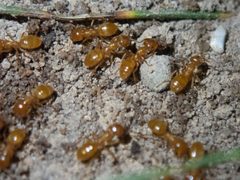
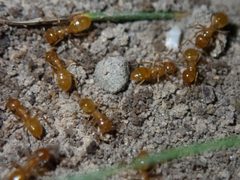
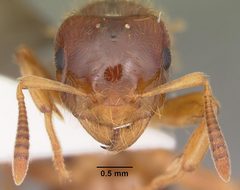
Small to medium-sized ants with yellow to yellowish-brown coloration. are wingless; reproductive forms (queens and males) possess wings. are distinctly elbowed. The petiole (narrow waist between and ) is pronounced, with a single node. Winged forms have forewings noticeably larger than hindwings, with few prominent —features that distinguish them from .
Habitat
Nests in soil, often in moist or shaded locations. Frequently found under stones, logs, or other ground cover. Associated with open woodlands, forest edges, meadows, and suburban lawns. Colonies typically located near roots of plants where tending occurs.
Distribution
Native to the United States. Distributed across eastern and central North America, with records from the Mid-Atlantic region, Midwest, and extending into the South. The has been documented swarming in Maryland in December and January.
Seasonality
Winged reproductive forms emerge and swarm in late autumn through early winter (October–January in temperate regions), with peak activity often occurring around December. This unusual winter swarming distinguishes the from most temperate ants that swarm in spring or summer.
Diet
Feeds primarily on honeydew excreted by root-feeding aphids that the ants tend and protect. Also consumes soft-bodied prey and other small arthropods. (food exchange between colony members) is an important mechanism for nutrient distribution within the colony.
Host Associations
- Lasius flavus - eatsLasius claviger is not associated with Lasius flavus; this appears to be a name confusion in some sources. Lasius flavus is a European .
Life Cycle
Behavior
Exhibits herding with root-feeding aphids, moving them between plants to optimize honeydew production. When threatened, release citronellal from mandibular glands as an , recruiting nestmates to defend the colony. Glands near the tip produce formic acid as a defensive chemical. Workers engage in (regurgitation of liquid food) to feed nestmates, larvae, and queens. Winged reproductives swarm in large numbers for mating.
Ecological Role
Functions as an engineer through soil excavation and nest construction. Acts as a of soft-bodied and as a mutualist with aphids, protecting them from predators and in exchange for honeydew. The -tending influences plant root health and nutrient cycling. Serves as prey for various - predators and .
Human Relevance
Often mistaken for when winged forms swarm near homes in winter, causing unnecessary concern. Does not damage wood or structures. The citronellal odor may provide minor natural insect repellency. Not considered a significant pest, though large swarms can be a nuisance. E. O. Wilson studied Lasius ants including this in Rock Creek Park, Maryland, during his youth—research that contributed to his lifelong passion for myrmecology.
Similar Taxa
- Lasius interjectusLarger yellow ant with similar and citronellal odor; distinguished by larger size and subtle morphological differences in petiole structure
- Reticulitermes flavipesEastern subterranean termite; winged forms superficially similar but have bead-like , broad waist, and equal-sized wings—easily distinguished with close examination
- Lasius neonigerSimilar-sized Lasius but darker in color, lacks citronellal odor, and swarms in late summer rather than winter
Misconceptions
Winged swarms are frequently mistaken for , leading to unnecessary alarm and pest control treatments. Unlike termites, L. claviger does not consume wood or damage structures. Some sources conflate this with European Lasius species (e.g., Lasius flavus) due to outdated or translation errors, but L. claviger is strictly North American.
More Details
Chemical defenses
Produces citronellal (lemon-scented compound also found in lemongrass and eucalyptus) from mandibular glands as , and formic acid from abdominal glands for defense against .
Aphid mutualism
actively transport root-feeding aphids between plants to maximize honeydew production, a described as 'herding' that represents one of the classic examples of .
Taxonomic history
Originally described in Acanthomyops, which is now treated as a subgenus of Lasius. The epithet 'claviger' refers to the clubbed characteristic of the group.
Sources and further reading
- BugGuide
- Wikipedia
- GBIF taxonomy match
- iNaturalist taxon
- NCBI Taxonomy
- Catalogue of Life
- The Ants and Butterflies of Gates Canyon: Quite the Ecosystem | Bug Squad
- Encyrtid Holdings | Entomology Research Museum
- From the Bug of the Week mailbag, termites or ants? Eastern subterranean termites, Reticulitermes flavipes, or Citronella ants, Lasius sp. — Bug of the Week
- 52-million-year-old Beetle Fossil is Oldest Known Practitioner of Myrmecophily
- Curious isolation: new butterfly species discovered | Blog
- Alternative host-searching strategy in Ghilaromma orientalis
- Regurgitation behaviour of the Lasius flavus worker (Formicidae) towards the myrmecophilous beetle Claviger testaceus (Pselaphidae) and other recipients
- Factors affecting the regurgitation behaviour of the ant Lasius flavus (Formicidae) to the guest beetle Claviger testaceus (Pselaphidae)