
Reticulitermes flavipes
(Kollar, 1837)
Eastern Subterranean Termite
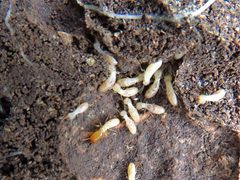
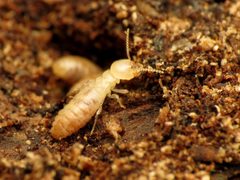
Reticulitermes flavipes, the eastern subterranean , is the most common and economically significant termite in North America. Colonies are large, ranging from 20,000 to 5 million , with a primary producing 5,000–10,000 annually. The species exhibits complex differentiation including workers, soldiers, and multiple reproductive forms. Native to the southeastern United States, it has become in Europe, South America, and other regions through human transport.
Pronunciation
How to pronounce Reticulitermes flavipes: /rɛˌtɪkjʊlaɪˈtɜːrmiːz ˈflævɪˌpiːz/
These audio files are automatically generated. While they are not always 100% accurate, they are a good starting point.
Identification
Distinguish from similar Reticulitermes by ocellus position: lateral view shows distance from ocellus to nearest at least equal to ocellus diameter. Soldiers of R. flavipes have rectangular with fontanelle; compare to R. virginicus and R. hageni which require microscopic examination for definitive separation. distinguished by yellowish . Subterranean habit and mud tubes help distinguish from drywood termites (Kalotermitidae).
Images
Habitat
Strictly subterranean; colonies occupy soil and maintain contact with ground moisture. Construct galleries in soil and mud tubes to access above-ground food sources. Found in forests, urban landscapes, and within wooden structures. Require moist environments; activity governed by temperature, moisture, and food availability.
Distribution
Native to eastern United States from southern Ontario to Texas and Florida; southeastern United States considered area of origin. established in Europe (France, Germany, Italy, Netherlands), South America (Uruguay, Chile), the Bahamas, and southern Canada. Recorded in Oregon (2006) on West Coast. Reticulitermes santonensis in France is a synonym of R. flavipes.
Seasonality
swarming occurs February to April in daytime. Year-round subterranean activity in suitable climates; foraging and colony expansion continuous when soil temperatures permit.
Diet
Cellulose from wood, structural timber, paper, books, cotton, and other plant materials. Unable to digest cellulose independently; relies on flagellate (at least 9 , 11 including Trichonympha agilis, Pyrsonympha vertens, Dinenympha species) and bacterial microbiome (dominated by Treponema spirochetes, Endomicrobia) for lignocellulose breakdown.
Life Cycle
Developmentally flexible system: newly hatched typically become , which may into pre-soldiers then terminal soldiers, or into nymphs. Nymphs are non-terminal and can revert to pseudergate workers or develop into (winged sexuals) or brachypterous neotenics. Alates disperse, shed wings, pair, and found new colonies as dealates (kings and queens). Ergatoid neotenics rarely develop from worker line. Secondary reproductives enable colony .
Behavior
Colonies are mobile and decentralized with no permanent central nest; all distributed across multiple occupied sites. forage through underground tunnel systems, construct and repair shelter tubes, groom and feed other castes, and care for . Soldiers defend colonies, crushing invading ants with and secreting terpenoid defensive compounds from fontanelle. Workers and soldiers exhibit shaking upon contact with royal reproductives, mediated by cuticular recognition . Undertaker workers bury or consume dead nestmates; fresh corpses cannibalized for nitrogen, decomposing corpses buried. Proctodeal used to transmit gut between individuals.
Ecological Role
Primary decomposer of dead wood and cellulose debris in forest ; critical for nutrient cycling and carbon mineralization. Gut research subject; serves as model organism for studying insect–microbe , including flagellate, bacterial, and archaeal associations.
Human Relevance
Most economically important wood-destroying insect in the United States, responsible for substantial structural damage to buildings. Along with R. virginicus, accounts for 80% of $2.2 billion U.S. control costs. often undetected until significant damage occurs; timber appears sound externally while internally honeycombed. Control methods include physical barriers, chemical treatments, soil treatments, and physical treatments (heat, freezing, electrocution, microwave). Research model for social insect , regulation, and gut microbiome studies.
Similar Taxa
- Reticulitermes virginicusOverlaps in distribution and ; requires microscopic examination of soldier capsule or for definitive identification
- Reticulitermes hageniNative subterranean with similar ; morphological separation of requires detailed examination
- Coptotermes formosanusFormosan subterranean termite is larger, more aggressive, with different soldier shape; in southern U.S. but less cold-tolerant than R. flavipes
Sources and further reading
- BugGuide
- Wikipedia
- GBIF taxonomy match
- iNaturalist taxon
- NCBI Taxonomy
- Catalogue of Life
- Funeral or Feast: How Termites Manage Their Dead
- A visit to Ohio State University's Department of Entomology
- Bug Eric: May 2023
- How to Become a Vulture: Tropical Bees and Their Gut Microbes
- Bug Eric: City Nature Challenge 2023 Recap
- What lies beneath the mulch? Formosan termite, Coptotermes formosanus, and Eastern subterranean termite, Reticulitermes flavipes — Bug of the Week
- Reticulitermes flavipes . [Distribution map].
- Native Subterranean Termites: Reticulitermes flavipes (Kollar), Reticulitermes virginicus (Banks), Reticulitermes hageni Banks (Insecta: Blattodea: Rhinotermitidae)
- Fungi Associated with the Subterranean Termite Reticulitermes flavipes in Ontario
- SOIL MOISTURE MEDIATED BEHAVIORAL AND PHYSIOLOGICAL ALTERATIONS OF COPTOTERMES FORMOSANUS AND RETICULITERMES FLAVIPES (BLATTODEA: RHINOTERMITIDAE)
- Policing behavior resolves reproductive conflict in the Eastern subterranean termite,Reticulitermes flavipes
- Queen and king recognition in the subterranean termite, Reticulitermes flavipes: Evidence for royal recognition pheromones
- Fungi Associated with the Subterranean Termite Reticulitermes Flavipes in Ontario