
Reticulitermes
Holmgren, 1913
subterranean termites
Species Guides
4- Reticulitermes flavipes(Eastern Subterranean Termite)
- Reticulitermes hageni(light southeastern subterranean termite)
- Reticulitermes hesperus(western subterranean termite)
- Reticulitermes tibialis(Arid-land Subterranean Termite)
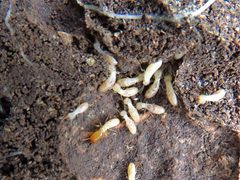
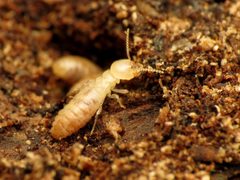
Reticulitermes is a of subterranean termites in the , found across temperate regions of Asia, Europe, and North America. These are economically significant structural pests that live in soil and construct mud tubes to access above-ground wood. Colonies exhibit a three- system of , soldiers, and reproductives, with workers retaining developmental plasticity to become ergatoid reproductives. identification within the genus often requires molecular techniques due to overlapping morphological characteristics.
Pronunciation
How to pronounce Reticulitermes: //rɛˌtɪkjʊlɪˈtɜːrmiːz//
These audio files are automatically generated. While they are not always 100% accurate, they are a good starting point.
Identification
Accurate identification within Reticulitermes requires combined molecular and morphological analysis. Cuticular hydrocarbon profiling, mitochondrial sequencing (16S rRNA, COI, COII), and microsatellite analysis are necessary to distinguish cryptic species. Morphological examination alone is unreliable due to overlapping characteristics and wide size variation within colonies. Soldiers of some species show sex biases (more females), which can aid identification. In California, spring-swarming colonies represent R. hesperus sensu stricto, while fall- and winter-swarming colonies represent distinct, undescribed species.
Images
Habitat
Strictly subterranean; colonies require contact with soil moisture. Found in fallen trees, stumps, dead wood in contact with soil, and structural lumber. Construct mud tubes of soil, wood, saliva, and excrement to access above-ground food sources. Some introduced show aggregated distribution in human-modified environments.
Distribution
Temperate regions across Asia (China, Japan, Korea, Middle East, India), Western Europe (France, Spain, Portugal, Corsica, Sardinia), and North America (eastern United States, southern Ontario, California, Arizona, Mexico). Multiple occur sympatrically in several regions, particularly California where at least five species may be present.
Seasonality
Swarming varies by and region. In California, R. hesperus swarms in spring; undescribed sympatric species swarm in fall and winter. Eastern North American species typically swarm in spring and early summer following warm, sunny periods after rain. In the San Francisco Bay Area, mass synchronous swarming occurs during calm sunny periods immediately after first autumn rains.
Diet
Cellulose-based materials including wood, fallen leaves, and other plant debris. Rely on symbiotic gut bacteria to digest cellulose; some related groups use protozoan .
Life Cycle
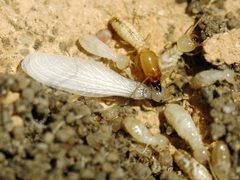
Hemimetabolous development with bifurcated . can develop into soldiers, remain workers, or become ergatoid (secondary) reproductives. Primary reproductives (kings and queens) develop from nymphs with wing buds, then tan to dark pigmentation before . After mating, shed wings and establish new colonies. Some exhibit where neotenic queens are produced parthenogenetically. Queens of some species may live more than 40 years and produce over 20,000 daily.
Behavior
Construct extensive foraging territories with mud tubes for above-ground access. Engage in proctodeal —transferring symbiotic microbes and through anal fluid exchange. Soldiers defend colonies via mandibular attack or -plugging of nest entrances; in some , soldiers accompany and stimulate supplementary reproductive production. aggregate around queens in response to n-pentacosane cuticular hydrocarbon signals. Colonies exhibit kin-biased investment patterns in some species.
Ecological Role
Decomposers of cellulose material; contribute to nutrient cycling, soil structure formation, and water infiltration. Serve as food sources for birds, lizards, other insects, and spiders during swarming events.
Human Relevance
Major economic pests of wooden structures in temperate regions. Responsible for significant damage to buildings, crops, and infrastructure. Management relies on baiting systems, soil treatments, and regular inspection protocols. Accurate identification is essential for effective pest management due to behavioral differences between species. Some introduced species (e.g., R. flavipes in Europe, R. urbis in urban France) represent threats.
Similar Taxa
- CoptotermesAlso subterranean termites with economic importance, but distinguished by fontanelle (defensive pore) on soldier and different cuticular hydrocarbon profiles. Coptotermes formosanus is the most damaging globally.
- HeterotermesFormerly included Reticulitermes; now recognized as distinct . Morphological and molecular differences separate these groups, though they share subterranean habits.
More Details
Species Complex Taxonomy
R. hesperus in California represents a of at least two distinct, reproductively isolated . Genetic studies using mitochondrial loci and microsatellites, combined with cuticular hydrocarbon analysis, revealed cryptic diversity. The 2023 description of R. rusti from southern California exemplifies ongoing taxonomic revision in the .
Queen Recognition Chemistry
In R. speratus, identify neotenic queens through elevated n-pentacosane in cuticular hydrocarbon profiles. This -specific signal triggers and represents independent evolution of royal recognition from social hymenopterans.
Invasive Potential
Introduced of Reticulitermes show modified social structures enhancing invasiveness, including increased neotenic reproductive production and colony rather than swarming . R. santonensis in France and R. urbis in urban Mediterranean areas demonstrate these characteristics.
Sources and further reading
- BugGuide
- Wikipedia
- GBIF taxonomy match
- iNaturalist taxon
- NCBI Taxonomy
- Catalogue of Life
- How Termites 'Looking for Love' Landed in the News | Bug Squad
- Western U.S. Has More Subterranean Termite Species Than Previously Thought, Study Shows
- And Then There Were Three: New Termite Species Identified in California
- Ice dams, wet wood, and termites - Reticulitermes flavipes — Bug of the Week
- What lies beneath the mulch? Formosan termite, Coptotermes formosanus, and Eastern subterranean termite, Reticulitermes flavipes — Bug of the Week
- How to raise a crop of termites: Eastern subterranean termites, Reticulitermes flavipes — Bug of the Week
- Native Subterranean Termites: Reticulitermes flavipes (Kollar), Reticulitermes virginicus (Banks), Reticulitermes hageni Banks (Insecta: Blattodea: Rhinotermitidae)
- Comparison of the spatial distribution and reproductive cycle of Reticulitermes santonensis Feytaud and Reticulitermes lucifugus grassei Clément (Isoptera, Rhinotermitidae) suggests that they represent introduced and native species, respectively
- Cuticular hydrocarbon profile for queen recognition in the termite Reticulitermes speratus
- SOIL MOISTURE MEDIATED BEHAVIORAL AND PHYSIOLOGICAL ALTERATIONS OF COPTOTERMES FORMOSANUS AND RETICULITERMES FLAVIPES (BLATTODEA: RHINOTERMITIDAE)
- Potentialités ontogéniques, différenciation des castes et conséquences sur la structure génétique des termites du genre reticulitermes
- Policing behavior resolves reproductive conflict in the Eastern subterranean termite,Reticulitermes flavipes
- Distribution et habitat naturel du termite invasif Reticulitermes urbis dans les Balkans (Isoptera: Rhinotermitidae)
- Fertility and Viability of Hybrid Offspring Imply the Absence of Major Postzygotic Isolation Between Two Reticulitermes Termite Species.