
Reticulitermes hesperus
Banks, 1920
western subterranean termite
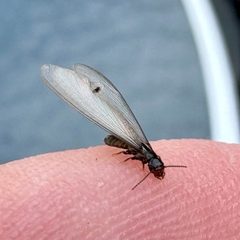
A subterranean native to the Pacific coast of North America, ranging from British Columbia to Southern California. Recent molecular studies indicate this name may represent a rather than a single biological species, with spring-swarming in California now recognized as distinct from fall-winter swarming populations (described as R. rusti). Colonies are eusocial with queens, , soldiers, and winged reproductives. This species is a significant structural pest in its native range.
Pronunciation
How to pronounce Reticulitermes hesperus: //rɛˌtɪkjʊˈlaɪtərmiːz ˈhɛspərəs//
These audio files are automatically generated. While they are not always 100% accurate, they are a good starting point.
Identification
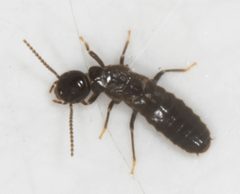
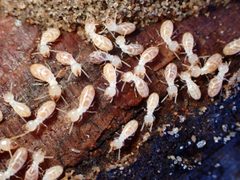
Reliable identification from other Reticulitermes requires molecular analysis (mitochondrial COI/COII genes, 16S rRNA) or cuticular hydrocarbon profiling; morphological characters overlap substantially between species. Spring swarms distinguish R. hesperus sensu stricto from the sympatric R. rusti, which swarms in fall and winter. Soldiers have rectangular with fontanelles; are small, pale, and soft-bodied.
Images
Habitat
Subterranean; colonies nest in soil and maintain contact with ground through mud tubes. Prefers moist environments. Utilizes wood partially decayed by saprotrophic fungi. Found in fallen trees, stumps, structural lumber, and other cellulose materials in contact with soil.
Distribution
Native to the Pacific coast of North America from British Columbia through California; historical records from Central America require verification given taxonomic uncertainty. Not found in interior arid regions where R. tibialis occurs.
Seasonality
Reproductive swarm during warm periods in spring; in southern California and the northern Sacramento Valley, may also swarm in fall. Swarming peaks following rain events.
Diet
Cellulose from wood, preferring material partially decayed by fungi. Does not consume sound, dry wood directly.
Life Cycle
Colonies contain a primary and king, , soldiers, and nymphs. Winged disperse to form new colonies after mating . Secondary reproductives may develop in established colonies.
Behavior
Forages via trails; trail establishment requires ≥28 individual passages and trails persist <48 hours without reinforcement. follow trails of (3Z,6Z,8E)-dodecatrien-1-ol at optimal concentrations of 10 fg/cm; higher concentrations are repellent. Cannot detect pheromone gradients or differentiate concentrations. Exhibits arrestant at food sources.
Ecological Role
Decomposes cellulose material, contributing to nutrient cycling and soil formation. Enhances water infiltration and soil structure. Serves as prey for including larvae (Lomamyia latipennis).
Human Relevance
Major structural pest in western North America; responsible for significant economic damage to wooden buildings. Management requires -specific strategies due to behavioral differences among cryptic species in the complex.
Similar Taxa
- Reticulitermes rustiPreviously confused with R. hesperus; distinguished by fall-winter swarming vs. spring swarming, and genetic differences in mitochondrial genes
- Reticulitermes tibialisOccupies more arid inland regions of western North America; does not overlap in distribution with coastal R. hesperus
- Reticulitermes flavipesEastern North American ; distinguished by geography and genetic differentiation
Sources and further reading
- BugGuide
- Wikipedia
- GBIF taxonomy match
- iNaturalist taxon
- NCBI Taxonomy
- Catalogue of Life
- How Termites 'Looking for Love' Landed in the News | Bug Squad
- Western U.S. Has More Subterranean Termite Species Than Previously Thought, Study Shows
- And Then There Were Three: New Termite Species Identified in California
- New Method Makes for Faster Genetic ID of Eastern U.S. Termites
- Ice dams, wet wood, and termites - Reticulitermes flavipes — Bug of the Week
- What lies beneath the mulch? Formosan termite, Coptotermes formosanus, and Eastern subterranean termite, Reticulitermes flavipes — Bug of the Week
- The morphology of Spironympha, with a description of a new species from reticulitermes hesperus Banks
- Behavioural and chemical investigation of trail pheromone from the termite Reticulitermes hesperus Banks (Isopt., Rhinotermitidae)
- Role of (3Z,6Z,8E)-Dodecatrien-1-ol in Trail Following, Feeding, and Mating Behavior of Reticulitermes hesperus