
Coptotermes
Wasmann, 1896
Species Guides
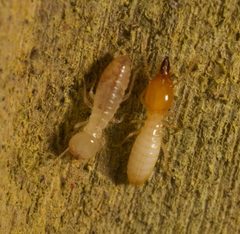
1- Coptotermes formosanus(Formosan subterranean termite)
Coptotermes is a of subterranean termites in the , containing approximately 71 described . The genus is thought to have originated in Southeast Asia and includes some of the world's most economically destructive pests, notably () and C. gestroi (Asian subterranean termite). A 2013 consensus among 31 termite experts reduced the number of validated species from 69 to 21 based on morphological and molecular evidence, with many historical names suspected to be synonyms. Species in this genus exhibit complex social including age-based task division and unique nitrogen recycling strategies.
Pronunciation
How to pronounce Coptotermes: //ˌkɒptoʊˈtɜːrmiːz//
These audio files are automatically generated. While they are not always 100% accurate, they are a good starting point.
Identification
Identification of Coptotermes is complicated by high morphological plasticity—individuals of the same species can show more variability than some different species. Soldier caste capsule shape varies among species; C. gestroi shows extreme head-capsule shapes with lateral expansion of the part. Molecular methods (mitochondrial COII, 12S rRNA, and 16S rRNA sequences) are increasingly used to distinguish species where is ambiguous. C. formosanus and C. gestroi can be differentiated by their tunneling patterns: C. gestroi constructs thin, highly branched tunnels while C. formosanus builds wider, less branched tunnels.
Images
Habitat
Subterranean environments; forage underground and construct roofed tunnels along surfaces. Colonies occupy wooden structures, soil, and carton nests. In Australia, some colonies build mound nests. suitability is limited by temperature and humidity—C. formosanus is restricted to subtropical and warm temperate regions, while C. gestroi occurs in tropical areas.
Distribution
Thought to have originated in Southeast Asia. C. formosanus is native to East Asia (Taiwan possibly a center of origin) and has been introduced to Japan, China, the United States (Gulf Coast and Hawaii), and other regions. C. gestroi is native to Southeast Asia and has been introduced to Hawaii, Florida, and other tropical areas. Both are established pests in multiple countries.
Seasonality
Foraging activity varies by and climate. In Hawaii, C. formosanus shows higher activity during cooler months (winter), while C. gestroi is more active in late spring and summer. Activity patterns are irregular year-round in tropical regions.
Diet
Cellulose from wood and wood products. possess gut protozoa for wood digestion.
Life Cycle
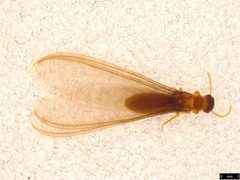
Colonies contain reproductives (, king), , and soldiers. Workers return to the central nest to near the queen and . (winged reproductives) emerge for swarming and colony founding. Colony size can reach several million individuals in mature colonies of some .
Behavior
forage in underground tunnels and construct roofed surface runways. Workers exhibit molting site fidelity, returning to the central nest to shed . Colonies practice consumption: workers eat shed exoskeletons to recycle nitrogen, which is transferred through to the and larvae. Age occurs in mature colonies—young workers groom larvae while older workers forage, maintain the royal , and process fecal material into nest carton. Older workers are the primary recipients of proctodeal trophallaxis (feeding on others' ) and deposit processed feces as building material. In Australia, Coptotermes colonies may the parasitic Ahamitermes, which lives in separate nest sections and feeds on carton material.
Ecological Role
Decomposers of wood and cellulose material. As , they outcompete native such as Reticulitermes . Nitrogen recycling through consumption represents a novel nutrient conservation mechanism that supports colony growth and .
Human Relevance
Major economic pests causing structural damage to buildings, wooden infrastructure, and trees. C. formosanus causes over one billion dollars in damage annually in the southern United States. Spread occurs via boats, shipping containers, railroad ties, and landscape materials. measures have been implemented in some regions to limit movement of infested wood. Management relies on soil termiticide barriers, systems using (which exploit molting site fidelity), and physical barriers. The has never been completely eradicated from any area once established.
Similar Taxa
- ReticulitermesAlso subterranean termites in , but Coptotermes are generally more aggressive, form larger colonies, and exhibit more complex age ; Coptotermes soldiers have different capsule .
More Details
Taxonomic Uncertainty
Over 140 have been described in Coptotermes since the was established, but a 2013 expert consensus recognized only 21 as valid based on available evidence. Many names remain as 'taxonomic cold cases'—suspected synonyms that cannot be formally synonymized due to inaccessible or missing .
Family Placement
Coptotermes has been placed in both and Heterotermitidae in different classification systems; current sources show both usages.
Evolutionary Significance
Coptotermes represents an evolutionary transition between lower (with gut protozoa) and higher termites (with more complex ). Behavioral complexity increases with colony maturity, making it a model for studying evolutionary transitions in eusocial insects.
Sources and further reading
- BugGuide
- Wikipedia
- GBIF taxonomy match
- iNaturalist taxon
- NCBI Taxonomy
- Catalogue of Life
- What lies beneath the mulch? Formosan termite, Coptotermes formosanus, and Eastern subterranean termite, Reticulitermes flavipes — Bug of the Week
- Nitro-Nosh: Why Termites' Molted Exoskeletons Never Go to Waste
- Termite Experts Attempt to Solve Taxonomic Cold Cases
- More Than a Pest: Termites as Models for Evolutionary Transitions
- For Termites, Home is Where the Molt Is
- In Subterranean Termite Colonies, Older Workers Change the Diapers
- Vertical transfer of nematodes associated with alates of Coptotermes formosanus and Coptotermes gestroi (Isoptera: Rhinotermitidae)
- Do Tunnel Patterns of Coptotermes formosanus and Coptotermes gestroi (Blattodea: Rhinotermitidae) Reflect Different Foraging Strategies?
- Comparison of Coptotermes formosanus and Coptotermes gestroi (Blattodea: Rhinotermitidae) Field Sites and Seasonal Foraging Activity in Hawaii
- Morphometric Analysis of Coptotermes spp. Soldier Caste (Blattodea: Rhinotermitidae) in Indonesia and Evidence of Coptotermes gestroi Extreme Head-Capsule Shapes
- Coptotermes formosanus (Formosan subterranean termite).
- Coptotermes formosanusandCoptotermes gestroi(Blattodea: Rhinotermitidae) Exhibit Quantitatively Different Tunneling Patterns
- Behavioral and Chemical Ecology of Formosan Subterranean Termites, Coptotermes Formosanus Shiraki.
- Phylogeography of Coptotermes gestroi and Coptotermes formosanus (Isoptera: Rhinotermitidae) in Taiwan
- SOIL MOISTURE MEDIATED BEHAVIORAL AND PHYSIOLOGICAL ALTERATIONS OF COPTOTERMES FORMOSANUS AND RETICULITERMES FLAVIPES (BLATTODEA: RHINOTERMITIDAE)