
Heterotermes
Froggatt, 1897
subterranean termites
Species Guides
1- Heterotermes aureus(Desert Subterranean Termite)
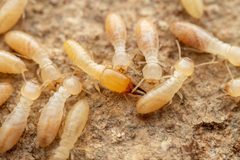
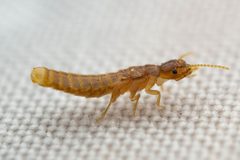
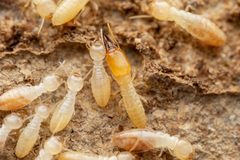
Heterotermes is a of subterranean termites with near- distribution. Members are eusocial insects forming large colonies with distinct : primary reproductives (), nymphoid neotenic secondary reproductives, , and soldiers. The genus is closely related to Reticulitermes. Several are significant pests of timber, crops, and structures.
Pronunciation
How to pronounce Heterotermes: /ˌhɛt.ə.roʊˈtɜr.miːz/
These audio files are automatically generated. While they are not always 100% accurate, they are a good starting point.
Identification
Soldiers are distinguished from Reticulitermes by their smaller size and : curved tip with straighter base area. Cuticular hydrocarbon profiles are -specific and can identify without diagnostic . In Heterotermes tenuis, linear alkanes C24–C27 dominate cuticular extracts (ca. 65%), with no olefins detected. resemble Reticulitermes alates but are more lightly pigmented. Nymphoid neotenic reproductives are the only secondary reproductive caste present.
Images
Habitat
Subterranean nesting in wooded areas, ranging from dry to humid conditions. Found in natural forests, gallery forests, and plantations. In Colombia, occurs in gallery forests of the Orinoquía and Pinus caribaea plantations. Heterotermes aureus occupies arid regions of northwestern Mexico and the southwestern United States.
Distribution
Near- distribution. Documented from South America (Brazil, Colombia), Central America, the West Indies, the Bahamas, Africa, Asia (India, Sri Lanka, Philippines), and Australia. Heterotermes aureus is restricted to northwestern Mexico and the southwestern United States. Heterotermes tenuis spans South and Central America.
Seasonality
disperse following rainfall events; in Arizona, September monsoon rains trigger .
Diet
Cellulose from dead wood, including tree logs, stumps, and branches. Several are pests of living trees and crops, including Eucalyptus, Pinus, and sugarcane. Lower protozoan gut (Parabasalia: Cononympha, Pseudotrichonympha, Holomastigotoides, Cthulhu) that facilitate cellulose digestion via cellulase .
Life Cycle
Colonies are founded by primary reproductives ( pairs) following . Colonies typically contain one pair of primary reproductives, though multiple pairs occasionally occur. Secondary reproductives arise only as nymphoid neotenic individuals, developing from nymphs around the third instar; older nymphs can back into this when needed. Nymphoid neotenic pairs become physogastric within weeks and produce . Protist are inherited vertically via proctodeal , though transmission is occasionally imperfect.
Behavior
exhibit individual transportation during tunnel excavation: grasp soil at tunnel terminus, carry it outside to discard, and return. Soldiers defend colonies by excreting a light grey-tinted sticky liquid when disturbed and by bumping against nest walls to alert nestmates. Tunneling behavior is -specific and inherited rather than size-dependent. Cuticular hydrocarbons function in chemical communication and nestmate recognition.
Ecological Role
Decomposers of dead wood in natural . In plantation and agricultural systems, several become pests. Functional morphological traits of show plasticity in response to food resource availability, with homogenization observed in softwood-dominated plantations.
Human Relevance
Significant economic pests. Heterotermes damage timber in service, buildings, books, and paper. Several species are pests of plantation forestry (Eucalyptus, Pinus) and agriculture (sugarcane). Heterotermes indicola and H. tenuis are targets of research using plant extracts. Subject of taxonomic and behavioral research due to structural damage potential.
Similar Taxa
- ReticulitermesClosest relative; distinguished by soldier shape (less curved tip, less straight base), larger soldier size, and darker pigmentation in . Reticulitermes possesses both nymphoid and ergatoid neotenic reproductives, while Heterotermes has only nymphoid neotenics.
More Details
Protist Symbiont Diversity
Heterotermes tenuis eight -level protist phylotypes across four (Cononympha, Pseudotrichonympha, Holomastigotoides, Cthulhu). diversification patterns show independent evolution from host in some lineages.
Functional Morphological Plasticity
in H. tenuis shows larger feeding-related morphological traits in gallery forests compared to pine plantations, suggesting resource-driven trait homogenization in environments.
Sources and further reading
- BugGuide
- Wikipedia
- GBIF taxonomy match
- iNaturalist taxon
- NCBI Taxonomy
- Catalogue of Life
- Let's All Appreciate Ants! Don't Miss These Biodiversity Museum Programs | Bug Squad
- Digging Deep: The Secrets Within Termite Nests
- termite size chart - Entomology Today
- Cuticular Hydrocarbons of Heterotermes tenuis (Isoptera: Rhinotermitidae): Analyses and Electrophysiological Studies
- Biogeography and Independent Diversification in the Protist Symbiont Community of Heterotermes tenuis
- Bioactivity of Medicinal Plants Piper nigurm and Tamarindus indica against Heterotermes indicola (Wasmann)
- Fumigant Toxicity of Mentha arviensis Leaves Extracts on Coptotermes heimi, Heterotermes indicola and Their Gut fFlagellates
- Effect of biotic and abiotic factors on the tunneling behavior of Coptotermes gestroi and Heterotermes tenuis (Isoptera: Rhinotermitidae)
- Ecology, behavior and bionomics: functional response of Heterotermes tenuis Hagen (Insecta: Blattaria: Isoptera: Rhinotermitidae) in forests of the Colombian Orinoquía
- Key to the soldiers of South American Heterotermes with a new species from Brazil (Isoptera: Rhinotermitidae)
- Ecology, Behavior and Bionomics: Functional response of Heterotermes tenuis Hagen (Insecta: Blattaria: Isoptera) in forests of the Colombian Orinoquía
- Updating the Systematic Status of Genus Heterotermes (Rhinotermitidae: Isoptera: Blattodea) by Combining Morphometric Analysis, Distribution Mapping, and DNA Barcoding Approaches.