
Heterotermes aureus
(Snyder, 1920)
Desert Subterranean Termite
Heterotermes aureus is a subterranean native to the deserts of North America. Colonies are large, with estimates ranging from 45,000 to over 2 million individuals. The is notable for its ability to forage in drier conditions than other desert subterranean termites and for its distinctive soldier .

Pronunciation
How to pronounce Heterotermes aureus: //ˌhɛtəroʊˈtɜrmiz ˈɔːriəs//
These audio files are automatically generated. While they are not always 100% accurate, they are a good starting point.
Identification
Soldiers distinguished from Reticulitermes hesperus (western subterranean termite) by shape: H. aureus has long, slender, nearly straight mandibles with slight inward curve at tip, versus thick, curved mandibles in R. hesperus. Winged reproductives lack distinct fontanelle, unlike some . Creates yellowish-brown mud shelter tubes with circular cross-section.
Images
Appearance
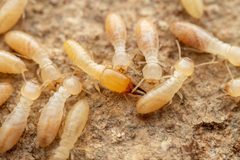
Small . Winged reproductives approximately 4 mm long including wings, with forewings larger than hind wings and two distinctive hardened at the front. Body pale yellowish brown. Fontanelle on indistinct or absent in reproductives. Soldiers have rectangular heads with distinct fontanelle and long, slender that are fairly straight with slight inward curve near tip.
Habitat
Arid desert , particularly Colorado and Sonoran Deserts. Occupies underground nests in desert grassland and urban desert environments. Forages in shaded or damp microhabitats. Capable of colonizing drier locations than other subterranean desert . Enters buildings through cracks in concrete.
Distribution
to northern Mexico and southwestern United States. Common in Arizona. Present in Middle America and North America according to distribution records.
Seasonality
Winged reproductives emerge for on warm humid nights in summer. have been observed leaving colonies following September monsoon rains in Arizona.
Diet
Dead wood, including standing timber, dead cacti, and ground-dwelling wood debris. In the Sonoran Desert, observed to consume blue palo verde (Parkinsonia florida) most frequently in greatest quantities; prefers cholla (Cylindropuntia), mesquite (Prosopis), and catclaw (Senegalia greggii) when available. When infesting structures, prefers wood with spring growth over summer growth due to lower lignin content.
Host Associations
- Parkinsonia florida - food sourceMost common dead wood consumed in Sonoran Desert study
- Cylindropuntia - preferred foodPreferred when available
- Prosopis - preferred foodPreferred when available
- Senegalia greggii - preferred foodPreferred when available
Life Cycle
Colony contains four : , winged , , and soldiers. Queen resides deep underground. Colony founding occurs when mated pairs excavate soil to establish new nests. Colony size ranges from 45,000 to 300,000 workers in typical colonies, with foraging associated with structures ranging from 23,596 to over 2 million individuals.
Behavior
exhibit individual transportation during tunnel excavation: grabbing sand with from tunnel end, carrying it outside to discard, and returning for next load. Creates free-standing tubes descending from ceilings in structures. Builds yellowish-brown mud shelter tubes with circular cross-section to traverse objects. Foraging territories show extensive overlap between colonies; colonies randomly distributed in space. Mean maximum linear foraging distance from structures 27.6 m; foraging distances significantly greater at older (>10 year) urban sites than newer sites or undisturbed desert.
Ecological Role
processing dead wood in desert . Gut harbors symbiotic protists that assist with cellulose digestion. Contributes to nutrient cycling in arid environments.
Human Relevance
Significant structural pest in southwestern United States. Infests buildings, fences, and utility poles. Attacked timber exhibits honeycomb-like galleries containing soil. Can enter through minute cracks in concrete. Creates distinctive free-standing tubes from ceilings. One of the most common underground in Arizona.
Similar Taxa
- Reticulitermes hesperusWestern subterranean termite; distinguished by soldier (thick, curved vs. long, slender, nearly straight in H. aureus)
- Gnathamitermes perplexusLong-jawed desert termite; shares individual transportation tunneling but differs in and
More Details
Family placement note
Sources show conflicting placement: Heterotermitidae (Wikipedia, iNaturalist, Catalogue of Life) versus (NCBI, GBIF, older literature). This reflects ongoing taxonomic revision of higher classification.
Tunneling behavior inheritance
Research by Mizumoto et al. (2020) indicates tunneling is -specific and inherited, with H. aureus showing individual transportation behavior rather than cooperative kicking behavior seen in some other desert .
Sources and further reading
- BugGuide
- Wikipedia
- GBIF taxonomy match
- iNaturalist taxon
- NCBI Taxonomy
- Catalogue of Life
- Let's All Appreciate Ants! Don't Miss These Biodiversity Museum Programs | Bug Squad
- Digging Deep: The Secrets Within Termite Nests
- Golden jackals might be settling near Prague | Blog
- Density of Colonies and Spatial Distribution of Foraging Territories of the Desert Subterranean Termite, Heterotermes aureus (Snyder) 123
- Foraging Populations and Distances of the Desert Subterranean Termite, Heterotermes aureus (Isoptera: Rhinotermitidae), Associated with Structures in Southern Arizona
- Foraging Populations and Distances of the Desert Subterranean Termite, <I>Heterotermes aureus</I> (Isoptera: Rhinotermitidae), Associated with Structures in Southern Arizona