
Gnathamitermes perplexus
(Banks, 1920)
tube-building termite, long-jawed desert termite
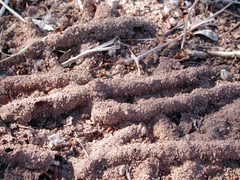
Gnathamitermes perplexus is a desert-dwelling known for constructing distinctive sand tubes and for its elongated . and colony founders transport sand individually using their mandibles to excavate tunnels, a that differs from the cooperative "bucket-brigade" kicking seen in some related termites. The species occurs in arid regions of the southwestern United States and Mexico, where it contributes to soil enrichment and decomposition of dead wood. have been observed to decline following application of certain termiticides, particularly fipronil.
Pronunciation
How to pronounce Gnathamitermes perplexus: //ˌnæθəməˈtɜrmiz pərˈplɛksəs//
These audio files are automatically generated. While they are not always 100% accurate, they are a good starting point.
Identification
Distinguished from other desert by its long relative to body size, earning it the "long-jawed desert termite." The builds conspicuous sand tubes on vegetation and soil surfaces. are smaller than colony founders but share the same tunneling . Molecular or detailed morphological examination may be required to distinguish it from related Gnathamitermes species.
Images
Habitat
Arid and semi-arid desert environments, particularly in southern Arizona and the southwestern United States. Constructs tunnels and tubes in sandy soils. Associated with dead wood in desert environments.
Distribution
North America: southwestern United States (Arizona, and potentially adjacent states); Mexico. The iNaturalist record suggests broader Central American distribution though specific countries are not documented in available sources.
Diet
Feeds on dead wood and cellulose material in desert environments. Specific dietary preferences beyond general wood-feeding habits are not documented.
Life Cycle
Colony founders (primary reproductives) establish new nests following rainfall events, excavating soil to initiate colonies. and colony founders exhibit identical tunneling , suggesting this trait is inherited rather than size-dependent. Detailed developmental stages and colony founding dynamics are not well documented.
Behavior
Exhibits "individual transportation" tunneling : and colony founders use to grab sand from tunnel ends, carry it outside to discard, and return for subsequent loads. This contrasts with the "bucket-brigade" kicking behavior observed in Paraneotermes simplicicornis. Both workers and colony founders transport sand to excavate tunnels. The builds characteristic tubes using sand and soil particles.
Ecological Role
Decomposes dead wood in desert environments, contributing to nutrient cycling. Enriches and aerates large quantities of soil through tunneling activities. Serves as a non-target potentially affected by termiticides applied for structural pest control.
Human Relevance
No direct economic importance as a structural pest; considered non-structure invading. However, are negatively impacted by fipronil-based termiticides used to control economically damaging with which it co-occurs. Subject of research on termite tunneling and collective nest construction.
Similar Taxa
- Paraneotermes simplicicornisBoth are desert-dwelling , but P. simplicicornis exhibits cooperative "bucket-brigade" sand-kicking rather than individual mandibular transport
- Heterotermes aureusShares individual transportation tunneling and co-occurs in southern Arizona, but belongs to different ()
Sources and further reading
- BugGuide
- Wikipedia
- GBIF taxonomy match
- iNaturalist taxon
- Catalogue of Life
- Aphytis Project Final Report | Entomology Research Museum
- Digging Deep: The Secrets Within Termite Nests
- Bug Eric: Wasp Wednesday: A Real Surprise
- Putting Bumble Bees in a Box Might Help Scientists Study Their Nesting Ecology
- Predator Satiation | Beetles In The Bush
- Bug Eric: August 2012
- Foraging Populations of Tube Building Termites, Gnathamitermes perplexus (Banks), Associated With Termiticide Experiments in Southern Arizona (Isoptera: Termitidae)