
Gnathamitermes
Light, 1932
Long-jawed Desert Termites
Species Guides
1- Gnathamitermes perplexus(tube-building termite)
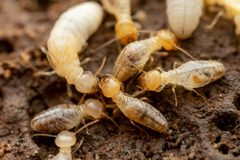
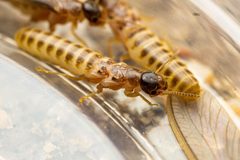
Gnathamitermes is a of subterranean termites in the Termitidae, comprising approximately six described distributed in arid and semi-arid regions of North America. The genus is commonly known as the long-jawed desert , reflecting the elongated characteristic of at least some species. Research has focused particularly on G. perplexus and G. tubiformans, which exhibit distinct foraging and nest-building . These termites play significant ecological roles in desert through soil modification and decomposition processes.
Pronunciation
How to pronounce Gnathamitermes: /ˌnæθəmaɪˈtɜrmiz/
These audio files are automatically generated. While they are not always 100% accurate, they are a good starting point.
Identification
Members of this can be distinguished from other Amitermitinae by their association with desert and, in at least G. perplexus, notably elongated relative to body size. The "long-jawed desert " specifically references this mandibular elongation. Accurate -level identification requires examination of morphological characters by .
Images
Habitat
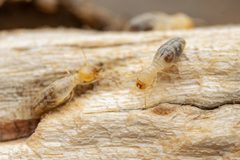
Arid and semi-arid desert environments. occupy different substrates: G. perplexus constructs foraging tubes and nests in soil in southern Arizona desert regions; G. tubiformans occurs in Oklahoma grasslands; and G. perplexus has been documented in association with (Pogonomyrmex rugosus) nests in Durango, Mexico.
Distribution
Southwestern United States (Arizona, Oklahoma) and northern Mexico (Durango). The appears restricted to North American arid zones, though precise range boundaries for most remain undocumented.
Diet
G. tubiformans feeds on grass. Diet of other is not documented in available sources.
Host Associations
- Pogonomyrmex rugosus - nest associationG. perplexus documented in or near nests of this in Durango, Mexico
Behavior
of G. perplexus exhibit individual transportation during tunnel excavation: using to grasp soil particles, carrying them outside to discard, and returning for subsequent loads. This behavior is consistent between workers and colony founders within the , suggesting inherited rather than size-dependent behavioral patterns. G. perplexus constructs visible foraging tubes on soil surfaces. G. tubiformans exhibits distinct foraging behaviors appropriate to its grassland .
Ecological Role
G. perplexus contributes to decomposition of dead wood in desert environments and enriches and aerates substantial quantities of soil through its tunneling activities. These processes are significant in nutrient cycling and soil structure maintenance in arid .
Human Relevance
G. perplexus is considered non-structural invading; it does not damage buildings and has no direct economic importance. are incidentally exposed to termiticides applied for control of more damaging co-occurring such as Heterotermes aureus. Research indicates differential responses to termiticides: chlorfenapyr application was associated with increased foraging populations, while fipronil reduced populations relative to controls.
Similar Taxa
- Heterotermes aureusCo-occurs in southern Arizona and exhibits similar individual transportation tunneling , but belongs to rather than Termitidae and differs in colony founder size relative to G. perplexus
- Paraneotermes simplicicornisDesert dampwood termite that co-occurs in Arizona but exhibits distinct kicking/bucket-brigade tunneling rather than individual transportation, and belongs to Kalotermitidae
More Details
Research significance
Gnathamitermes perplexus has served as a key study organism for understanding the evolution of collective nest-building in . Research by Mizumoto et al. (2020) used this to demonstrate that tunneling behavior is inherited at the species level rather than determined by body size, contributing to broader understanding of social insect behavioral evolution.
Sources and further reading
- BugGuide
- Wikipedia
- GBIF taxonomy match
- iNaturalist taxon
- NCBI Taxonomy
- Catalogue of Life
- Digging Deep: The Secrets Within Termite Nests
- termite size chart - Entomology Today
- Morphology and Foraging Behavior of Oklahoma's Grass-Feeding Termite:Gnathamitermes tubiformans(Isoptera: Termitidae)
- The Termite Gnathamitermes perplexus1 Associated with Nests of the Harvester Ant Pogonomyrmex rugosus2 in Durango, Mexico
- Foraging Populations of Tube Building Termites, Gnathamitermes perplexus (Banks), Associated With Termiticide Experiments in Southern Arizona (Isoptera: Termitidae)