
Erannis
Hübner, [1825]
Species Guides
2- Erannis tiliaria(Linden Looper)
- Erannis vancouverensis(Vancouver Looper)
Erannis is a of geometer moths (Geometridae: Ennominae) erected by Jacob Hübner in 1825. The genus comprises approximately twelve distributed primarily across the Holarctic region, with greatest diversity in northern temperate zones. Several species are significant forest pests, with larvae feeding on coniferous and deciduous trees. Taxonomic placement remains debated: some authorities recognize the tribe Erannini with Erannis as type genus, while others merge this group into Boarmiini or Bistonini.
Pronunciation
How to pronounce Erannis: /ɪˈrænɪs/
These audio files are automatically generated. While they are not always 100% accurate, they are a good starting point.
Identification
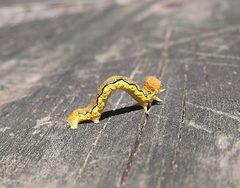
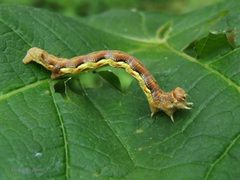
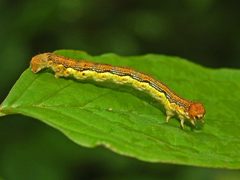
are smallish . Females of at least some (e.g., E. vancouverensis, E. tiliaria) are wingless, a trait useful for distinguishing these from many other geometrid moths. Larvae are loopers with typical geometrid locomotion. Species-level identification requires examination of genitalia and other morphological features; the is taxonomically challenging and has been subject to frequent misidentification in published records.
Images
Habitat
Forest environments, primarily in association with trees. Larvae occur in the crowns of host trees. Specific associations vary by : E. ankeraria and E. jacobsoni occur in larch forests; E. vancouverensis inhabits deciduous forest; E. defoliaria (mottled umber) and E. tiliaria (linden looper/winter moth) are associated with broadleaf trees.
Distribution
Holarctic distribution with primary diversity in northern temperate regions. Specific ranges include: E. ankeraria from southeastern Europe to East Asia; E. vancouverensis from northern British Columbia to central California; E. jacobsoni in Russia (Eastern Siberia, Far East, Western Siberia), China (Inner Mongolia), Japan, Kazakhstan, and Mongolia; E. defoliaria in Europe. GBIF records indicate presence in Denmark, Norway, Sweden, and the United States (Vermont).
Seasonality
timing varies by : E. vancouverensis adults emerge in late autumn, occasionally during winter or early spring; E. tiliaria is known as the "winter moth" due to late-season adult activity. E. ankeraria and E. jacobsoni periods have been documented through studies, though specific adult periods are not detailed in available sources.
Diet
Larval feeding habits vary by : E. ankeraria larvae feed on Larix (larch), Quercus (oak), and Picea (spruce); E. jacobsoni specializes on Larix spp., particularly L. gmelinii (Dahurian larch) and L. sibirica (Siberian larch); E. vancouverensis larvae feed on young leaves of several deciduous tree species; E. defoliaria larvae feed on various broadleaf trees. do not feed.
Host Associations
- Larix spp. - larval Primary for E. ankeraria and E. jacobsoni
- Larix gmelinii - larval Dahurian larch, for E. jacobsoni
- Larix sibirica - larval Siberian larch, for E. jacobsoni
- Quercus spp. - larval for E. ankeraria
- Picea spp. - larval for E. ankeraria
- Tilia spp. - larval for E. tiliaria (linden looper)
Life Cycle
Winter is passed in the stage, or sometimes in the pupal stage (documented for E. vancouverensis). Larval instars have been described in detail for E. vancouverensis. occurs in soil or leaf litter. Females of some are wingless and presumably lay eggs on or near trees.
Behavior
of some are known to live in the crowns of trees. Larvae exhibit typical geometrid looping locomotion. of several species (E. ankeraria, E. jacobsoni, E. vancouverensis) can reach levels causing significant defoliation. E. jacobsoni exhibits a pattern of outward diffusion from centers during outbreak periods.
Ecological Role
Larvae function as herbivores on forest trees, occasionally reaching pest densities that cause significant defoliation and tree damage. Natural enemies include (-specific such as EranNPV in E. ankeraria) and tachinid (documented for E. vancouverensis), which contribute to . These natural enemies have been evaluated for applications.
Human Relevance
Several are significant forest pests: E. ankeraria (larch looper) causes extensive damage to larch forests in northeastern China; E. jacobsoni (Jas's larch inchworm) causes significant defoliation in Mongolian larch forests; E. vancouverensis occasionally reaches levels in western North America; E. defoliaria (mottled umber) and E. tiliaria (winter moth) are European pests. have been identified for E. ankeraria and are used for monitoring. Species-specific (e.g., EranNPV) have been developed as biocontrol agents. The has been subject to notable taxonomic misidentification in scientific publications, with one study finding 15 of 19 records in a Russian regional book to be incorrect.
Similar Taxa
- Colotois pennariaSympatric geometrid ; E. ankeraria components decrease captures of this , suggesting potential for misidentification in pheromone trapping studies
- Operophtera brumata (winter moth) "winter moth" shared with E. tiliaria; both have late-autumn and wingless females, requiring careful morphological distinction
- Apocheima cinerariumRelated geometrid with similar (ApciNPV closely related to EranNPV), potentially indicating ecological or morphological similarity
Misconceptions
Published records of Erannis in the Murmansk oblast of Russia (including E. defoliaria, Archips crataegana, and A. podana) were found to be erroneous misidentifications; these species have not been documented from this region despite claims in a 2019 book on woody introducents. Such errors highlight the importance of professional identification for this taxonomically challenging .
More Details
Taxonomic Uncertainty
Tribal placement of Erannis remains unsettled. Some authorities recognize Erannini with Erannis as type ; others merge this group into Boarmiini or Bistonini. This taxonomic instability reflects broader challenges in Ennominae .
Pheromone Biology
E. ankeraria is a quaternary blend of (Z,Z,Z)-3,6,9-nonadecatriene and three epoxynonadecadienes. The 3,4- and 9,10-epoxides represent newly identified components for the and may mediate interspecific chemical communication with sympatric .
Remote Sensing Applications
of E. jacobsoni have been monitored using Sentinel-2 satellite imagery and UAV-based red edge spectral features, with machine learning models achieving >82% in severity classification. Optimal outbreak conditions occur at elevations of 1171–1234 m on gentle slopes in semi-shaded or semi-sunny areas.
Sources and further reading
- BugGuide
- Wikipedia
- GBIF taxonomy match
- iNaturalist taxon
- NCBI Taxonomy
- Catalogue of Life
- Book on plants in the Murmansk region (Russia) scores 4/19 correct insect identifications | Blog
- Erannis jacobsoni . [Distribution map].
- Genome Analysis of an Alphabaculovirus Isolated from the Larch Looper, Erannis ankeraria
- THE STAGES OF ERANNIS VANCOUVERENSIS (LEPIDOPTERA: GEOMETRIDAE) AND LIFE HISTORY NOTES
- Erannis jacobsoni disturbance detection based on unmanned aerial vehicle red edge spectral features
- Identification and field evaluation of sex pheromone for Erannis ankeraria Staudinger ( Lepidoptera: Geometridae )
- Discrimination of Larch Needle Pest Severity Based on Sentinel-2 Super-Resolution and Spectral Derivatives—A Case Study of Erannis jacobsoni Djak
- Estimation of the water content of needles under stress by Erannis jacobsoni Djak. via Sentinel-2 satellite remote sensing.