
Adela
Latreille, 1796
fairy longhorn moths
Species Guides
11- Adela astrella
- Adela caeruleella(Southern Longhorn Moth)
- Adela eldorada(fairy longhorn moth)
- Adela flammeusella(Fairy Longhorn Moth)
- Adela punctiferella
- Adela purpurea(Purple Fairy Moth)
- Adela ridingsella(Ridings' Fairy Moth)
- Adela septentrionella(Ocean Spray Fairy Moth)
- Adela singulella(fairy longhorn moth)
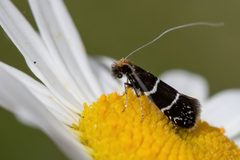
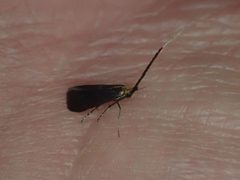
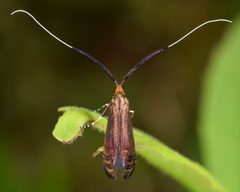
Adela is a of fairy longhorn moths in the Adelidae, characterized by exceptionally long —especially in males, which can possess antennae up to three times the length of their forewings. These small, delicate exhibit metallic coloration and are , often observed nectaring on flowers. The genus belongs to the Adelinae and is widespread across the Holarctic region.
Pronunciation
How to pronounce Adela: /əˈdeɪlə/
These audio files are automatically generated. While they are not always 100% accurate, they are a good starting point.
Identification
Distinguished from other Adelidae by combination of extremely long (especially males), metallic coloration, and activity. Males can be confused with Nemophora , but Adela typically shows more pronounced antennae thickening at base. Females may resemble other small metallic such as Mathildana newmanella (Oecophoridae), but differ in antennae structure and wing shape. Accurate identification to species level often requires examination of genitalia or specific plant associations.
Images
Appearance
Small, delicate with metallic luster, typically dark with iridescent blue or coppery sheen. Males have extremely long , often 2–3 times forewing length, with basal half distinctly thickened; female antennae are shorter, approximately twice forewing length. Wings are narrow and elongated. Body is slender and compact.
Habitat
Deciduous woodlands, forest edges, and areas with abundant flowering vegetation. Often found along woodland trails and in shrubby . Some associated with specific plants including Black Horehound (Ballota nigra), American bittersweet (Celastrus scandens), and black snakeroot (Sanicula marilandica). frequently use dense vegetation such as Common Hop (Humulus lupulus), Japanese Rose (Kerria japonica), and Blackthorn (Prunus spinosa) for shelter.
Distribution
Widespread across the Holarctic region. Recorded from Europe (including Scandinavia: Denmark, Norway, Sweden), North America (eastern United States including Vermont, central Illinois, Missouri; western North America including California), and temperate Asia. Specific distributions vary; for example, Adela caeruleella is widespread across eastern North America, while Adela ridingsella has unknown status in some regions.
Seasonality
active primarily in spring and early summer, with peak activity in April and May in temperate regions. Some may extend into July. Activity is strongly tied to warm, sunny conditions; adults are thermophilous and .
Diet
feed on nectar from various flowering plants. Larval diet varies by : some feed on leaves of specific plants (e.g., Black Horehound, Ballota nigra), while others are leaf miners or case-bearers on detritus or specific plant tissues. Larval is incompletely known for many species.
Host Associations
- Ballota nigra - larval food plantBlack Horehound; exclusive for some
- Celastrus scandens - nectar sourceAmerican bittersweet
- Sanicula marilandica - nectar sourceBlack snakeroot; preferred in some regions
- Zizia aurea - nectar sourceGolden Alexander
- Humulus lupulus - shelterCommon Hop
- Kerria japonica - shelterJapanese Rose
- Prunus spinosa - shelterBlackthorn
Life Cycle
Holometabolous. laid on or near larval food plants. Larvae are typically leaf miners, case-bearers, or feed within plant tissues; some construct portable cases from silk and plant material. occurs in soil or leaf litter. are short-lived, with mating and oviposition occurring rapidly. Specific details vary considerably among species and are poorly documented for many.
Behavior
and thermophilous; are most active in sunny, warm conditions. Males are highly mobile, traveling long distances and often occupying treetops; they have been observed resting on undersides of leaves in dense, thorny shrubs. Females are more sedentary, retaining preferred patches for oviposition and showing short-distance . When disturbed, individuals may either leave the patch seeking shelter or take flight and land within the same area, sometimes followed by resumed oviposition. Adults are elusive, often entering densely branched, inaccessible vegetation to avoid . appear irregular, with small, transient that are difficult to monitor.
Ecological Role
function as while nectaring. Larvae serve as herbivores, with some acting as on particular plant species. The group contributes to overall Lepidoptera diversity in woodland . Their specific ecological impacts are understudied due to their elusive nature and small sizes.
Human Relevance
Primarily of scientific and aesthetic interest due to their delicate appearance and remarkable . Some serve as indicators of quality and woodland health. No significant economic impact; neither major pests nor widely used in .
Similar Taxa
- NemophoraAlso longhorn with extremely long ; distinguished by less pronounced basal thickening of antennae and different wing venation patterns
- Mathildana newmanellaSimilar metallic coloration but belongs to Oecophoridae; are noticeably shorter and not as dramatically elongated
- CauchasAnother adelid with long ; differs in specific morphological details of wing pattern and antennae structure
More Details
Taxonomic history
Formerly treated as a of Incurvariidae, now placed in Adelidae. The family is considered one of the most primitive lineages of Lepidoptera.
Conservation concerns
Many are under-recorded due to their elusive and small, transient . Climate change impacts, including severe summer droughts and heatwaves, may affect population persistence; observations suggest irrigation of plants can help cope with extreme temperatures, though this is not a landscape- solution.
Research challenges
-level studies are difficult due to the ' inconspicuous lifestyle, irregular establishment of populations, and the challenges of locating individuals within dense vegetation. Continued disturbance of vegetation during surveys may trigger oviposition in females, complicating behavioral interpretations.
Sources and further reading
- BugGuide
- Wikipedia
- GBIF taxonomy match
- iNaturalist taxon
- NCBI Taxonomy
- Catalogue of Life
- Addie Abrams, Ph.D to Be, to Present Exit Seminar | Bug Squad
- Addie Abrams Targeting Aphids and Thrips in California Lettuce | Bug Squad
- Hear That Buzz? It's World Bee Day! | Bug Squad
- Chicharra que canta, calor adelanta | Beetles In The Bush
- Dainty, delicate, little fairies | Beetles In The Bush
- Surveying the Horehound Long-horn Moth - Buglife Blog - Buglife