
Nemophora
Hoffmannsegg, 1798
fairy longhorn moths
Species Guides
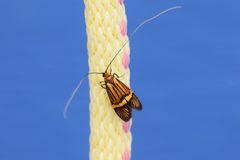
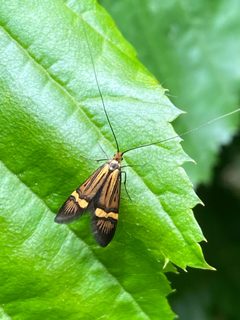
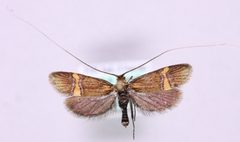
1Nemophora is a of micro- in the Adelidae, commonly known as fairy longhorn moths. are characterized by metallic coloration and exceptionally long , particularly in males. The genus is distributed across Europe, Asia, and other regions, with species occupying diverse including meadows, peat bogs, and gardens. Several species have specialized larval plant associations and are considered indicators of well-preserved traditional habitats.
Pronunciation
How to pronounce Nemophora: /nɛˈmɒfərə/
These audio files are automatically generated. While they are not always 100% accurate, they are a good starting point.
Identification
The combination of tiny size, metallic coloration, and extraordinarily long distinguishes Nemophora from other micro- . Males of many have antennae exceeding body length by two to three times. Accurate species identification typically requires examination of genitalia, as external is similar among closely related species. For example, N. prodigellus requires dissection to separate from N. fasciella. are and active in sunshine, unlike many moth groups.
Images
Habitat
varies by : open meadows and Molinia grasslands (N. prodigellus), peat bogs and open tundra with Betula nana (N. bellela), gardens and woodland edges with larval plants (N. fasciella), and tropical forest habitats (undescribed species from Papua New Guinea). Many species require open conditions maintained by traditional management such as mowing; woody threatens habitat suitability.
Distribution
Palearctic distribution with extensions into other regions. Europe: widespread including UK, Poland, Germany, France, Spain, Italy, Switzerland, Austria, Balkans, Czech Republic, Slovakia, Hungary, Romania, Ukraine, Russia. Asia: Korea, India, Nepal. Papua New Guinea (at least one undescribed species). Circumpolar distribution for N. bellela in northern Europe.
Seasonality
period primarily summer months. N. prodigellus: mid-June to late July. N. fasciella: July, with observations from early July to late July. N. bellela: presumably summer, matching circumpolar pattern. are with single per year.
Host Associations
- Ballota nigra - larval food plantBlack horehound; sole larval for N. fasciella
- Stachys officinalis - larval food plant and nectar source for N. prodigellus; larvae feed on flowers and leaves, nectar on flowers
- Betula nana - association and likely larval Dwarf birch; associated with N. bellela in peat bog and tundra
- Mentha spicata - nectar sourceCommon mint; observed as nectar source for N. fasciella males
Life Cycle
with single annually. laid singly on or near plants. Larval development includes case-building in later instars: larvae construct portable cases from silk and plant material, used for movement, feeding, hibernation, and . Final larval case typically flat, brown, bivalve (mussel-shell-like) with convex sides. Pupation occurs within case, often in loose soil or sand with incorporated mineral particles. as larva in case at or below ground level.
Behavior
activity pattern with active in hot, sunny conditions. Males are highly mobile and travel longer distances; females more sedentary, remaining near plants for oviposition. Adults exhibit undulating and may swarm around branch tips. When disturbed, adults either flee the patch or take flight and return to same area, with females resuming oviposition after short rest. Adults rarely attracted to light. Concealment : adults rest in dense vegetation, often on undersides of leaves or within inaccessible branched spaces, making detection difficult without careful disturbance of vegetation.
Ecological Role
Member of endangered meadow and grassland lepidopteran ; serves as for well-preserved, traditionally managed such as Molinia meadows. Associated with other threatened Lepidoptera in same habitats including Phengaris and Euphydryas aurinia. Potential pollination role through nectar-feeding on diverse flowers, though this function remains understudied relative to larger species.
Human Relevance
Subject of citizen science and conservation monitoring due to rarity and specificity of several . N. fasciella has become emblematic of garden- conservation success, persisting for over 13 years in a single Bulgarian garden through maintenance of larval plant. sequencing completed for N. metallica (Brassy Long-horn), contributing to lepidopteran genomic resources. Some species threatened by habitat abandonment, plants, and climate change-induced drought and temperature extremes.
Similar Taxa
- AdelaSame Adelidae with similar metallic coloration and long ; distinguished by wing pattern details and genitalia structure
- CauchasAdelidae with fairy longhorn ; separation requires examination of scaling and genitalia
- NematopogonAdelidae ; males lack the extremely elongated characteristic of Nemophora
More Details
Conservation significance
Several Nemophora are among the most elusive and rarely recorded micro- in Europe. N. fasciella is considered nationally scarce in the UK and rare across Europe, with scattered records often representing one-off observations rather than established . N. prodigellus is threatened by abandonment of traditional hay meadow management and requires active maintenance.
Taxonomic challenges
The contains morphologically similar requiring genitalia dissection for reliable identification. Undescribed species likely exist in under-surveyed regions; a specimen from Papua New Guinea collected in 1998 may represent a new species.
Climate vulnerability
Observations of N. fasciella indicate sensitivity to drought and heat extremes, with retreating to cooler shrubby areas during heatwaves. Increased irrigation supported population persistence during 2024 survey, suggesting water availability may become critical factor under climate change.
Sources and further reading
- BugGuide
- Wikipedia
- iNaturalist taxon
- NCBI Taxonomy
- Catalogue of Life
- This Super-Tiny Fairy Longhorn Moth Has Quite a History | Bug Squad
- Stories about small insects and making a big difference - Buglife Blog - Buglife
- Reversing insect declines – a matter of personal responsibility before our own existence - Buglife Blog - Buglife
- Surveying the Horehound Long-horn Moth - Buglife Blog - Buglife
- The great potential of citizen science - an opportunity to work together more in the name of preserving insects in 2021 - Buglife Blog - Buglife
- A new species of Nemophora from Korea (Lepidoptera, Adelidae, Adelinae)
- Nemophora prodigellus (Zeller, 1853) (Lepidoptera, Adelidae): the first definite record in Poland, with comments on the protection of its habitat
- Description of immature stages of <i>Nemophora bellela</i> (Walker, 1863) (Lepidoptera: Adelidae)
- The genome sequence of the Brassy Long-horn, Nemophora metallica (Poda, 1761) (Lepidoptera: Adelidae).