
Nemophora bellela
(Walker, 1863)
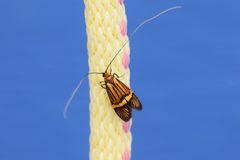
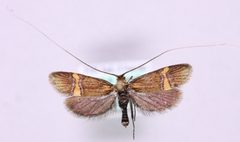
Nemophora bellela is a circumpolar micro- in the Adelidae, notable as the only of its in North America and the sole circumpolar member of Nemophora. have a wingspan of 17–20 mm and are active in June and July in northern Europe. Later instar larvae are case-dwelling and feed on detritus on the ground in peat bog and tundra .
Pronunciation
How to pronounce Nemophora bellela: //nɛˈmɒfərə bəˈliːlə//
These audio files are automatically generated. While they are not always 100% accurate, they are a good starting point.
Identification
Distinguished from other Nemophora by its circumpolar distribution and presence in North America; other Nemophora species are Palearctic. In North America, it is the only representative of the . Case-dwelling larval and ground-dwelling detritus feeding in later instars differ from some .
Images
Appearance
Small with wingspan of 17–20 mm. Metallic coloration typical of Adelidae. notably long, characteristic of fairy longhorn moths—males possess antennae 1–3 times the length of the forewing.
Habitat
Peat bogs and open tundra with Betula nana in northern Europe. In North America, found from Quebec across Canada north of the plains to the mountains of British Columbia and Alaska.
Distribution
Circumpolar: North America (Quebec to Alaska, including British Columbia), northern Europe (Fennoscandia, Lithuania, northern Russia).
Seasonality
active June and July in northern Europe.
Diet
Later instar larvae feed on detritus on the ground. Larvae have been recorded in association with Betula nana and Salix , though later instar feeding is detritivorous rather than herbivorous.
Host Associations
- Betula nana - association; larval presence recordedLater instar larvae are case-dwelling and feed on detritus, not living plant tissue
- Salix - larval food plant association reportedSource indicates larvae feed on Salix , though this may refer to early instars or context
Life Cycle
Later instar larvae are case-dwelling, constructing portable cases and feeding on detritus on the ground. Female pupal have been described. Early instar less documented; some association with living plants (Betula nana, Salix) reported but later instars shift to detritivory.
Behavior
with undulating typical of Adelidae. Later instar larvae case-dwelling and ground-dwelling, feeding on detritus. Larvae described as constructing portable cases.
Ecological Role
in later larval stages, contributing to nutrient cycling in peat bog and tundra . Potential as given activity and nectar-feeding typical of .
Similar Taxa
- Nemophora fasciellaBoth in Nemophora with long and metallic coloration; N. fasciella is Palearctic, on Ballota nigra, with more restricted distribution and different preferences
- Adela reaumurellaBoth in Adelidae with extremely long and metallic appearance; A. reaumurella is more widespread in Europe, greenish in color, with different larval
More Details
Taxonomic significance
Only circumpolar in Nemophora and sole representative of the genus in North America, making it important for understanding biogeographic patterns in the Adelidae
Research gaps
Early instar larval and precise relationships remain incompletely documented; most detailed information pertains to later instars
Sources and further reading
- BugGuide
- Wikipedia
- GBIF taxonomy match
- iNaturalist taxon
- NCBI Taxonomy
- Catalogue of Life
- This Super-Tiny Fairy Longhorn Moth Has Quite a History | Bug Squad
- Stories about small insects and making a big difference - Buglife Blog - Buglife
- Reversing insect declines – a matter of personal responsibility before our own existence - Buglife Blog - Buglife
- Surveying the Horehound Long-horn Moth - Buglife Blog - Buglife
- The great potential of citizen science - an opportunity to work together more in the name of preserving insects in 2021 - Buglife Blog - Buglife
- Description of immature stages of <i>Nemophora bellela</i> (Walker, 1863) (Lepidoptera: Adelidae)