
Adela septentrionella
Walsingham, 1880
Ocean Spray Fairy Moth, Fairy Longhorn Moth
Adela septentrionella is a small fairy longhorn moth in the Adelidae, described by Walsingham in 1880. The is characterized by the exceptionally long typical of male adelids, with forewings measuring 4.5–5.7 mm. are active from mid-April to mid-July across their western North American range. The larvae are specialized feeders on the buds of Holodiscus discolor (ocean spray), a woody shrub in the rose family.
Pronunciation
How to pronounce Adela septentrionella: /əˈdiːlə ˌsɛptɛntrioʊˈnɛlə/
These audio files are automatically generated. While they are not always 100% accurate, they are a good starting point.
Identification
Distinguished from other Adela by geographic range and plant association. The combination of small size, metallic luster, and extraordinarily long (especially in males) separates it from superficially similar microlepidoptera such as Mathildana newmanella (Oecophoridae), which lacks the extreme antennal elongation. Final identification requires reference to genitalia or association with larval host plant Holodiscus discolor.
Images
Appearance
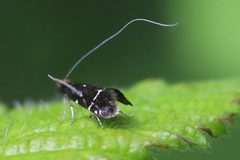
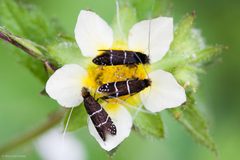
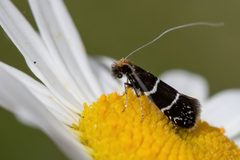
Small with forewings 4.5–5.7 mm in length. Males possess extremely long , up to three times the length of the forewings, a defining trait of the Adelidae. Females have antennae approximately twice the forewing length. The exhibits metallic coloration typical of fairy moths.
Habitat
Associated with supporting the larval plant Holodiscus discolor (ocean spray), a deciduous shrub occurring in forest openings, edges, and disturbed areas. have been observed nectaring on flowers in woodland settings.
Distribution
Western North America from southern British Columbia and northwestern Idaho southward through Washington and Oregon to the Transverse Range in southern California.
Seasonality
on wing from mid-April to mid-July. occurs in late March or April, preceding adult .
Diet
Larvae feed on buds of Holodiscus discolor (ocean spray, Rosaceae). feeding habits are not documented.
Host Associations
- Holodiscus discolor - larval food plantlarvae feed on buds
Life Cycle
Larvae feed on plant buds. occurs in late March or April. emerge and are active from mid-April through mid-July. Specific details of placement and larval development are not documented.
Behavior
are and have been observed nectaring on flowers. Males likely engage in territorial and mate-location given observations in . The ' flight period coincides with plant bud development.
Ecological Role
herbivore on Holodiscus discolor. may contribute to pollination while nectaring. Specific functions are not well documented.
Human Relevance
No documented economic or cultural significance. The is not known to be a pest.
Similar Taxa
- Adela caeruleellaSimilar metallic coloration and antennal structure; distinguished by eastern North American distribution and association with different plants including Celastrus scandens and Sanicula marilandica
- Mathildana newmanellaSimilar small size and coloration but belongs to Oecophoridae; lacks the extremely elongated characteristic of Adelidae
More Details
Taxonomic note
Adelidae was formerly treated as a of Incurvariidae but is now recognized as a distinct family within the superfamily Adeloidea.
Sources and further reading
- BugGuide
- Wikipedia
- GBIF taxonomy match
- iNaturalist taxon
- NCBI Taxonomy
- Catalogue of Life
- Addie Abrams Targeting Aphids and Thrips in California Lettuce | Bug Squad
- Hear That Buzz? It's World Bee Day! | Bug Squad
- Addie Abrams, Ph.D to Be, to Present Exit Seminar | Bug Squad
- Chicharra que canta, calor adelanta | Beetles In The Bush
- Dainty, delicate, little fairies | Beetles In The Bush
- Surveying the Horehound Long-horn Moth - Buglife Blog - Buglife