
Incurvariidae
Spuler, 1899
Leafcutter Moths
Genus Guides
2- Paraclemensia(maple leafcutter moths)
- Phylloporia
is a of small primitive monotrysian comprising twelve recognized . These moths are characterized by their narrow wings held tightly along the body at rest and notably long in some . Many species are leaf miners with well-documented plant associations, though the family exhibits diverse feeding habits including some species that cut and carry leaf pieces. The family includes familiar European species such as Incurvaria masculella and Phylloporia bistrigella.
Pronunciation
How to pronounce Incurvariidae: //ˌɪnkʊrˌvɛəriˈɪdiː//
These audio files are automatically generated. While they are not always 100% accurate, they are a good starting point.
Identification
Narrow wings held tightly along the body at rest distinguish from many other small . Extremely long (especially in males) are characteristic of the Adelinae. Leaf-mining larvae with distinctive —such as cutting circular leaf pieces and carrying them to construct portable cases—provide additional diagnostic features for some . may be distinguished from similar small moths by their resting posture and, in some , metallic luster.
Images
Appearance
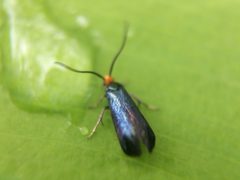
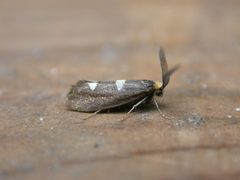
Small with narrow wings held tightly appressed to the body when at rest. Some possess exceptionally long , particularly males of the Adelinae (formerly treated as a separate ), where antennae may reach three times the forewing length. Wings are typically unpatterned or subtly marked. Body form is slender and compact.
Habitat
vary by and region. European species occur in deciduous woodlands and forest edges. Australian species such as Perthida glyphopa inhabit jarrah (Eucalyptus marginata) forests in Western Australia. North American species occupy diverse habitats including maple forests (Paraclemensia acerifoliella) and subalpine peat bogs (Incurvaria ullae in the Swiss Alps). The Adelinae is frequently found along deciduous forest trails.
Distribution
Widespread across the Northern Hemisphere with notable concentrations in Europe, North America, and East Asia. European fauna includes well-known in Incurvaria and Phylloporia. North American distribution spans eastern deciduous forests (maple-associated species) and western regions (including newly discovered on Rosaceae ). Asian species occur in China, Japan, and the Ryukyu Islands. Australian distribution is restricted to Western Australia for Perthida glyphopa. Records from Scandinavia (Denmark, Norway, Sweden) and the northeastern United States (Vermont) documented.
Seasonality
activity varies by and climate. Incurvaria species in Europe show spring activity with April-May periods. North American Adela caeruleella is active in April-May in the eastern U.S. and late May in central Illinois. Perthida glyphopa in Western Australia has a seasonal flight period in April-May. Some species exhibit bimodal patterns suggestive of multiple .
Host Associations
- Acer - larval Maple ; primary for Paraclemensia acerifoliella and hypothesized ancestral host for the
- Amelanchier alnifolia - larval Saskatoon; newly discovered for western Canadian of Paraclemensia acerifoliella, representing a derived host shift to Rosaceae
- Eucalyptus marginata - larval Jarrah; exclusive for Perthida glyphopa in Western Australia
- Eucalyptus rudis - larval Flooded gum; secondary for Perthida glyphopa
- Fagaceae - larval Beech ; association for Vespina in western North America and East Asia
- Myricaceae - larval Bayberry ; for Vespina sichuana in warm temperate Asia
- Sapindaceae - larval Soapberry ; includes Acer (maple) for some Vespina in eastern Europe
Life Cycle
details vary among . Perthida glyphopa is : are deposited under leaf , larvae excavate mines avoiding thick and oil glands, mature larvae construct and enter soil to aestivate and pupate. Pupae possess abdominal spines and setae that aid in wriggling to the soil surface for . Some species show multivoltine patterns with approximately 30-day life cycles under favorable temperatures. Larval and extended development periods occur in some species to synchronize with .
Behavior
Larvae of many are leaf miners, with some exhibiting distinctive leaf-cutting where circular pieces are excised and carried to construct portable cases. Female Perthida glyphopa exhibit gregarious oviposition behavior, preferring young leaves in the lower crown portion and dispersing more readily than males. Oviposition occurs primarily at 14-22°C in diminishing light or overcast conditions. Some species show territorial behaviors in males.
Ecological Role
Leaf-mining larvae create distinctive damage patterns on foliage, serving as indicators of forest health and contributing to nutrient cycling. High densities of such as Perthida glyphopa cause conspicuous defoliation of Eucalyptus forests. The serves as host for diverse including Hymenoptera in families Eulophidae and Ichneumonidae, with rates varying inversely with host . Larvae and pupae in soil are preyed upon by birds, ants, , and carabid beetles.
Human Relevance
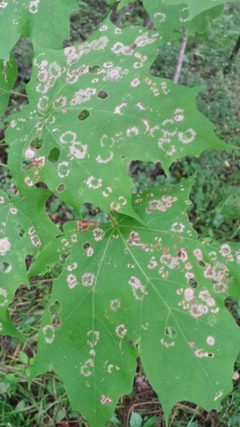
Some are forest pests of localized economic concern, particularly Perthida glyphopa in Western Australian jarrah forests. Paraclemensia acerifoliella causes damage to sugar maple in North American forestry contexts, with larvae mining leaves and creating characteristic circular cuts. The has contributed to understanding of -plant and phylogenetic shifts in herbivore diet breadth. Some species are familiar to European naturalists and amateur lepidopterists.
Similar Taxa
- AdelidaeLong treated as a (Adelinae) of ; distinguished by extremely long (especially males) and that visit flowers. Now often treated as a separate but historically and morphologically closely allied.
- HeliozelidaeAnother of small primitive monotrysian with leaf-mining larvae; distinguished by different wing venation and larval case construction.
- TischeriidaeSmall with blotch-mining larvae; similar in size and general habitus but with reduced wing venation and different larval .
More Details
Systematic Position
represents one of the most primitive lineages of Heteroneura (the monotrysian ), retaining ancestral characteristics in wing venation, genitalia, and larval . The 's phylogenetic placement has been stable in recent classifications, though the status of Adelinae remains debated with some treatments recognizing it as family Adelidae.
Molecular Systematics
studies of European Incurvaria reveal distinct species-level barcodes with minimum K2P divergences averaging 7.05% (range 1.2-12.8%), supporting morphological species boundaries. New species such as Incurvaria pirinella have been described based on combined morphological, genitalic, and genetic divergence data.
Biogeographic Patterns
plant associations show biogeographic structure: Fagaceae-feeding predominates in western North America and East Asia, Aceraceae/Sapindaceae-feeding in eastern Europe and North America, and Myricaceae-feeding in warm-temperate Asia. The derived capability for Rosaceae-feeding in Paraclemensia acerifoliella represents a significant host-range expansion in western North America.
Sources and further reading
- BugGuide
- Wikipedia
- GBIF taxonomy match
- iNaturalist taxon
- NCBI Taxonomy
- Catalogue of Life
- Lepidoptera | Beetles In The Bush | Page 7
- Bibliography | Beetles In The Bush
- Habitat: Adela bella in Florida (Incurvariidae: Adelinae)
- NATURAL ENEMIES OF PERTHIDA GLYPHOPA COMMON (LEPIDOPTERA: INCURVARIIDAE)
- Bionomics of the Maple Leaf Cutter, Paraclemensia acerifoliella (Fitch), (Lepidoptera: Incurvariidae)
- The biology of the Jarrah leaf miner, Perthida glyphopa common (Lepidoptera : Incurvariidae)
- THE IMMATURE STAGES AND LIFE HISTORY OF THE JARRAH LEAFMINER, PERTHIDA GLYPHOPA COMMON (LEPIDOPTERA: INCURVARIIdAE)
- Incurvaria ullae sp. n. (Lepidoptera: Incurvariidae) from the Alps of Grisons, Switzerland
- Review of the genus Vespina (Lepidoptera, Incurvariidae) with two new species from China and Japan
- POPULATION DISTRIBUTION OF THE MAPLE LEAFCUTTER, PARACLEMENSIA ACERIFOLIELLA (LEPIDOPTERA: INCURVARIIDAE), IN SUGAR MAPLE TREES
- Biology and immature stages ofPanteles schnetzeanus(Hymenoptera: Ichneumonidae), a parasitoid ofLampronia fuscatella(Lepidoptera: Incurvariidae)
- THE IMMATURE STAGES AND BIOLOGY OF CHRYSONOTOMYIA SP.A (HYMENOPTERA: EULOPHIDAE), A PARASITOID OF PERTHIDA GLYPHOPA COMMON (LEPIDOPTERA: INCURVARIIDAE)
- OVIPOSITION BEHAVIOUR AND DISPERSAL OF PERTHID A GLYPHOPA COMMON (LEPIDOPTERA: INCURVARIIDAE)
- Incurvaria pirinella sp. nov., a new species of the vetulella species-group (Lepidoptera, Incurvariidae) from Bulgaria, with release of DNA barcodes for European species of Incurvaria
- Paraclemensia acerifoliella (Lepidoptera: Incurvariidae) in western Canada: a newly discovered host, an expanded range, and biogeographical considerations
- IMMATURE STAGES AND LIFE HISTORY OF ENYTUS SP. (HYMENOPTERA: ICHNEUMONIDAE), A PARASITOID OF PERTHIDA GLYPHOPA COMMON (LEPIDOPTERA: INCURVARIIDAE)
- THE IMMATURE STAGES AND LIFE HISTORY OF DIAULOMORPHA SP. (HYMENOPTERA: EULOPHIDAE), A PARASITOID OF PERTHIDA GLYPHOPA COMMON (LEPIDOPTERA: INCURVARIIDAE)
- First Report of the Immature Stages of the Leaf-Mining Genus Subclemensia Kozlov, 1987 (Lepidoptera: Incurvariidae), with a Re-Illustration of the Type Species and a Generic Concept Discussion Based on Immature Characters.