
Adela caeruleella
Walker, 1863
Southern Longhorn Moth
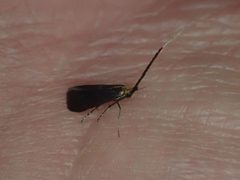
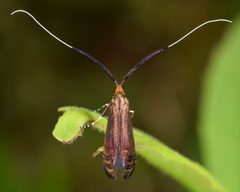
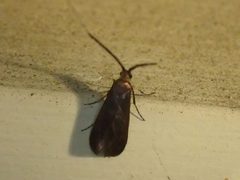
Adela caeruleella is a small in the Adelidae, known as fairy longhorn moths. are characterized by exceptionally long , especially in males which can reach three times the forewing length. The occurs across the eastern and southern United States, where adults have been observed nectaring on flowers in woodland during spring.
Pronunciation
How to pronounce Adela caeruleella: /əˈdɛlə sɛruːliˈɛlə/
These audio files are automatically generated. While they are not always 100% accurate, they are a good starting point.
Identification
Distinguished from other Adelidae by geographic range (eastern North America) and association with specific plants. Males can be distinguished from females by length: three times forewing length versus twice forewing length. Females show distinctly thickened basal half of antennae. Identification to level may require comparison with reference specimens or photographs, as other Adela species occur in the same region.
Images
Appearance
Small with dark metallic luster to the body. extremely long: males with antennae up to three times forewing length, females with antennae about twice forewing length. In females, the basal half of the antennae is distinctly thickened. Wings appear relatively short compared to the antennae.
Habitat
Deciduous forest trails and woodland edges. frequently found along forest paths where larval plants and nectar sources occur.
Distribution
Eastern and central North America. Recorded from Alabama, Arkansas, Florida, Illinois, Kentucky, Louisiana, Maryland, Mississippi, North Carolina, Ohio, Oklahoma, Pennsylvania, South Carolina, Tennessee, Texas, Virginia, West Virginia, and Quebec.
Seasonality
active March through May, with March activity in Florida, April to May northward, and August records in Quebec. Late April observations in Missouri and late May in central Illinois.
Diet
nectar on flowers including golden Alexander (Zizia aurea), American bittersweet (Celastrus scandens), and black snakeroot (Sanicula marilandica). Larval plant inferred from related and limited records: likely associated with leaf litter or decaying plant material, though specific diet unconfirmed for this species.
Host Associations
- Zizia aurea - nectar sourceGolden Alexander (Apiaceae), observed in Missouri
- Celastrus scandens - nectar sourceAmerican bittersweet (Celastraceae), recorded by Powell (1969)
- Sanicula marilandica - nectar sourceBlack snakeroot (Apiaceae), noted by Microleps.org as preferred
Life Cycle
Complete with , larval, pupal, and stages. Larval poorly documented; larvae of Adelidae typically feed on leaf litter, decaying vegetation, or possibly living plant tissue. Specific details for this not established.
Behavior
activity pattern. observed nectaring calmly on flowers. Males presumably engage in territorial and mate-location based on observations of congeneric . Females remain closer to plant patches for oviposition.
Ecological Role
pollination of early spring wildflowers. Larval role in decomposition or nutrient cycling inferred from -level but not confirmed for this .
Human Relevance
Subject of interest to lepidopterists and macrophotographers due to distinctive appearance and accessible . No economic importance established.
Similar Taxa
- Adela reaumurellaGreen longhorn , occurs in Europe; distinguished by geographic range and greenish coloration
- Nemophora fasciellaHorehound longhorn , European with different plant associations and male up to four times body length
- Other Adela speciesSeveral occur in North America; identification requires careful examination of proportions, coloration, and known geographic distribution
More Details
Taxonomic history
Originally described by Francis Walker in 1863. formerly treated as Incurvariidae, now recognized as distinct family Adelidae.
Research needs
Larval and precise relationships remain undocumented. -level studies of movement and use would improve understanding of conservation needs.
Sources and further reading
- BugGuide
- Wikipedia
- GBIF taxonomy match
- iNaturalist taxon
- NCBI Taxonomy
- Catalogue of Life
- Addie Abrams Targeting Aphids and Thrips in California Lettuce | Bug Squad
- Hear That Buzz? It's World Bee Day! | Bug Squad
- Lepidoptera | Beetles In The Bush | Page 7
- Chicharra que canta, calor adelanta | Beetles In The Bush
- Australia’s wish list of exotic pets | Blog
- Surveying the Horehound Long-horn Moth - Buglife Blog - Buglife