
Adela singulella
Walsingham, 1880
fairy longhorn moth
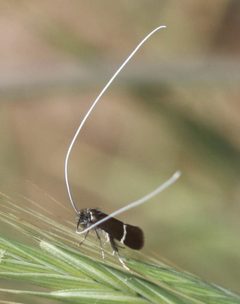
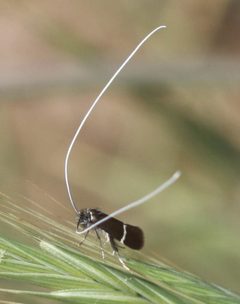
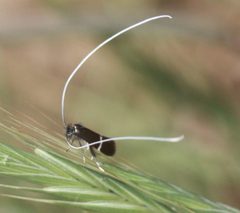
Adela singulella is a of fairy longhorn moth ( Adelidae) to California. Described by Walsingham in 1880, it is distinguished by the extreme in length typical of the family—males possess antennae up to three times the length of their forewings. The species has a restricted but disjunct distribution across coastal and montane regions of California, with larval development tied specifically to two Gilia species (Polemoniaceae).
Pronunciation
How to pronounce Adela singulella: /əˈdɛlə sɪŋˈɡjuːlɛlə/
These audio files are automatically generated. While they are not always 100% accurate, they are a good starting point.
Identification
As a member of Adelidae, A. singulella exhibits the 's diagnostic trait of extraordinarily long , particularly in males. Males have antennae up to three times forewing length; females have antennae approximately twice forewing length with the basal half distinctly thickened. -level identification requires examination of genitalia or association with larval plants, as congeneric species in California (A. flammeusella, A. trigrapha) are superficially similar. The metallic luster and dark coloration are shared with other Adela species.
Images
Habitat
Occupies diverse across its California range including coastal scrub, chaparral, oak woodland, and montane coniferous forest. Larval habitat is dictated by presence of plants Gilia capitata and G. achilleifolia, which occur in open, disturbed areas and grasslands. have been observed nectaring on flowers in woodland edge habitats.
Distribution
to California, USA. Documented from southern Mendocino, Napa, and northern Marin Counties; west slope of Sierra Nevada from El Dorado to Kern County; Coast Ranges from Santa Clara County south to San Luis Obispo County; and San Gabriel Mountains.
Seasonality
active mid-May to mid-June north of San Francisco Bay, central Sierra Nevada, and San Gabriel Mountains. In southern Coast Range and southern Sierra Nevada, adults recorded in April. period corresponds with blooming of larval plants and nectar sources.
Diet
Larvae feed on buds of Gilia capitata and Gilia achilleifolia (Polemoniaceae). feeding habits not documented.
Host Associations
- Gilia capitata - larval plantlarvae feed on buds
- Gilia achilleifolia - larval plantlarvae feed on buds
Life Cycle
Complete with larval development in buds of plants. Specific details of placement, site, and stage not documented.
Ecological Role
Larval herbivore on native Polemoniaceae; potential as . Specific ecological interactions not studied.
Similar Taxa
- Adela flammeusellaOverlapping California distribution; similar metallic coloration and long ; distinguished by genitalia and plant associations
- Adela trigraphaOverlapping California distribution; similar ; distinguished by genitalia and plant associations
- Adela caeruleellaSimilar and dimorphism; distinguished by eastern North American distribution and association with different plants (Celastrus scandens, Sanicula marilandica)
More Details
Taxonomic history
Adelidae was formerly treated as Adelinae within Incurvariidae; elevated to family status based on morphological and molecular evidence. The 'fairy longhorn moth' refers to the distinctive of males.
Conservation status
Not formally assessed; restricted distribution and specific plant requirements may increase vulnerability to loss and climate change, particularly given documented sensitivity of related Adelidae to drought and temperature extremes.
Sources and further reading
- BugGuide
- Wikipedia
- GBIF taxonomy match
- iNaturalist taxon
- Catalogue of Life
- Addie Abrams Targeting Aphids and Thrips in California Lettuce | Bug Squad
- Hear That Buzz? It's World Bee Day! | Bug Squad
- Addie Abrams, Ph.D to Be, to Present Exit Seminar | Bug Squad
- Chicharra que canta, calor adelanta | Beetles In The Bush
- Dainty, delicate, little fairies | Beetles In The Bush
- Surveying the Horehound Long-horn Moth - Buglife Blog - Buglife