
Adela trigrapha
Zeller, 1876
Three-striped Longhorn
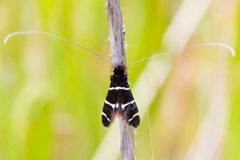
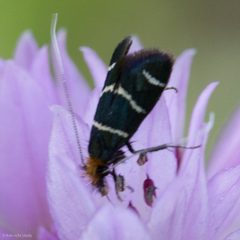
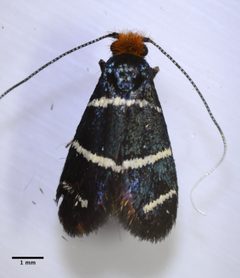
Adela trigrapha is a fairy longhorn moth in the Adelidae, described by Zeller in 1876. It occurs in western North America from Vancouver Island to California. males display striking with extremely long and black forewings marked by three white lines, while females have shorter antennae, orange , and metallic blue-purple wings. The belongs to a family characterized by elongated antennae, particularly in males.
Pronunciation
How to pronounce Adela trigrapha: /əˈdɛlə trɪˈɡræfə/
These audio files are automatically generated. While they are not always 100% accurate, they are a good starting point.
Identification
Males distinguished by extremely long (three times forewing length) and black forewings with three white lines. Females recognized by orange , metallic blue forewings, and purple hindwings with shorter antennae. The three white lines on male forewings provide the specific epithet reference. Similar to other Adela but geographic range and distinct color patterns aid separation.
Images
Appearance
Small with forewing length 5.5–6.2 mm. males have large and long white approximately three times the forewing length; forewings black with three white transverse lines. Females smaller with smaller eyes and antennae; bright orange; forewings bright metallic blue, hindwings purple. pronounced in both coloration and antennae length.
Distribution
Western North America, from Vancouver Island (British Columbia, Canada) south to California (USA).
Host Associations
- Leptosiphon androsaceus - possible larval tentative association
- Leptosiphon bicolor - possible larval tentative association
Similar Taxa
- Adela caeruleellaSimilar metallic blue coloration in females, but occurs in eastern North America rather than western; male and wing patterns differ
- Adela ridingsellaAnother North American Adelidae with potentially overlapping range; distinguished by wing pattern and proportions
Sources and further reading
- BugGuide
- Wikipedia
- GBIF taxonomy match
- iNaturalist taxon
- NCBI Taxonomy
- Catalogue of Life
- Addie Abrams Targeting Aphids and Thrips in California Lettuce | Bug Squad
- Hear That Buzz? It's World Bee Day! | Bug Squad
- Addie Abrams, Ph.D to Be, to Present Exit Seminar | Bug Squad
- Dainty, delicate, little fairies | Beetles In The Bush
- Chicharra que canta, calor adelanta | Beetles In The Bush
- Surveying the Horehound Long-horn Moth - Buglife Blog - Buglife