
Adela flammeusella
Chambers, 1876
Fairy Longhorn Moth
Adela flammeusella is a of fairy longhorn moth in the Adelidae, characterized by the extremely long typical of this group. Males possess antennae up to three times the length of the forewings, while females have antennae roughly twice as long. The species was described by V.T. Chambers in 1876 and is restricted to the Pacific coastal region of western North America.
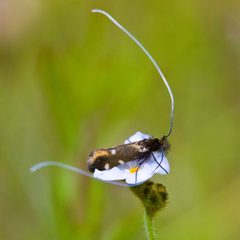
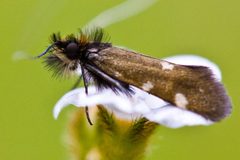
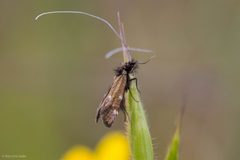
Pronunciation
How to pronounce Adela flammeusella: /əˈdɛlə flæmjuˈsɛlə/
These audio files are automatically generated. While they are not always 100% accurate, they are a good starting point.
Identification
The combination of extremely long (especially in males), small size (5–6 mm forewing length), and metallic purple hindwings distinguishes this from other micro- in its range. The geographic restriction to cismontane California and southern Washington helps separate it from eastern North American Adela species such as A. caeruleella. Within California, it may occur with A. trigrapha; precise differentiation between these species requires examination of genitalia or detailed wing pattern analysis.
Images
Appearance
Small with forewing length of 5–6 mm. Both sexes possess metallic purple hindwings. Males have approximately three times the forewing length; females have antennae approximately twice the forewing length. The forewings are narrow and elongated. The metallic coloration on the hindwings is a distinctive feature of this within its range.
Habitat
Found in foothills and interior valleys of cismontane California, extending north to southern Washington. Specific microhabitat preferences are not well documented, but related in the are associated with deciduous woodlands, forest edges, and areas where larval plants occur.
Distribution
to western North America. Range extends from southern Washington south through the foothills and interior valleys of most of cismontane California. The does not occur east of the Cascade-Sierra Nevada divide.
Seasonality
are active from late March to early June. This spring period corresponds with the flowering period of suspected larval plants in the Orthocarpus and Castilleja.
Host Associations
- Orthocarpus - probable larval Larvae probably feed on various ; based on inference from related species and association
- Castilleja - probable larval Larvae probably feed on various ; based on inference from related species and association
Ecological Role
have been observed nectaring on flowers. As with other Adelidae, the larvae are likely case-bearers that feed on living plant tissue. The specific ecological role in native plant has not been studied.
Similar Taxa
- Adela trigraphaOccurs in California; similar size and general appearance; requires genitalia examination or detailed wing pattern analysis for reliable separation
- Adela caeruleellaEastern North American with similar and metallic coloration; distribution (east of the Rocky Mountains) provides primary separation
- Nemophora fasciellaEuropean fairy longhorn moth with similar extremely long in males; distinguished by geographic range and wing pattern
More Details
Taxonomic history
Originally described by Vactor Tousey Chambers in 1876. The was included in Powell's 1969 synopsis of Nearctic adelid .
Research needs
Larval remains poorly known; plant associations are inferred rather than confirmed. No detailed studies of mating , oviposition, or larval case construction have been published for this .
Sources and further reading
- BugGuide
- Wikipedia
- GBIF taxonomy match
- iNaturalist taxon
- NCBI Taxonomy
- Catalogue of Life
- Addie Abrams Targeting Aphids and Thrips in California Lettuce | Bug Squad
- Hear That Buzz? It's World Bee Day! | Bug Squad
- Addie Abrams, Ph.D to Be, to Present Exit Seminar | Bug Squad
- Chicharra que canta, calor adelanta | Beetles In The Bush
- Dainty, delicate, little fairies | Beetles In The Bush
- Surveying the Horehound Long-horn Moth - Buglife Blog - Buglife