
Ancistrocerus campestris
(de Saussure, 1853)
Walden's Mason Wasp
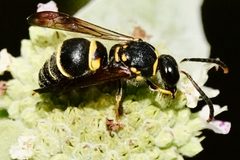
Ancistrocerus campestris is a solitary mason wasp in the Eumeninae. reach approximately 10 mm in length. Females construct nests in pre-existing cavities such as borings in wood, hollow twigs, or abandoned mud dauber nests, partitioning them with mud into individual . The is distinguished by distinctive yellow markings on the and a characteristic pattern on the rear of the . It preys specifically on caterpillars of the Amphisbatidae and Gelechiidae.
Pronunciation
How to pronounce Ancistrocerus campestris: /ænˈsɪstroʊˌsɪərəs kæmˈpɛstrɪs/
These audio files are automatically generated. While they are not always 100% accurate, they are a good starting point.
Identification
Distinguished from other mason wasps by combination of: (1) transverse carina on first abdominal segment (shared with all Ancistrocerus), (2) yellow hind margins on first three abdominal segments, (3) distinctive 'smiley ' pattern on rear of , and (4) entirely black in females (lacking pale markings on scape found in many other mason wasps). Similar A. unifasciatus has more extensive yellow on face and different abdominal banding pattern. A. waldenii has white rather than yellow markings and constructs free-form mud nests on hard surfaces rather than using pre-existing cavities.
Images
Habitat
Woodland edges and forest . Nests specifically in pre-existing cavities: borings in wood, hollowed twigs (including sumac), and abandoned mud dauber nests (particularly those of Sceliphron caementarium, Trypoxylon politum, and occasionally active nests of Trypoxylon clarkei).
Distribution
Eastern North America: southern Ontario, Canada through New England, south to Florida, west to Minnesota, South Dakota, Kansas, and Texas.
Diet
feed on nectar and other sources. Larvae are provisioned with paralyzed caterpillars from Amphisbatidae (leaf-tiers, Psilocorsis) and Gelechiidae (twirler moths).
Host Associations
- Amphisbatidae - preyleaf-tier caterpillars, Psilocorsis
- Gelechiidae - preytwirler moth caterpillars
Life Cycle
Solitary lifecycle. Female constructs nest in pre-existing cavity, partitions into with mud. Lays single suspended by silken thread from cell roof before provisioning. Hunts caterpillars on foliage, paralyzes them with sting, and caches multiple (average unknown, related cache ~9) per cell. Seals cell with mud, constructs additional adjoining cells. Nest contains 2–11 cells. Larva hatches, feeds on cached caterpillars, spins silken cocoon, and pupates. emerges by chewing through mud partition. Multiple per year likely in southern range.
Behavior
Females exhibit specialized hunting : when pursuing leaf-tier caterpillars in shelters between lashed leaves, attempts to entice caterpillar to eject by running back and forth and vibrating ; also chews holes in leaf shelters to gain access. Has been observed attempting to take over active nests of other . Female spends night in incomplete mud .
Ecological Role
of caterpillars, contributing to of Amphisbatidae and Gelechiidae. Provides nest cavities for subsequent users after abandonment. Serves as for including bee fly Toxophora amphitea, eulophid Melittobia chalybii, and wedge-shaped beetle Macrosiagon cruentum.
Similar Taxa
- Ancistrocerus unifasciatusOverlapping range; distinguished by more extensive yellow facial markings in both sexes, different abdominal banding pattern, and preference for leaf-roller caterpillars (Tortricidae) rather than leaf-tiers.
- Ancistrocerus waldeniiSimilar size and build; distinguished by white (not yellow) markings, construction of free-form mud nests attached to hard surfaces rather than use of pre-existing cavities, and more southeastern distribution.
More Details
Nest usurpation
Documented case of female evicting rightful owner from active nest of Trypoxylon clarkei.
Oviposition sequence
Like other Eumeninae, female lays in empty before provisioning with prey, unlike Crabronidae and Sphecidae where egg is laid on cached prey.
Sources and further reading
- BugGuide
- Wikipedia
- GBIF taxonomy match
- iNaturalist taxon
- NCBI Taxonomy
- Catalogue of Life
- Bug Eric: How to (Almost) Catch a Leaf-tier Caterpillar (Video)
- Bug Eric: Wasp Wednesday: Walden's Mason Wasp, Ancistrocerus waldenii
- Bug Eric: How to Catch a Leafroller Caterpillar (Video)
- Bug Eric: Eight Illinois Wasp and Bee Mimics in Twenty Minutes
- Bug Eric: City Nature Challenge 2023 Recap