
Braula coeca
Nitzsch, 1818
bee louse, bee fly, braulid
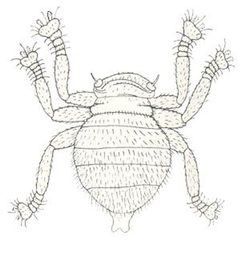
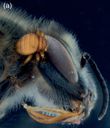
Braula coeca is a tiny, wingless fly in the Braulidae that lives as an or commensalist in colonies of the western honey bee, Apis mellifera. attach to adult bees and feed by stealing food from the 's mouth during . The possesses highly specialized attachment structures adapted to grip the 's hairy surface, with claw featuring comb-like teeth that match bee hair diameter. Host selection is mediated by detection of mandibular gland , particularly and substance, allowing the to target bees with higher trophallactic activity.
Pronunciation
How to pronounce Braula coeca: /ˈbraʊla ˈkɔɪka/
These audio files are automatically generated. While they are not always 100% accurate, they are a good starting point.
Identification
Distinguished from other Braulidae by association with Apis mellifera; Megabraula occur on different Apis species. Wingless condition and minute size separate from other Diptera. Claw with comb-like teeth is diagnostic for the . Specific identification requires examination of association and subtle morphological features.
Images
Appearance
Tiny wingless fly. lack functional wings and , with reduced . equipped with strongly broadened claws split into numerous comb-like teeth that match the diameter of hairs. Lateral stoppers on tarsal segments prevent overflexion. Body size minute relative to .
Habitat
Exclusively within colonies of the western honey bee, Apis mellifera. Found on bees within the hive environment, attached to the hairy surfaces of , queens, and drones.
Distribution
Distribution coincides with that of its Apis mellifera. Present in colonies across the host's range. GBIF records indicate presence in Denmark, Norway, and Sweden.
Diet
Feeds by stealing food from the mouth of bees during ; specifically takes regurgitated nectar, honey, or other food materials from the host's .
Host Associations
- Apis mellifera - /commensalistWestern honey bee; primary and obligate . Attaches to , queens, and drones with varying .
Behavior
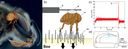
attach to bees using specialized tarsal claws that generate strong friction against hairs, with safety factors around 1130 times body weight. Host selection involves eavesdropping on mandibular gland , showing preference for bees with higher concentrations of (9-oxo-2(E)-decenoic acid) and substance (10-hydroxy-2(E)-decenoic acid). Can rapidly detach by tarsal chain torsion. Remounts preferred hosts after removal.
Ecological Role
or commensalist in colonies. Impact on is generally considered minor, though classified as pest in some contexts.
Human Relevance
Minor pest of managed colonies. Occasionally noted in contexts but rarely requires active management. Presence indicates colony activity but generally not economically significant.
Similar Taxa
More Details
Taxonomic note
Braulidae contains two (Braula and Megabraula) with eight total. Braula coeca is the only species associated with Apis mellifera.
Attachment mechanics
Average safety factor of attachment force to body weight is approximately 1130, among the highest recorded for insect attachment systems. Claw teeth interlock with hairs, generating friction when hairs slip into narrow gaps between spines.
Sources and further reading
- BugGuide
- Wikipedia
- GBIF taxonomy match
- iNaturalist taxon
- NCBI Taxonomy
- Catalogue of Life
- Meloidae Holdings | Entomology Research Museum
- Bug Eric: Spider Sunday: Another Jumper
- Beelouse, Braula coeca Nitzsch (Insecta: Diptera: Braulidae)
- Bee louse, bee fly, braulid, Braula coeca Nitzsch (Insecta: Diptera: Braulidae)
- Distribution of the Bee LouseBraula CoecaNitzsch in Honeybee Colonies and its Preferences Among Workers, Queens and Drones
- A Hitchhiker’s Ride: The Honey Bee Louse Braula Coeca (Diptera: Braulidae) Selects its Host by Eavesdropping
- The exceptional attachment ability of the ectoparasitic bee louse Braula coeca (Diptera, Braulidae) on the honeybee
- The sensory physiology and behaviour of the Honeybee LouseBraula coeca Nitzcsh (Diptera, Braulidae)