
Braulidae
Pascoe, 1877
bee lice, bee louse
Genus Guides
1- Braula(bee lice)
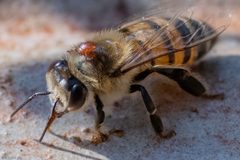
is a of highly modified, wingless flies (Diptera) comprising two —Braula and Megabraula—with approximately seven to eight described . These insects are obligate associates of honey bees (Apis spp.), exhibiting a commensal to kleptoparasitic lifestyle. are minute (1.6–3 mm), reddish-brown, and superficially resemble mites or due to their reduced . They attach to bodies using specialized claw structures and feed by intercepting food during . The family has undergone extensive morphological simplification associated with this specialized relationship.
Pronunciation
How to pronounce Braulidae: //bɹɔːˈlɪdiˌiː//
These audio files are automatically generated. While they are not always 100% accurate, they are a good starting point.
Identification
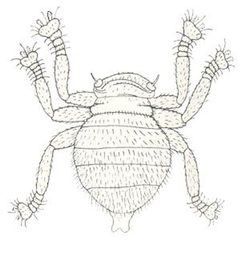
Distinguished from all other Diptera by the combination of complete winglessness (including ), reduced , concealed , and specialized tarsal claws with comb-like teeth. Superficially similar to keds (Hippoboscidae) and but differs in tarsal structure and association. Distinguished from mites by segmented body plan, 5-segmented , and dipteran . Megabraula distinguished from Braula by larger size (3 mm vs. 1.6 mm) and association with Apis laboriosa rather than Apis mellifera.
Images
Appearance
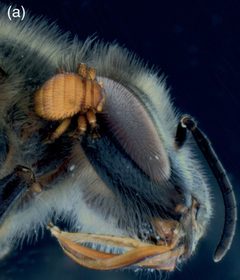
Minute, wingless flies with extreme morphological reduction. Body reddish-brown, dorsoventrally flattened. of Braula approximately 1.6 mm; Megabraula approximately 3 mm. reduced to small structures located just above . Antennae concealed in grooves. short, approximately half length of . Wings and entirely absent. Legs short and robust, with 5-segmented . Tarsal claws strongly broadened, split into numerous comb-like teeth adapted for gripping setae. Scutellum absent from . Overall appearance convergent with parasitic lice or mites.
Habitat
Exclusively associated with colonies of honey bees (Apis spp.). occur on bodies, particularly queens, within hive cavities. Larvae develop in tunnels excavated in wax comb and cappings. Occasionally found on flowers near hives, where adults await contact.
Distribution
in distribution, present wherever honey bees are established. Native range encompasses Africa, Europe, and Asia. Introduced to North America, South America, and Australia, likely via commercial importation. Distribution closely tracks that of managed and colonies.
Seasonality
Present year-round within active colonies. Activity and tied to colony and rearing cycles.
Diet
feed on mouth secretions, including honey and , obtained through kleptoparasitism during . Larvae feed on wax and pollen within comb tunnels.
Host Associations
- Apis mellifera - primary most commonly associated with western honey bee; attach to and preferentially to queens
- Apis laboriosa - for Megabraula in Nepal
- Apis mellifera scutellata - African honey bee associated with Braula coeca
Life Cycle
laid on wax cappings. Larvae tunnel through wax comb, feeding on wax and pollen. occurs within excavated tunnels. emerge from using to burst circular exit. Total development from oviposition to adult approximately 21 days. Adults immediately seek bees, with strong preference for bees.
Behavior
are agile and nimble, moving rapidly across bodies. Exhibit strong fidelity, remounting original host bees when removed. Use mandibular gland (particularly 9-oxo-2(E)-decenoic acid, the ) as to select hosts with high trophallactic status. Adults cluster on bees, with up to 30 individuals reported on a single queen, compared to one or two on . Attachment to host mediated by specialized tarsal claws that generate friction against bee setae, achieving safety factors exceeding 1000× body weight. Host (leg shaking, wing rubbing) are ineffective at dislodging adults.
Ecological Role
Commensal to mildly parasitic associate of honey bees. May cause restlessness and minor energy expenditure through attempts. No demonstrated role in transmission or significant colony impact under normal conditions.
Human Relevance
Minor pest of managed colonies. Presence may indicate colony stress or handling. No direct economic impact; considered nuisance rather than threat. Historical taxonomic confusion due to unusual complicated early understanding of dipteran evolution.
Similar Taxa
- Hippoboscidae (keds)Similar wingless, flattened body form and ectoparasitic lifestyle, but keds retain , have different tarsal structure, and parasitize mammals or birds rather than bees
- Acari (mites)Superficially similar minute size and association with bees, but mites have unsegmented bodies, different leg structure, and include true such as Varroa destructor
- PhoridaeHistorical taxonomic confusion; phorids are small flies with humpbacked appearance and different wing venation when winged forms present
Misconceptions
Despite 'bee lice,' are true flies (Diptera), not (). Early taxonomic placement was uncertain due to extreme morphological reduction; variously thought to be pupiparous, related to Phoridae, or incertae sedis before definitive placement in . Not true in the strict sense, as they do not consume tissue or cause significant harm, but rather kleptoparasites or commensals.
More Details
Attachment biomechanics
Tarsal claws of Braula coeca are among the most specialized attachment structures in insects, with comb-like teeth perfectly matching the diameter of setae. High-speed video analysis and force measurements demonstrate exceptional friction-based attachment with safety factors averaging 1130.
Host race specificity
Some show race specificity: B. kohli and B. pretoriensis restricted to Carniolan and Middle Eastern races; B. schmitzi associated with Italian race; B. coeca most widespread and .
Phylogenetic placement
position historically unstable. Currently placed in superfamily Ephydroidea as sister group to Drosophilidae based on molecular (Wiegmann et al., 2011), though earlier hypotheses included placement near Sphaeroceridae or exclusion from standard classifications.
Sources and further reading
- BugGuide
- Wikipedia
- GBIF taxonomy match
- iNaturalist taxon
- NCBI Taxonomy
- Catalogue of Life
- Beelouse, Braula coeca Nitzsch (Insecta: Diptera: Braulidae)
- Families Braulidae and Streblidae (Insecta: Diptera) as ectoparasites of mammals
- Bee louse, bee fly, braulid, Braula coeca Nitzsch (Insecta: Diptera: Braulidae)
- The sensory physiology and behaviour of the Honeybee LouseBraula coeca Nitzcsh (Diptera, Braulidae)
- A Hitchhiker’s Ride: The Honey Bee Louse Braula Coeca (Diptera: Braulidae) Selects its Host by Eavesdropping
- Megabraula, a new genus for two new species of Braulidae (Diptera), and a discussion of braulid evolution
- The exceptional attachment ability of the ectoparasitic bee louse Braula coeca (Diptera, Braulidae) on the honeybee