
Ancistrocerus waldenii
(Viereck, 1906)
Walden's Mason Wasp, Walden's Potter Wasp
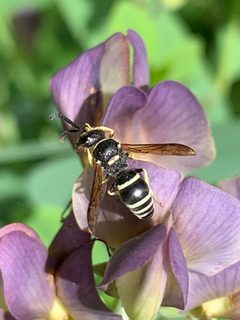
Ancistrocerus waldenii is a solitary mason wasp in the Eumeninae, known for constructing distinctive free-form mud nests attached to hard surfaces such as rocks, concrete, or flower pots. The is distinguished by white or rarely yellow abdominal markings and entirely black in females. It provisions its nests with paralyzed caterpillars, which serve as food for its developing larvae. The is found in eastern North America and is most active during the warmer months.
Pronunciation
How to pronounce Ancistrocerus waldenii: //ænˈsɪstroʊˌsɪrəs ˈwɔːldəniː//
These audio files are automatically generated. While they are not always 100% accurate, they are a good starting point.
Identification
Females have a prominent transverse carina (ridge) on the base of the first abdominal segment (T1), a diagnostic feature of the Ancistrocerus. A. waldenii specifically has white markings (less often yellow): a spot on the top of the sixth abdominal segment (T6) and complete bands on abdominal segments one through five (T1–T5). The female has entirely black , unlike many mason wasps which have yellow or white markings on the antennal scape. Males have hooked tips on their antennae. The constructs free-form mud nests attached to hard surfaces, which helps distinguish it from cavity-nesting .
Images
Habitat
Occurs in gardens, suburban areas, and woodland edges where suitable nesting substrates (rocks, concrete, terra cotta pots) and caterpillar prey are available.
Distribution
Eastern North America; records from Vermont and surrounding regions in the United States.
Diet
feed on flower nectar and other sources. Females hunt caterpillars (Lepidoptera larvae) to provision nests; an average of nine paralyzed caterpillars is placed per .
Life Cycle
Females construct free-form mud nests attached to hard surfaces, building cylindrical mud in layers. The lays a single suspended from the cell roof by a silken thread before provisioning the cell with paralyzed caterpillars. After filling the cell with prey, she seals it with mud and may construct adjoining cells. The egg hatches in a few days; the larva drops onto the caterpillars and feeds. The paralyzed prey remains alive for several days, providing fresh food. The mature larva spins a silken cocoon and pupates. emerge after completing development. Females have been observed spending nights in incomplete mud cylinders.
Behavior
Females exhibit specialized mud-collection : they imbibe water and store it in the crop, then gather soil particles to form a moistened mud bolus carried in the back to the nest. When hunting, they capture caterpillars on foliage, sting them to cause paralysis, and transport them beneath the body to the nest. The shows substrate specificity for nest construction, preferring hard surfaces with concave features that assist in forming walls.
Ecological Role
of caterpillars, contributing to natural control of herbivorous Lepidoptera. As a solitary , it serves as prey for nest including bee flies (Toxophora amphitea) and eulophid wasps (Melittobia chalybii).
Human Relevance
Generally beneficial in gardens due to caterpillar . Non-aggressive; stings are rare and occur only if the is handled. Nest construction on human-made structures (flower pots, concrete) may bring it into close proximity with people.
Similar Taxa
- Ancistrocerus unifasciatusSimilar size and coloration, but A. unifasciatus has fewer yellow markings (one band on ) and typically nests in abandoned mud dauber nests rather than constructing free-form mud nests on hard surfaces.
- Ancistrocerus campestrisOverlapping range and similar -level features, but A. campestris has yellow hind margins on the first three abdominal segments and nests in pre-existing cavities ( borings, hollow twigs, abandoned mud dauber nests) rather than free-form mud nests.
- Other Ancistrocerus speciesMany have yellow or white markings on the antennal scape, which A. waldenii lacks; nest architecture (free-form mud cylinders on hard surfaces) is distinctive for A. waldenii among many Ancistrocerus .
Sources and further reading
- BugGuide
- GBIF taxonomy match
- iNaturalist taxon
- NCBI Taxonomy
- Catalogue of Life
- Bug Eric: Wasp Wednesday: Walden's Mason Wasp, Ancistrocerus waldenii
- Bug Eric: How to (Almost) Catch a Leaf-tier Caterpillar (Video)
- Bug Eric: How to Catch a Leafroller Caterpillar (Video)
- Bug Eric: Eight Illinois Wasp and Bee Mimics in Twenty Minutes
- Bug Eric: City Nature Challenge 2023 Recap