
Ancistrocerus unifasciatus
(de Saussure, 1853)
One-banded Mason Wasp
Species Guides
2Ancistrocerus unifasciatus is a solitary mason wasp in the Vespidae, Eumeninae. Females construct nests in pre-existing cavities such as abandoned mud dauber nests, borings in wood, or hollow twigs. The hunts leafroller caterpillars (family Tortricidae), using a distinctive behavioral strategy to extract prey from silk-bound leaf rolls. It occurs throughout the eastern United States west to Iowa, Kansas, and Texas, plus southern Ontario, Quebec, and Prince Edward Island in Canada.
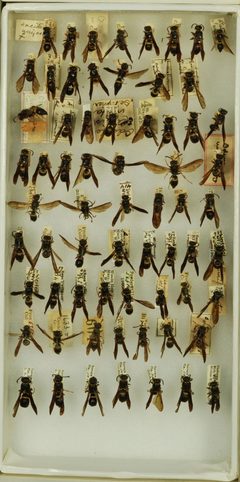
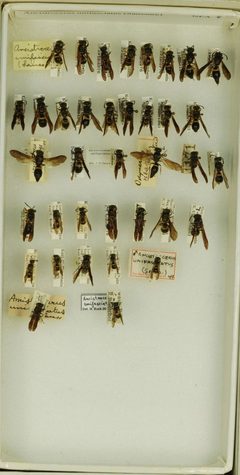
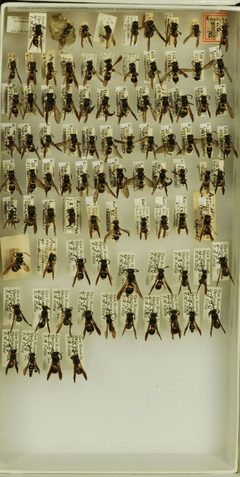
Pronunciation
How to pronounce Ancistrocerus unifasciatus: /ænˌsɪstɹoʊˈsɛɹəs ˌjuːnɪˌfæsiˈeɪtəs/
These audio files are automatically generated. While they are not always 100% accurate, they are a good starting point.
Identification
The Ancistrocerus is identified by a prominent transverse ridge on the base of the first abdominal segment, creating an abrupt angle. A. unifasciatus is distinguished from by its sparse yellow markings and single pale abdominal band. Males are readily identified by hooked tips, a characteristic of male eumenine . The may be confused with A. campestris, which has yellow hind margins on the first three abdominal segments rather than a single band.
Images
Habitat
Suburban and rural areas with mixed hardwood and conifer forest edges. Nests in pre-existing cavities including abandoned mud dauber nests (especially Sceliphron caementarium and Trypoxylon politum), borings in wood, and hollow twigs. Foraging occurs on vegetation where leafroller caterpillars feed, including goldenrod.
Distribution
Eastern United States west to Iowa, Kansas, and Texas; southern Ontario and Quebec, Canada; Prince Edward Island.
Diet
feed on flower nectar, honeydew, and fermenting tree sap. Larvae are provisioned with paralyzed leafroller caterpillars (Tortricidae), possibly including Archips purpurana.
Host Associations
- Archips purpurana - preyPossible prey ; known to feed on goldenrod among other plants
- Sceliphron caementarium - nest usurpationFrequently occupies abandoned mud dauber nests
- Trypoxylon politum - nest usurpationFrequently occupies abandoned mud dauber nests
Life Cycle
Females lay single suspended from roof by silken thread before provisioning. Cell is then stocked with multiple paralyzed caterpillars (average number not specified for this ). Larva hatches, drops onto prey cache, and feeds. Mature larva spins silken cocoon and pupates. emerges weeks later by chewing through mud wall. Multiple cells may be constructed in series within a single cavity, separated by mud partitions.
Behavior
Females hunt by exploiting leafroller caterpillar escape : running to one end of a leaf roll, then back while vibrating to entice caterpillar to eject itself from silk-bound shelter. Captured caterpillars are stung into paralysis and carried beneath the body to the nest. Females spend nights in incomplete nest .
Ecological Role
of leafroller caterpillars; contributes to of tortricid moths. Nesting in abandoned cavities may reduce competition for nest sites with primary cavity-nesting .
Similar Taxa
- Ancistrocerus campestrisSimilar size and ; distinguished by yellow hind margins on first three abdominal segments versus single band, and different prey preferences (leaf-tiers in Amphisbatidae and Gelechiidae)
- Ancistrocerus waldeniiBoth in Ancistrocerus with transverse carina; A. waldenii constructs free-form mud nests attached to hard surfaces rather than using pre-existing cavities, and has white markings on T1-T5 plus T6 spot in females
More Details
Nesting behavior
Unlike A. waldenii which builds free-form mud nests, A. unifasciatus relies entirely on pre-existing cavities, particularly abandoned mud dauber nests. This represents distinct nesting strategies within the same .
Hunting strategy documentation
The specific hunting exploiting caterpillar escape responses was documented in Athol, Massachusetts in June 2015, representing one of the few detailed field observations of this ' foraging .
Sources and further reading
- BugGuide
- GBIF taxonomy match
- iNaturalist taxon
- NCBI Taxonomy
- Catalogue of Life
- Bug Eric: How to Catch a Leafroller Caterpillar (Video)
- Bug Eric: How to (Almost) Catch a Leaf-tier Caterpillar (Video)
- Bug Eric: Wasp Wednesday: Walden's Mason Wasp, Ancistrocerus waldenii
- Bug Eric: Eight Illinois Wasp and Bee Mimics in Twenty Minutes
- Bug Eric: City Nature Challenge 2023 Recap