
Sphex ashmeadi
(Fernald, 1906)
thread-waisted wasp
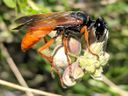
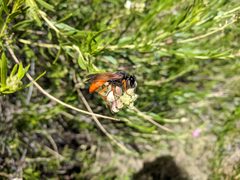
Sphex ashmeadi is a of thread-waisted wasp in the Sphecidae. It has been observed in New Mexico, USA, where it visits milkweed flowers. The species is part of the diverse Sphex , which includes solitary that excavate burrows and provision them with paralyzed prey for their larvae.
Pronunciation
How to pronounce Sphex ashmeadi: /ˈsfɛks æʃˈmiːdiː/
These audio files are automatically generated. While they are not always 100% accurate, they are a good starting point.
Identification
As a member of the Sphex, this likely exhibits the characteristic thread-waisted with a narrow petiole connecting the and . Within Sphex, species are distinguished by coloration patterns, body proportions, and wing characteristics. S. ashmeadi has been specifically noted among other Sphecidae at milkweed patches, suggesting it may be distinguished from similar genera like Prionyx (which have silvery facial patches) by its overall coloration and abdominal shape.
Images
Habitat
Distribution
North America (documented in New Mexico, USA); Middle America. GBIF records indicate presence in both Middle America and North America.
Diet
Behavior
Observed visiting flowers for nectar. Based on characteristics, females likely excavate burrows in soil, paralyze prey with venom, and store multiple prey items per for larval development. Males may perch on vegetation to seek mates.
Ecological Role
As a when foraging on flowers. As a , likely helps regulate of orthopteran prey. The Sphex contributes to nutrient cycling through burrowing activities.
Similar Taxa
- Sphex ichneumoneusGreat Golden Digger wasp is larger (15-27 mm), has distinctive golden and bi-colored , and is more widely distributed across North America; S. ashmeadi lacks the golden coloration
- Sphex lucaeFemales are black with red and yellowish or violaceous wings; males are entirely black with violaceous wings; S. lucae shows strong and has more oval abdomen in females
- Prionyx speciesPrionyx have silvery patches on the and that Sphex lack; they also have different abdominal proportions
More Details
Sources and further reading
- BugGuide
- Wikipedia
- GBIF taxonomy match
- iNaturalist taxon
- NCBI Taxonomy
- Catalogue of Life
- Bug Eric: Bosque del Apache National Wildlife Refuge
- Bug Eric: January 2016
- Bug Eric: Wasp Wednesday: Sphex lucae
- Bug Eric: Wasp Wednesday: Great Golden Digger
- Bug Eric: Grape is Blooming
- Bug Eric: Wasp Wednesday: Neorileya