
Caliadurgus fasciatellus
(Spinola, 1808)
Blotchwing Spider Wasp
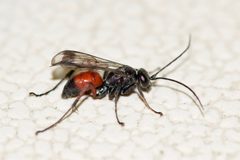
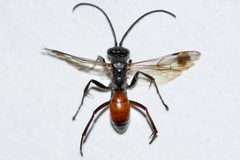
Caliadurgus fasciatellus is a small spider wasp in the Pompilidae, Pepsinae. It ranges from Western Europe to the Far East of Asia. The hunts orb-weaving spiders, paralyzes them, and provisions underground burrows for its larval offspring. It was historically confused with Priocnemis hyalinata due to taxonomic errors regarding type species designations.

Pronunciation
How to pronounce Caliadurgus fasciatellus: /ˌka.li.ə.ˈdɜːɡəs ˌfæ.si.ə.ˈtɛl.əs/
These audio files are automatically generated. While they are not always 100% accurate, they are a good starting point.
Identification
Distinguished from similar spider wasps by the combination of small size (6–10 mm), brownish-red coloration on the first two abdominal segments, and white leg spurs. The dark spot on the forewing and toothed hind tibia are diagnostic in females. Not easily confused with other North American spider wasps where it occurs. Distinguished from Priocnemis hyalinata (formerly conflated under the same name) by stable taxonomic separation based on designation.
Images
Appearance
Small measuring 6–10 mm in length. The first and second abdominal segments are brownish-red. White spurs present on the middle and hind legs. Females have clear wings with a dark spot on each forewing. Hind tibia bears a noticeable row of teeth along the upper edge. and hind legs are bicolored.
Habitat
Occupies exposed dry sandy or sandy clay soils. Requires suitable substrate for excavation of short vertical burrows. Associated with open, well-drained ground conditions.
Distribution
Palearctic distribution spanning Western Europe to the Far East of Asia. In Europe: Great Britain (primarily south and east), eastward through Russia and Finland, south to Spain and the Balkans. Also recorded in Belgium. North American records under the synonym C. hyalinatus include eastern United States and adjacent Canada, west to Washington state, the Dakotas, and Kansas, south to Georgia and Louisiana, with sparse records in Texas, New Mexico, and Arizona.
Seasonality
period in Britain spans June to October, with peak activity in July and August.
Diet
feeding habits unknown; nectar sources unrecorded. Larvae provisioned with paralyzed orb-weaving spiders (Araneidae), specifically Araneus and Meta in Europe, and additionally Acanthepeira, Larinoides, Eustala, and Neoscona in North America. Prey are consistently spiders, likely due to size constraints of the small .
Host Associations
- Araneus - preyOrb-weaving spiders hunted as larval provisions
- Meta - preyOrb-weaving spiders hunted as larval provisions
- Acanthepeira stellata - preyStarbellied Orb Weaver, North America
- Larinoides patagiatus - preyFurrow spider, North America
- Eustala anastera - preyHumpbacked Orb Weaver, North America
- Araneus marmoreus - preyMarbled Orb Weaver, North America
- Neoscona - preyOrb-weaving spider , North America
Life Cycle
Females hunt and paralyze orb-weaving spiders using venom. Prey is grasped at the base of a leg and carried in front of the during transport; the wasp may climb vertical objects to glide with the prey. Spiders are temporarily stashed in vegetation while the female excavates a burrow. Burrows are short (approximately 4 cm), vertical or diagonal tunnels in sandy substrate, terminating in a about 4 cm below the surface. Excavation takes approximately 30 minutes. The paralyzed spider is placed side up in the cell, a single is attached, and the entrance is filled. Multiple cells are constructed sequentially.
Behavior
Hunting involves active searching for orb-weaving spiders in their webs. Prey capture requires stinging the spider into paralysis. Transport behavior includes carrying the spider in front of the body and using elevated launch points to glide when carrying heavy prey. Burrow construction is rapid and efficient in suitable sandy soils. Prey is oriented vertically in the , suggesting specific provisioning behavior to facilitate larval development.
Ecological Role
Human Relevance
No documented negative impacts. Potential minor benefit as of orb-weaving spiders. Subject of historical entomological study, notably by Jean Henri Fabre in Europe and Howard E. Evans in North America.
Similar Taxa
- Priocnemis hyalinataFormerly confused with C. fasciatellus due to taxonomic error where Pate selected Sphex hyalinata as type of Caliadurgus while Kohl had selected Pompilus fasciatellus as type of the original Calicurgus; later research confirmed these are distinct species
- Other PompilidaeDistinguished by small size, specific wing markings, and leg spur characteristics; not easily confused with other in regions where well-studied
Misconceptions
The was long conflated with Priocnemis hyalinata under the name Caliadurgus hyalinatus or Calicurgus hyalinatus due to mistaken assumption that fasciatellus and hyalinata represented the same . This was resolved when researchers confirmed these are separate species with different type designations.
More Details
Taxonomic history
The name Caliadurgus was established by Pate in 1946 as a replacement for the preoccupied Calicurgus (Lepeletier, 1845). A critical error occurred when Pate selected Sphex hyalinata as type rather than Pompilus fasciatellus, which Kohl had designated as type of Lepeletier's original genus. This led to decades of confusion until the two species were recognized as distinct.
Nesting biology
Nesting has been documented in detail by Howard E. Evans and Frank E. Kurczewski in North America, building on Fabre's earlier European observations. The 's small size restricts it to spider prey, which may influence its seasonal timing to coincide with spider recruitment.