
Eustala anastera
(Walckenaer, 1841)
Humpbacked Orbweaver
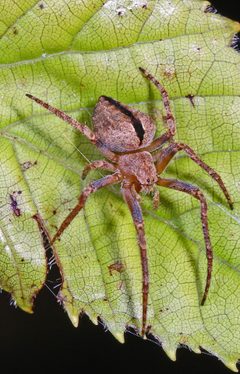
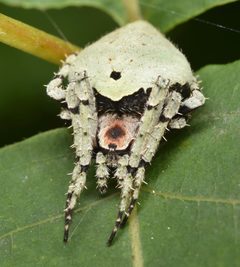
Eustala anastera, commonly known as the humpbacked orbweaver, is a small orb-weaving spider in the Araneidae. Females reach approximately 10 mm in body length, males 9.5 mm. The exhibits highly variable coloration, ranging from tan to vivid green, with many individuals displaying a foliate pattern. It is found across North and Central America and has been documented as a for the spider wasp Caliadurgus hyalinatus. Juveniles have been observed active during winter months in temperate regions.
Pronunciation
How to pronounce Eustala anastera: //juːˈstɑːlə əˈnæstərə//
These audio files are automatically generated. While they are not always 100% accurate, they are a good starting point.
Identification
Distinguished from other small orb-weavers by combination of: highly variable green to tan coloration with foliate abdominal pattern; compact body with subtle humped profile; short spines on legs (especially males); small size under 10 mm. Similar to other Eustala but specific identification requires examination of genitalia. Distinguished from larger orb-weavers in same (Araneus, Neoscona) by smaller size and less robust build.
Images
Appearance
Small orb-weaver with pronounced in size. Females: ~10 mm body length; males: ~9.5 mm. Prosoma () coloration highly variable, usually matching opisthosoma (). Color ranges from tan tones to vivid green. Many individuals possess a dark line. Abdominal pattern often foliate (leaf-like). Legs covered in short spines, more prominent in males. Overall body form compact with characteristic 'humped' profile suggested by .
Habitat
orb-weaver found in varied terrestrial . Constructs webs in vegetation including trees, shrubs, and herbaceous plants. Documented from forest edges, open woodlands, and residential areas. In temperate regions, juveniles overwinter and become active on warm winter days. Not associated with specific plants or specialized microhabitats.
Distribution
North America and Central America. Records from United States (including Kansas, Ohio, New Jersey), Canada, and Middle America. GBIF distribution includes Brazil (Mato Grosso).
Seasonality
and juveniles active across multiple seasons. In temperate North America, juveniles observed active during winter on unseasonably warm days. Adults present during warmer months; specific peak activity periods not documented.
Host Associations
- Caliadurgus hyalinatus - preySpider wasp that paralyzes E. anastera to provision nests for larvae
Behavior
Constructs orb webs typical of Araneidae. Juveniles observed active on warm winter days in temperate regions, suggesting in stages. No other specific documented.
Ecological Role
of flying insects captured in orb webs. Serves as prey for spider wasps, particularly stages. Contributes to in varied terrestrial .
Human Relevance
Occasionally observed in residential areas and yards. No documented economic or medical significance. Subject of casual observation by naturalists and citizen scientists.
Similar Taxa
- Other Eustala speciesSimilar size range, color variation, and orb-weaving habit; require genital examination for definitive separation
- Araneus spp.Larger, more robust build; typically more distinct abdominal patterns and larger size
- Neoscona spp.Larger size, different abdominal shape, more web-building