
Mesostenus thoracicus
Cresson, 1864
Mesostenus thoracicus is a of ichneumon in the Ichneumonidae. The Mesostenus comprises approximately ten species in North America north of Mexico, with bold black, white, and red coloration typical of the group. Members of this genus are that target caterpillars, particularly those in the families Pyralidae, Crambidae, and Tortricidae. Females possess a long, tail-like ovipositor used to deposit in insects, while males lack this structure.
Pronunciation
How to pronounce Mesostenus thoracicus: /mɛˈsɒstɛnəs θoʊˈræsɪkəs/
These audio files are automatically generated. While they are not always 100% accurate, they are a good starting point.
Identification
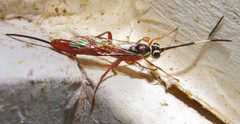
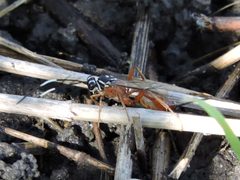
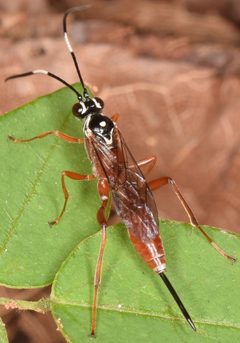
Females can be distinguished from males by the presence of a long, tail-like ovipositor. The is boldly marked in black, white, and red. Body length ranges approximately 6-13 mm. The ovipositor is often mistaken for a stinger by observers, but is non-venomous and used solely for -laying.
Images
Distribution
North America. Specific distribution records include Edmonton and Aweme in Canada.
Host Associations
- Caterpillars of Pyralidae - Includes stem-boring and shoot-boring caterpillars such as Acrobasis spp.
- Plodia interpunctella - Indianmeal Moth, a stored product pest
- Euzophera semifuneralis - American Plum Borer; caterpillars feed beneath bark
- Homoeosoma electella - Sunflower Moth caterpillar
- Crambidae - of caterpillars
- Tortricidae - of caterpillars
Behavior
have been observed visiting sunflowers (Helianthus spp.) to feed on extrafloral nectar. They persistently return to nectar sources despite interference from ants that also seek the sweet secretions.
Ecological Role
Mesostenus function as agents, parasitizing caterpillars of several . They help regulate of agricultural and stored product pests including the Indianmeal Moth and sunflower pests.
Human Relevance
Has potential value in of stored product pests and agricultural pests. The long ovipositor of females is frequently mistaken for a dangerous stinger, causing unnecessary alarm.
Similar Taxa
- Other Mesostenus speciesTen occur in North America north of Mexico; identification to species level requires expert examination. M. sicarius is closely associated with Opuntia cacti.
- Other ichneumon wasps with long ovipositorsMany in Ichneumonidae have females with prominent ovipositors; Mesostenus is distinguished by its bold black, white, and red coloration and small size (6-13 mm).
Misconceptions
The female's long ovipositor is commonly mistaken for a stinger, leading to fear of these harmless . The ovipositor is not venomous and cannot sting humans.
More Details
Taxonomic note
Described by Cresson in 1864. The Mesostenus is nearly worldwide in distribution.
Research opportunity
associations are known for only a few Mesostenus ; rearing caterpillars may yield new host records for M. thoracicus specifically.
Sources and further reading
- BugGuide
- Wikipedia
- GBIF taxonomy match
- iNaturalist taxon
- NCBI Taxonomy
- Catalogue of Life
- Bug Eric: Wasp Wednesday: Mesostenus
- Retrachydes thoracicus – times four! | Beetles In The Bush
- Boisterous bee-havior of ground nesting bees, Colletes thoracicus — Bug of the Week
- Spring sunshine heralds the appearance of plasterer bees: Colletes — Bug of the Week
- Spring arrives and with it, delightful Plasterer bees: Colletes spp. — Bug of the Week
- Bug of the Week