
Homoeosoma
Curtis, 1833
sunflower moth
Species Guides
10- Homoeosoma albescentella
- Homoeosoma ardaloniphas
- Homoeosoma asylonnastes
- Homoeosoma deceptorium(Black-banded Homoeosoma Moth)
- Homoeosoma electellum(American sunflower moth)
- Homoeosoma illuviella
- Homoeosoma impressalis
- Homoeosoma parvalbum
- Homoeosoma striatellum
Homoeosoma is a of pyralid moths ( Pyralidae, Phycitinae) containing multiple associated with plants in the Asteraceae family. The genus includes significant agricultural pests, particularly of sunflower (Helianthus annuus), as well as species feeding on weedy composites such as ragwort (Senecio jacobaea) and thistles. Several species have been studied extensively for their plant relationships, chemical , and potential for of weeds.
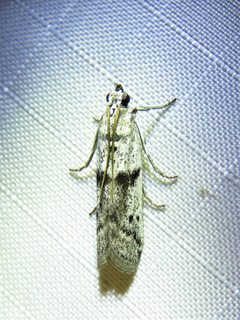
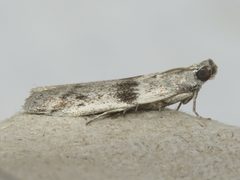
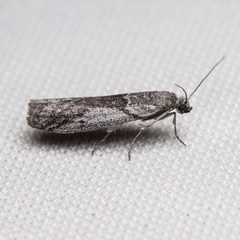
Pronunciation
How to pronounce Homoeosoma: /həˌmiː.oʊˈsoʊ.mə/
These audio files are automatically generated. While they are not always 100% accurate, they are a good starting point.
Identification
of H. electellum identified by small size (approximately ½ inch), slender silver-to-buff-gray body, and characteristic resting on sunflower during blooming period, especially early morning and evening. Distinguished from banded sunflower moth (Cochylis hospes, Tortricidae) by lack of brown triangular forewing marking and larger size. Distinguished from sunflower bud moth (Suleima helianthana, Tortricidae) by lack of two dark wing bands. Larvae of H. electellum identified by yellow color when young, maturing to brown with four longitudinal stripes, and presence on sunflower heads with visible webbing and . H. nebulellum (European sunflower ) requires trapping or dissection for reliable separation from .
Images
Habitat
Agricultural fields of sunflower (Helianthus annuus) and related cultivated composites; native and weedy stands of Asteraceae including ragwort (Senecio jacobaea), thistles, and cockleburs. H. electellum is specifically associated with cultivated sunflower in North America. H. nebulellum occurs in sunflower fields in Europe and western Asia. H. farinaria occurs on ragwort in Tasmania. H. oconequensis has been recorded on Senecio inaequidens and Sonchus oleraceus in Colombia.
Distribution
has worldwide distribution. H. electellum: North America, particularly Texas, Nebraska, California, Canadian Prairie Provinces (Manitoba, Saskatchewan); does not overwinter in Canada, arrives via or wind from southern . H. nebulellum: Europe, Turkey (Ankara Province), western Asia. H. farinaria: Tasmania, Australia. H. oconequensis: Colombia (Sabana de Bogotá). GBIF records indicate presence in Denmark, Norway, Sweden, Vermont (USA), and USA generally.
Seasonality
H. electellum in Texas: heaviest when early-planted fields bloom during May-June; smaller secondary possible later in season, especially in High Plains. active from onset of sunflower bloom (late R4 growth stage). H. farinaria in Tasmania: with adults active late November through summer (first ), and mid-February through March (second generation); overwinters as quiescent larva. H. nebulellum: adult flight periods monitored with traps to determine critical management windows.
Diet
Larvae feed on developing seeds and floral tissues of Asteraceae. H. electellum: newly hatched larvae feed on pollen and floral parts on flower surface; older larvae tunnel into seeds and tissue, with single larva destroying up to 12 seeds during 15-19 day development. H. nebulellum: larvae feed on newly formed sunflower seeds causing yield loss. H. farinaria: feeds internally on stems and tissues of Senecio jacobaea. H. oconequensis: feeds on seeds of Senecio inaequidens and Sonchus oleraceus, preventing head ripening.
Host Associations
- Helianthus annuus - primary cultivated sunflower, main for H. electellum and H. nebulellum
- Senecio jacobaea - ragwort, for H. farinaria in Tasmania
- Senecio inaequidens - for H. oconequensis in Colombia
- Sonchus oleraceus - cerraja, for H. oconequensis in Colombia
- Helianthus deserticola - wild sunflower , pre-breeding lines tested for resistance
- Helianthus paradoxus - wild sunflower , pre-breeding lines tested for resistance
- Helianthus praecox - wild sunflower , pre-breeding lines tested for resistance
- Helianthus petiolaris - wild sunflower , pre-breeding lines tested for resistance
- Helianthus resinosus - wild sunflower , pre-breeding lines tested for resistance
- Helianthus tuberosus - Jerusalem artichoke, pre-breeding lines showed consistent low preference-performance
Life Cycle
H. electellum: hatch in 24-72 hours. Larval development 15-19 days. Mature larvae descend plant to ground, spin silk cocoons, and overwinter before pupating in spring. Single per year in northern regions; possible partial second generation in southern areas. H. farinaria: with continuous development; overwinters as quiescent larva until spring warming. First generation late November, larvae complete development in summer; second generation adults mid-February to March. H. oconequensis: Life cycle completed in approximately 62 days under laboratory conditions. H. electellum does not overwinter in Canadian Prairie Provinces; re-established annually by immigration.
Behavior
H. electellum and H. nebulellum exhibit activity patterns with peak movement and oviposition during scotophase (dark period). H. nebulellum females show negative geotaxis in oviposition site selection, preferring upper half of sunflower . H. electellum females attracted to plants beginning bloom; approximately 80% of laid within 4-7 days after buds begin opening. H. electellum females initiate calling ( release for mating) at younger age and spend more time calling when exposed to plant pollen or pollen . H. nebulellum shows low tendency with females remaining near release point. H. electellum adults most often observed resting on sunflower heads during blooming period, especially early morning and early evening.
Ecological Role
Herbivore and seed of Asteraceae. H. electellum and H. nebulellum are major agricultural pests reducing sunflower yield and seed quality; larval feeding predisposes sunflower to Rhizopus head rot, compounding yield losses. H. farinaria and H. oconequensis have been investigated for potential against weedy composites (ragwort, fireweed). H. oconequensis parasitized by tachinid fly in Colombia, reducing field control potential. H. farinaria four hymenopterous in Tasmania (braconid Apantales sp. predominant). H. electellum hosts Dolichogenidea homoeosomae (Braconidae).
Human Relevance
Major economic pest of cultivated sunflower, particularly H. electellum in North America and H. nebulellum in Europe and Asia. Yield losses from direct seed feeding and secondary fungal (Rhizopus rot) can reach 50%. Management requires careful timing of applications during narrow bloom window (15-25% bloom stage). trapping used for monitoring and timing control decisions. breeding programs have identified wild Helianthus germplasm (particularly H. tuberosus derivatives) with reduced preference and performance. Potential for of weeds using H. farinaria and H. oconequensis investigated but limited by and low rates.
Similar Taxa
- Cochylis hospes (banded sunflower moth)Also feeds on sunflower ; distinguished by smaller size (¼ inch), straw coloration with brown triangular forewing marking, and Tortricidae affiliation; larvae change color through instars (off-white to pink to red to purple to green) unlike H. electellum
- Suleima helianthana (sunflower bud moth)Also associated with sunflower; distinguished by gray-brown coloration with two dark wing bands, Tortricidae affiliation, and larval feeding in buds and stalks rather than primarily in seeds
- Suleima baracanaTortricid with caterpillars boring in sunflower stems; distinguished by different and larval ; resembles bird droppings
More Details
Chemical Ecology
H. electellum females respond to in sunflower pollen, with antennal sensillae detecting oviposition stimulants. Ethanol pollen extracts elicit equivalent oviposition responses to intact pollen. plant pollen influences calling and ovarian development, with females exposed to pollen initiating earlier and at higher rates.
Domestication Effects
H. electellum shows incongruent behavioral responses to wild versus domesticated sunflowers compared to its Dolichogenidea homoeosomae, potentially disrupting efficacy in agricultural systems.
Morphological Studies
on cephalic appendages, , and ovipositor of H. nebulella has been characterized, showing specialized structures associated with plant detection and oviposition site selection.
Sources and further reading
- BugGuide
- Wikipedia
- GBIF taxonomy match
- iNaturalist taxon
- NCBI Taxonomy
- Catalogue of Life
- Managing Insect Pests of Texas Sunflowers - AgriLife Extension Entomology
- Bug Eric: Wasp Wednesday: Mesostenus
- Bug Eric: More Insects From Sunflowers
- Oviposition Behavior and Locomotor Activity of Homoeosoma nebulellum (Lepidoptera: Pyralidae) Under Laboratory Conditions
- Host plant pollen influences calling behavior and ovarian development of the sunflower moth, Homoeosoma electellum
- Distribution, Density and Swarming Periods of Homoeosoma nebulellum (Den. & Schiff.) Harmfull on Sunflower in Ankara Province
- Confused by domestication: incongruent behavioral responses of the sunflower moth, Homoeosoma electellum (Lepidoptera: Pyralidae) and its parasitoid, Dolichogenidea homoeosomae (Hymenoptera: Braconidae), towards wild and domesticated sunflowers
- The role of chemical cues in host-plant selection by adult female Homoeosoma electellum (Hulst) (Lepidoptera: Pyralidae) and Cochylis hospes Walsingham (Lepidoptera: Tortricidae)
- Abundance of a Native MothHomoeosoma electellum(Lepidoptera: Pyralidae) and Activity of Indigenous Parasitoids in Native and Agricultural Sunflower Habitats
- THE OCCURRENCE, LIFE HISTORY, COURTSHIP, AND MATING BEHAVIOUR OF THE SUNFLOWER MOTH, HOMOEOSOMA ELECTELLUM (LEPIDOPTERA: PHYCITIDAE), IN THE CANADIAN PRAIRIE PROVINCES
- Female preference and larval performance of sunflower moth, Homoeosoma electellum, on sunflower pre‐breeding lines
- Morphology and distribution of sensilia on the cephalic appendages, tarsi and ovipositor of the European sunflower moth, Homoeosoma nebulella Den. & Schiff. (Lepidoptera : Pyralidae)
- Behavioral and growth responses of specialist herbivore,Homoeosoma electellum, to major terpenoid of its host,Helianthus SPP
- Helianthus annuus pollen, an oviposition stimulant for the sunflower moth, Homoeosoma electellum
- OBSERVATIONS ON THE BIOLOGY AND BEHAVIOUR OF HOMOEOSOMA FARINARIA TURNER (LEPIDOPTERA: PYRALIDAE) ON SENECIO JACOBAEA L., IN TASMANIA
- Biology and Habits of Ensina Hyallipennis (Diptera: Tephritidae) Y Homoeosoma Oconequensis (Lepidoptera: Pyralidae), Weeds Phytophagous Insects in the Sabana de Bogotá