
Homoeosoma electellum
(Hulst, 1887)
American sunflower moth, sunflower moth, head moth
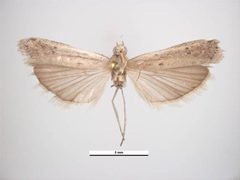
Homoeosoma electellum, commonly called the American sunflower moth or sunflower moth, is a small pyralid native to North America and also present in South America. It is the most economically significant pest of cultivated sunflowers in major production regions including Texas, Nebraska, California, and the Canadian Prairie Provinces. The does not overwinter in Canada; migrate northward annually from southern . Females are strongly attracted to blooming sunflower , where they deposit on or near the florets.
Pronunciation
How to pronounce Homoeosoma electellum: //həˌmiːəˈsoʊmə əˈlɛktɛləm//
These audio files are automatically generated. While they are not always 100% accurate, they are a good starting point.
Identification
are distinguished from similar pyralid moths by their small size (½ inch body length), slender build, and silver-to-buff-gray coloration. They are most readily identified by : adults rest on sunflower during blooming periods, particularly early morning and evening. Mature larvae are distinguished from other sunflower-feeding caterpillars by the combination of brown body color with four yellowish-green to cream longitudinal stripes, and by their presence within webbed, -laden sunflower heads. The banded sunflower moth (Cochylis hospes) has straw-colored adults with a brown triangular forewing marking and larvae that change from off-white to pink to red-purple to green. The sunflower bud moth (Suleima helianthana) has gray-brown adults with two dark wing bands and white larvae with dark head capsules.
Images
Habitat
Agricultural dominated by cultivated sunflowers (Helianthus annuus), particularly large fields. Also occurs in native habitats with wild sunflower and other Asteraceae. are highly attracted to blooming sunflower ; nearly 80% of are laid within 4–7 days after buds begin to open during the late R4 growth stage. Larval development occurs within sunflower heads. In Canada, the species does not overwinter; depend on northward adult .
Distribution
Native to North America; established in South America. Documented in major sunflower-producing regions of the United States including Texas, Nebraska, and California. In Canada, recorded from Manitoba and Saskatchewan since 1936, with confirmed economic damage in Saskatchewan. Canadian do not overwinter locally; result from immigration from southern source populations.
Seasonality
In Texas, primary and peak when early-planted fields bloom during May and June, with a secondary smaller flight possible later in the season, especially in the High Plains. In more northern states, trap sampling indicates activity from growth stages R3 to R5.1. In Canada, adults arrive via from southern each year; timing depends on weather patterns and source .
Diet
Larvae feed on pollen and floral parts of sunflower for the first 5–6 days, then tunnel into developing seeds and other head tissue. A single larva can destroy up to 12 seeds during its 15–19 day development period. Recorded plants include cultivated sunflower (Helianthus annuus), echinacea, canola, cotton, and oranges. feeding habits are not documented in detail; adults are attracted to sunflower pollen and nectar.
Host Associations
- Helianthus annuus - primary Cultivated sunflower; main economic . Females strongly attracted to blooming ; oviposition stimulated by pollen chemical cues.
- Helianthus spp. - Multiple wild sunflower support larval development; pre-breeding lines derived from H. tuberosus show low preference-performance measures.
- Echinacea spp. - Larvae feed on flowers and developing seeds.
- Brassica napus - Canola; larvae reported as pest.
- Gossypium spp. - Cotton; recorded as food plant.
- Citrus spp. - Oranges; recorded as food plant.
Life Cycle
hatch in 24–72 hours. Newly hatched larvae are yellow and feed exposed on pollen and floral parts for 5–6 days. Older larvae tunnel into seeds and tissue, developing over 15–19 days. Mature larvae descend to the ground and spin silk cocoons in which they overwinter, pupating in spring. In Canada, do not overwinter; the persists through northward . Multiple per year are possible in southern parts of the range where conditions permit.
Behavior
are , most active and visible resting on sunflower in early morning and early evening. Females are highly attracted to plants beginning to bloom, with oviposition concentrated during late R4 growth stage when ray flowers open and disk flowers are exposed. Females lay approximately 30 per day on sunflower heads. plant pollen serves as an oviposition stimulant; females exposed to Helianthus annuus pollen initiate calling at a significantly younger age, spend more time calling, and show increased egg maturation rates. This -mediated response occurs even without direct pollen contact, with sensillae for detection located primarily on the . Larvae construct silk webbing across the of sunflower heads, which accumulates and creates a characteristic 'trashy' appearance.
Ecological Role
Primary herbivore of sunflower ; significant consumer of developing seeds. Larval feeding damage predisposes sunflower heads to Rhizopus head rot, a fungal that can reduce yields up to 50% and lower seed oil content. Serves as for including Dolichogenidea homoeosomae (Braconidae) and Mesostenus spp. (Ichneumonidae). and parasitoid activity differ between native and agricultural sunflower .
Human Relevance
Major economic pest of sunflower in North America. Larval feeding destroys seeds directly and indirectly facilitates rot , causing substantial yield losses and quality reduction. application is often required for successful sunflower production; treatment timing is critical due to rapid bloom progression. Control recommendations include applying insecticides when 15–25% of plants are blooming and are present in the field, with possible additional applications at 5-day intervals when are moderate to heavy. Management challenges include the narrow treatment window and rapid bloom development. trapping is used for monitoring in northern states. The has been used as a model organism in studies of insect cryopreservation, - interactions, and chemical of plant-insect relationships.
Similar Taxa
- Cochylis hospesBanded sunflower moth; similar and use. Distinguished by smaller size (¼ inch), straw coloration with brown triangular forewing marking, and larvae that change color through pink and red stages to green.
- Suleima helianthanaSunflower bud moth; also feeds on sunflower. Distinguished by gray-brown with two dark wing bands, white larvae with dark capsules, and preference for terminal tissues and buds rather than open heads.
- Suleima baracanaAnother tortricid boring in sunflower stems; distinguished by different larval habits and appearance resembling bird droppings.
More Details
Oviposition Stimulant Chemistry
Helianthus annuus pollen contains chemical compounds that stimulate oviposition in female H. electellum. Both whole pollen and ethanolic pollen extracts elicit dose-dependent oviposition responses. Females prefer pollen over reconstituted pollen (extract plus residue), pollen extract over residue alone, and all pollen treatments over control substrates. Antennectomized females show reduced discrimination, indicating that antennal sensillae mediate detection of the oviposition stimulant.
Preference-Performance Correlation
Research on 16 sunflower pre-breeding lines derived from wild Helianthus supports the preference-performance hypothesis: female oviposition preference correlates strongly with larval performance (pupal weight and survival to ). Lines derived from H. tuberosus consistently showed low preference and low larval performance, suggesting potential resistance mechanisms.
Parasitoid Associations
The braconid Dolichogenidea homoeosomae is an important of H. electellum larvae. Ichneumonid wasps in the Mesostenus also parasitize sunflower moth caterpillars, along with other pyralid, crambid, and tortricid larvae. Parasitoid activity and abundance differ between native and agricultural sunflower .
Migration and Overwintering
In the Canadian Prairie Provinces, H. electellum does not successfully overwinter. result from or wind-borne transport from southern source populations. This migratory affects pest management timing and predictability in northern production regions.
Sources and further reading
- BugGuide
- Wikipedia
- NCBI Taxonomy
- Managing Insect Pests of Texas Sunflowers - AgriLife Extension Entomology
- Bug Eric: Wasp Wednesday: Mesostenus
- Bug Eric: More Insects From Sunflowers
- Host plant pollen influences calling behavior and ovarian development of the sunflower moth, Homoeosoma electellum
- Helianthus annuus pollen, an oviposition stimulant for the sunflower moth, Homoeosoma electellum
- The role of chemical cues in host-plant selection by adult female Homoeosoma electellum (Hulst) (Lepidoptera: Pyralidae) and Cochylis hospes Walsingham (Lepidoptera: Tortricidae)
- Abundance of a Native MothHomoeosoma electellum(Lepidoptera: Pyralidae) and Activity of Indigenous Parasitoids in Native and Agricultural Sunflower Habitats
- Confused by domestication: incongruent behavioral responses of the sunflower moth, Homoeosoma electellum (Lepidoptera: Pyralidae) and its parasitoid, Dolichogenidea homoeosomae (Hymenoptera: Braconidae), towards wild and domesticated sunflowers
- THE OCCURRENCE, LIFE HISTORY, COURTSHIP, AND MATING BEHAVIOUR OF THE SUNFLOWER MOTH, HOMOEOSOMA ELECTELLUM (LEPIDOPTERA: PHYCITIDAE), IN THE CANADIAN PRAIRIE PROVINCES
- Female preference and larval performance of sunflower moth, Homoeosoma electellum, on sunflower pre‐breeding lines
- Behavioral and growth responses of specialist herbivore,Homoeosoma electellum, to major terpenoid of its host,Helianthus SPP
- Isolation of nine microsatellite loci in Dolichogenidea homoeosomae (Hymenoptera) a parasitoid of the sunflower moth Homoeosoma electellum (Lepidoptera)
- Vitrification of Lepidopteran Embryos-A Simple Protocol to Cryopreserve the Embryos of the Sunflower Moth, Homoeosoma electellum.