
Suleima helianthana
(Riley, 1881)
sunflower bud moth
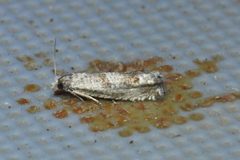
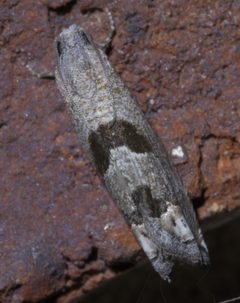
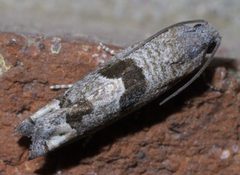
Suleima helianthana, commonly known as the sunflower bud , is a tortricid moth native to central North America. The species is a pest of sunflowers (Helianthus spp.), with larvae that tunnel into stalks and buds. Two occur annually. While historically documented on cultivated and wild sunflowers, the species was first recorded on Jerusalem artichoke (Helianthus tuberosus) in California's San Joaquin Valley in 2024, representing an emerging pest situation for small-farm producers.
Pronunciation
How to pronounce Suleima helianthana: /suːˈleɪmə ˌhiːliːænˈθeɪnə/
These audio files are automatically generated. While they are not always 100% accurate, they are a good starting point.
Identification
are distinguished from the banded sunflower moth (Cochylis hospes) by their gray-brown rather than straw-colored ground color, and by the presence of two dark transverse bands on the forewings rather than a single brown triangular patch. Larval presence is indicated by black surrounding entry holes in sunflower stalks, buds, or leaf axils. Deformed sunflower are a characteristic of .
Images
Habitat
Associated with sunflower and wild sunflower . In Texas, have been observed in commercial sunflower fields. In California, the has been documented in small-farm settings on Jerusalem artichoke (sunchoke).
Distribution
Central North America, ranging from Mexico to Canada. Documented from Manitoba and Saskatchewan in Canada; distribution extends southward through the central United States to Mexico.
Seasonality
Two per year throughout its range. In Texas, activity coincides with sunflower growth stages from terminal development through mature formation. Specific periods vary with latitude and local climate.
Diet
Larvae feed exclusively on Helianthus . They tunnel into stalks, buds, and receptacles of plants. In Texas, feeding has been observed in the fleshy portion of and stalks; larvae may burrow into small, unopened buds, preventing head formation. On Jerusalem artichoke, larvae bore into stems causing plant dieback from the top down.
Host Associations
- Helianthus annuus - primary Cultivated sunflower
- Helianthus tuberosus - Jerusalem artichoke/sunchoke; first documented in California 2024
- Helianthus spp. - Wild and other Helianthus
Life Cycle
Two annually. are laid in terminals of sunflowers, on the receptacle (underside) of mature , or in leaf axils. Larvae tunnel into plant tissues and develop within stalks or buds. occurs within the plant. stage not explicitly documented in available sources.
Behavior
females oviposit in protected locations: sunflower terminals, mature receptacles, or leaf axils. Larvae are internal feeders, tunneling into stalks and buds where they are protected from external environmental conditions and applications. Larval feeding produces characteristic black at entry points.
Ecological Role
As a herbivore on Helianthus, the functions as a regulator of native and cultivated sunflowers. Larval tunneling may predispose plants to secondary , though this has not been specifically documented for this species. In agricultural , it acts as a yield-reducing pest when larval feeding destroys developing buds.
Human Relevance
Agricultural pest of sunflowers. In Texas commercial production, have generally been light with minimal yield impact, except when larvae destroy unopened buds and prevent formation. The 2024 detection on Jerusalem artichoke in California represents an emerging concern for small-farm producers, where management is complicated by the larval boring habit (protecting larvae from contact ) and restrictions on insecticides in -attractive crops.
Similar Taxa
- Cochylis hospesBanded sunflower moth; similar size and but differs in straw-colored ground color and single brown triangular forewing patch versus two dark transverse bands in S. helianthana
- Homoeosoma electellumSunflower moth; larger (½ inch long) with silver-to-buff-gray coloration, larvae feed externally on pollen and floral parts before tunneling into seeds rather than stalks and buds
More Details
Emerging Pest Status
In July 2024, Suleima helianthana was documented for the first time on Jerusalem artichoke (Helianthus tuberosus) in California's San Joaquin Valley, representing a novel -plant association and geographic expansion of economic concern. The detection resulted from a small-farm producer reporting plant dieback to University of California Cooperative Extension. Management challenges include larval protection within plant tissues and regulatory restrictions on in -attractive crops.
Management Considerations
Cultural practices including crop , modified planting dates, and destruction of volunteer and wild sunflowers may reduce . Chemical control is complicated by the internal feeding habit of larvae. No specific have been established for this in commercial sunflower production.
Sources and further reading
- BugGuide
- Wikipedia
- GBIF taxonomy match
- iNaturalist taxon
- NCBI Taxonomy
- Catalogue of Life
- Managing Insect Pests of Texas Sunflowers - AgriLife Extension Entomology
- sunflower bud moths (Suleima helianthana) - Entomology Today
- Small Farms: On the Front Lines of Emerging Agricultural Pests
- Suleima helianthana Archives - Entomology Today
- Suleiman Mustapha - Entomology Today
- Suleiman Mustapha Archives - Entomology Today