
Cochylichroa hospes
(Walsingham, 1884)
Banded Sunflower Moth
A small tortricid native to North America, the banded sunflower moth is a significant pest of cultivated sunflowers. are active in mid-summer and are attracted to sunflower at twilight for -laying. The was transferred from the Cochylis to the redefined genus Cochylichroa in 2019 based on phylogenetic analysis.
Pronunciation
How to pronounce Cochylichroa hospes: /ˌkɒkɪˈlaɪkroʊə ˈhɒspɛs/
These audio files are automatically generated. While they are not always 100% accurate, they are a good starting point.
Identification
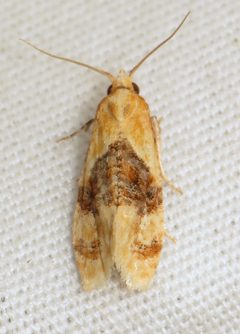
are approximately 6 mm in length with straw-colored forewings bearing a distinctive brown triangular band near the middle. This banded pattern distinguishes it from other small tortricids associated with sunflowers. The sunflower bud moth (Suleima helianthana) has two dark bands across the wing rather than a single triangular patch. The banded sunflower moth is smaller than the sunflower moth (Homoeosoma electellum), which is silver-to-buff-gray and lacks the brown triangular marking.
Images
Habitat
Associated with sunflower fields and stands of native sunflowers (Helianthus ). Found in agricultural settings and natural prairie where plants occur.
Distribution
North America: recorded from North Carolina westward to Colorado, Utah, New Mexico, and northern Arizona. Additional records from Vermont and other states suggest broader distribution within the central and eastern United States.
Seasonality
are active from July to August, with peak activity during the blooming period of sunflower crops.
Diet
Larvae feed on developing seeds within sunflower flower . Early instars feed on disk flowers before transitioning to seed consumption at the third instar. plants are Helianthus , particularly cultivated sunflower (Helianthus annuus).
Host Associations
- Helianthus annuus - primary cultivated sunflower, seeds consumed by larvae
- Helianthus species - native sunflower
Life Cycle
Females lay white on the outside of bracts on sunflower . Larvae hatch and move onto the flower disk, feeding on five to seven seeds before descending to the soil. They spin a cocoon in the soil where they pupate and overwinter. emerge the following summer. One per year.
Behavior
are , visiting sunflower plants primarily at twilight for oviposition. Spends daylight hours away from plants. Larvae feed internally within flower , concealed among developing seeds.
Ecological Role
Phytophagous on sunflowers; serves as prey for and . can significantly reduce seed production in agricultural settings.
Human Relevance
Major economic pest of commercial sunflower production. Larval feeding reduces seed yield and quality. Action threshold for chemical control is one per two plants during late bud (R4) to early bloom stage (R5.2). Scouting recommended during early morning or early evening when are active.
Similar Taxa
- Homoeosoma electellum (Sunflower Moth)Similar and damage pattern, but larger (about 12 mm), lacks brown triangular forewing band, and produces conspicuous webbing on flower
- Suleima helianthana (Sunflower Bud Moth)Same , but has two dark transverse wing bands rather than single triangular patch; larvae cause deformed and black on stalks
- Suleima baracanaSimilar size and , but caterpillar bores in stems rather than feeding on seeds; appearance differs