
Suleima
Heinrich, 1923
Species Guides
4- Suleima baracana(baracana moth)
- Suleima cinerodorsana
- Suleima helianthana(sunflower bud moth)
- Suleima skinnerana
Suleima is a of tortricid moths in the Olethreutinae, established by Heinrich in 1923. The genus contains seven described distributed in North America. Suleima helianthana, commonly known as the sunflower bud moth, is the best-known species due to its association with cultivated sunflowers and, more recently, sunchoke. Most species remain poorly studied with limited ecological data available.
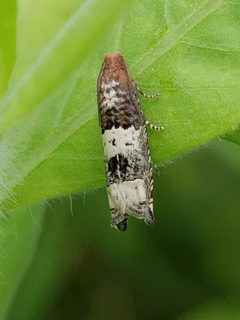
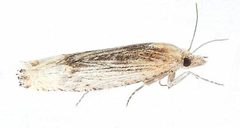
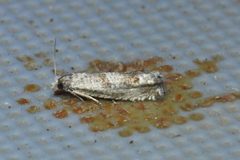
Pronunciation
How to pronounce Suleima: /suːˈleɪmə/
These audio files are automatically generated. While they are not always 100% accurate, they are a good starting point.
Identification
are small with wingspans approximately ⅔ inch (17 mm). Suleima helianthana adults are gray-brown with two distinct dark transverse bands on the forewings—one across the middle and one near the wingtip. Larvae are white with a dark capsule, reaching about ⅜ inch (10 mm) in length. Separation from related olethreutine requires examination of genitalic characters; the genus is characterized by specific structural features of the male valva and female sterigma as defined by Heinrich.
Images
Habitat
Associated with sunflower-dominated environments including agricultural fields, roadsides, and where wild and cultivated sunflowers occur. Suleima helianthana has been documented in commercial sunflower production regions and, in 2024, was recorded on sunchoke in the San Joaquin Valley, representing a expansion.
Distribution
North America. occur in the United States and Canada, with records from Texas, the Great Plains, and California. The appears restricted to regions supporting native or cultivated Asteraceae .
Seasonality
Suleima helianthana produces two annually in Texas. activity coincides with sunflower growth stages, with present during blooming periods. Specific seasonal patterns for other Suleima are undocumented.
Diet
Larvae feed on sunflower (Helianthus spp.) tissues. Suleima helianthana larvae initially mine into terminals, leaf axils, or receptacles; feeding is restricted to the fleshy portions of and stalks. The 2024 sunchoke record suggests potential flexibility within Helianthus-related Asteraceae.
Host Associations
- Helianthus annuus - primary cultivated sunflower
- Helianthus tuberosus - sunchoke; first record 2024, San Joaquin Valley
Life Cycle
Suleima helianthana: are laid in sunflower terminals, on receptacles of mature , or in leaf axils. Larvae enter plant tissue, leaving characteristic black at entry holes. Two per year in Texas. Larvae overwinter in stalks. sites and detailed developmental duration for most are unknown.
Behavior
are attracted to blooming sunflowers and are most active during early morning and evening. Larvae are internal feeders, tunneling into plant tissues and producing visible deposits.
Ecological Role
Minor pest of sunflower . Larval feeding causes deformation of flower and can prevent head formation when buds are small. In Texas, have historically been light with minimal yield impact. Larval damage may predispose plants to secondary issues, though this is less documented than for the sunflower moth (Homoeosoma electellum).
Human Relevance
Suleima helianthana is recognized as a sunflower pest in agricultural extension literature, though economic impact is generally minor compared to the sunflower moth or banded sunflower moth. The 2024 detection on sunchoke in California indicates potential emerging pest status on alternative crops. No control recommendations are specifically targeted at this .
Similar Taxa
- Cochylis hospesBanded sunflower moth; similar size and but forewing pattern differs—straw-colored with brown triangular patch rather than two transverse bands. Larvae change color through instars (off-white to pink to red/purple to green) unlike uniformly white Suleima larvae.
- Homoeosoma electellumSunflower moth; larger (½ inch length), silver-to-buff-gray without distinct wing bands. Larvae are brown with yellowish-green longitudinal stripes and cause more severe economic damage with webbing on .
Sources and further reading
- BugGuide
- Wikipedia
- GBIF taxonomy match
- iNaturalist taxon
- NCBI Taxonomy
- Catalogue of Life
- Managing Insect Pests of Texas Sunflowers - AgriLife Extension Entomology
- sunflower bud moths (Suleima helianthana) - Entomology Today
- Suleiman Mustapha - Entomology Today
- Suleima helianthana Archives - Entomology Today
- Suleiman Mustapha Archives - Entomology Today
- Meet the Recipients of the 2021 Black in Entomology Student Prizes