
Banchinae
Wesmael, 1845
Tribe Guides
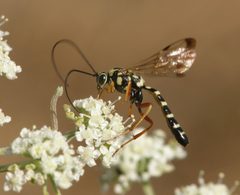
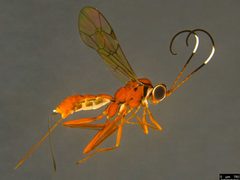
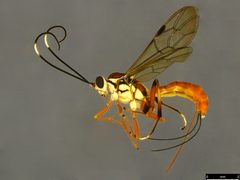
3Banchinae is a large of Ichneumonidae containing approximately 1,500–1,800 described distributed worldwide. The subfamily comprises three tribes: Banchini, Glyptini, and Atrophini. All banchines are koinobiont endoparasitoids of Lepidoptera larvae. Glyptini primarily parasitize Tortricidae, while Atrophini attack a broader range of small . The Lissonota is notable for possessing exceptionally long ovipositors capable of reaching deep wood-boring Lepidoptera such as Cossidae. Banchinae and Campopleginae are the only Ichneumonidae subfamilies known to harbor , which play a role in immune suppression.
Pronunciation
How to pronounce Banchinae: /ˈbæŋ.kɪˌniː/
These audio files are automatically generated. While they are not always 100% accurate, they are a good starting point.
Identification
Most Banchinae possess a stalked, diamond-shaped areolet in the forewing. The propodeum has few carinae (ridges) and features a distinctive lobe that projects over the middle . The is often described as 'goat-like' in appearance. These characters help distinguish Banchinae from other Ichneumonidae , though -level identification requires examination of additional morphological details.
Images
Distribution
Worldwide distribution across all major biogeographic regions. Individual show varying patterns: Orientoglypta occurs in the Eastern Palaearctic and Oriental regions including China (Zhejiang, Guangxi, Fujian, Taiwan, Xizang, Guizhou); Mnioes is predominantly Neotropical with records from Central and South America (Peru, Bolivia, Brazil, Ecuador); Hapsinotus occurs throughout the Neotropics including Mexico, Panama, Trinidad and Tobago, Venezuela, Suriname, French Guiana, Brazil, Ecuador, Bolivia, and Peru; Exetastes has both Nearctic and Neotropical components with Mexican fauna showing stronger affinities to the Nearctic region; Apophua occurs in Japan; Cryptopimpla is present in the Afrotropical region including South Africa.
Host Associations
- Tortricidae - primary For tribe Glyptini
- Lepidoptera larvae - General for ; koinobiont endoparasitism
- Cossidae - Reached by Lissonota using long ovipositors
- Small moth families - For tribe Atrophini
Behavior
Koinobiont endoparasitism: larvae develop inside living caterpillars, allowing hosts to continue feeding and growing until the is ready to emerge. Some possess exceptionally long ovipositors for accessing concealed hosts.
Ecological Role
agents of lepidopteran . The association with facilitates manipulation and immune suppression, enhancing success.
Human Relevance
Potential value in of pests, particularly tortricid pests in agricultural and forestry settings.
Similar Taxa
- CampopleginaeAlso possesses and contains koinobiont endoparasitoids of Lepidoptera; distinguished by different wing venation and propodeal structure
- LycorininaeFormerly included in Banchinae in older treatments; now recognized as separate based on revised morphological criteria
- NeorhacodinaeFormerly included in Banchinae; newer works treat as distinct
- StilbopinaeFormerly included in Banchinae; newer works treat as distinct
Sources and further reading
- BugGuide
- Wikipedia
- GBIF taxonomy match
- iNaturalist taxon
- NCBI Taxonomy
- The genus Orientoglypta Kuslitzky, 1973 (Ichneumonidae, Banchinae) from China with descriptions of four new species
- Ten new species of parasitoid wasps Mnioes Townes, 1946 (Hymenoptera: Ichneumonidae: Banchinae) described from Peru
- Revision of the genus Apophua Morley, 1913, from Japan <br />(Hymenoptera, Ichneumonidae, Banchinae)
- Mexican species of Exetastes (Hymenoptera: Ichneumonidae: Banchinae), with description of three new species
- The Iranian fauna of the subfamilies Acaenitinae, Banchinae, Campopleginae, Ophioninae and Tryphoninae (Hymenoptera: Ichneumonidae) with some new records
- Taxonomic notes on Exetastes fukuchiyamanus Uchida, 1928 (Hymenoptera, Ichneumonidae, Banchinae), with description of a new species from Japan and China
- Two new species of the genus Cryptopimpla Taschenberg (Hymenoptera, Ichneumonidae, Banchinae) with an updated key to African species
- Three new species of parasitoid wasps of the genus Mnioes Townes, 1946 (Ichneumonidae: Banchinae) in a humid forest in Peru
- Revision of the Neotropical parasitoid wasp genus Hapsinotus (Hymenoptera: Ichneumonidae: Banchinae)
- Review of Mexican species of Diradops Townes, with a key and description of a new species (Hymenoptera: Ichneumonidae: Banchinae)