
Exetastes
Gravenhorst, 1829
Species Guides
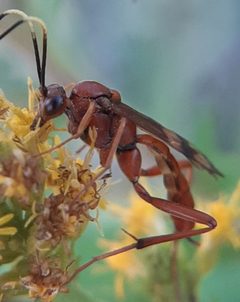
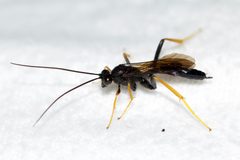
6Exetastes is a of in the Ichneumonidae, established by Johann Ludwig Christian Gravenhorst in 1829. The genus contains at least 11 described with a distribution, found across Europe, Asia, and North America. As ichneumonids, members of this genus are parasitoids, though specific associations remain poorly documented.

Pronunciation
How to pronounce Exetastes: //ɛk.sɛˈtæ.stiːz//
These audio files are automatically generated. While they are not always 100% accurate, they are a good starting point.
Identification
Specific diagnostic features distinguishing Exetastes from other ichneumonid are not well documented in accessible sources. Identification to level requires examination of morphological characters such as wing venation, structure, and coloration patterns, with reference to specialized taxonomic keys.
Images
Distribution
distribution. Documented occurrence records include Denmark, Norway, Sweden, Vermont (USA), and Japan. The has been reported from the Palearctic and Nearctic regions.
Ecological Role
As , members of this likely function as agents of other insects, though specific relationships and ecological impacts have not been well characterized.
More Details
Taxonomic History
The was first described by Johann Ludwig Christian Gravenhorst in 1829. The type is Exetastes ichneumoniformis Gravenhorst, 1829. Several species were originally described under other genera and later transferred to Exetastes, including Exetastes atrator (originally Ichneumon atrator Förster, 1771) and Exetastes fornicator (originally Ichneumon fornicator Fabricius, 1781).
Species Diversity
At least 11 are currently recognized: E. adpressorius, E. albiger, E. albimarginalis, E. atrator, E. bimaculatus, E. compressus, E. crousae, E. fornicator, E. fukuchiyamanus, E. ichneumoniformis, and E. ishikawensis. Recent descriptions include E. albimarginalis (Watanabe, 2020) and E. compressus (Watanabe & Sheng, 2018).