
Diapriinae
Tribe Guides
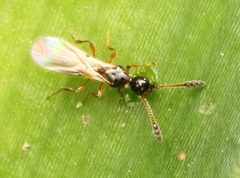
3Diapriinae is a of minute within the Diapriidae. Members are typically 1–8 mm in length, with most averaging 2–4 mm. They are characterized by a distinctive ledge-like extension of the above the (the "shelf face"), from which the originate. The subfamily contains three tribes: Diapriini, Psilini, and Spilomicrini. Most species are parasitoids of Diptera larvae and pupae, particularly fungus gnats (Mycetophilidae and Sciaridae), though some lineages have evolved specialized associations with ants. Many species remain undescribed, with an estimated 4,500 species worldwide compared to approximately 2,300 currently described.
Pronunciation
How to pronounce Diapriinae: /daɪəˈpraɪɪniː/
These audio files are automatically generated. While they are not always 100% accurate, they are a good starting point.
Identification
Diapriinae can be distinguished from other diapriid by the presence of a shelf-like facial projection above the in most , with originating from this ledge. Wing venation is minimal or absent. The is (narrowly constricted at the base), and the body is generally smooth and polished. Brachypterous or species occur in some , particularly in extreme such as subantarctic islands.
Images
Habitat
Moist woodland are most common, where stalk around fungi, leaf litter, and damp soil. Some occupy extreme habitats including intertidal zones and subantarctic islands. -associated inhabit ant nests.
Distribution
Worldwide distribution with records from all major biogeographic regions. Documented from North America (over 300 ), South America (Argentina), Europe, South Korea, Japan, New Zealand (South Island and subantarctic islands), and India (Odisha). First records from Odisha, India documented in rice (2018–2021).
Host Associations
- Diptera larvae and pupae - Primary ; includes fungus gnats (Mycetophilidae, Sciaridae)
- Formicidae - myrmecophilous symphileSpecialized -associated in some ; morphological and behavioral adaptations for integration with ants
Life Cycle
Larvae feed internally on maggots. Most are solitary , though some are gregarious with several larvae developing within a single host.
Behavior
Females search for in moist microhabitats. Some exhibit specialized for entering and surviving in colonies (myrmecophily), including morphological and behavioral adaptations for integration with host ants. Mating behavior has been observed in some species, with interactions between and host ants reported for ant-associated lineages.
Ecological Role
agents of dipteran , particularly fungus gnats in forest . -associated may influence ant colony dynamics.
Human Relevance
Potential for of pest flies, though generally not targeting major agricultural pests. Trichopria drosophilae has been studied for control of spotted wing drosophila (Drosophila suzukii).
Similar Taxa
- Other Diapriidae subfamiliesLack the characteristic shelf-like facial projection; originate differently
- PlatygastridaeSimilar minute size and lifestyle, but different wing venation and facial structure
Sources and further reading
- BugGuide
- Wikipedia
- iNaturalist taxon
- NCBI Taxonomy
- Publications | Entomology Research Museum
- Bug Eric: Wasp Wednesday: Diapriids
- Diapriinae Wasps (Hymenoptera: Diaprioidea: Diapriidae) Associated with Ants (Hymenoptera: Formicidae) in Argentina
- Revision of the genus Lepidopria Kieffer (Hymenoptera, Diapriidae, Diapriinae) of the world fauna
- New Diapriinae (Hymenoptera: Diapriidae) from the South Island and subantarctic islands of New Zealand
- First record of subfamily Diapriinae (Diaprioidea: Diapriidae) from Odisha, with generic level distribution in rice ecosystems
- Resilience mechanisms of Trichopria drosophilae (Hymenoptera: Diapriinae) under global extreme cooling: insights into parasitic response and physiological adaptation
- A review of Tetramopria (Hymenoptera, Diapriidae, Diapriinae) of the Eastern Palaearctic with notes on mating behaviour and interactions with host ants
- Supplementary material 1 from: Kawai R, Yoon S, Notton DG (2025) A review of Tetramopria (Hymenoptera, Diapriidae, Diapriinae) of the Eastern Palaearctic with notes on mating behaviour and interactions with host ants. Journal of Hymenoptera Research 98: 621-636. https://doi.org/10.3897/jhr.98.148115
- Figure 3 from: Kawai R, Yoon S, Notton DG (2025) A review of Tetramopria (Hymenoptera, Diapriidae, Diapriinae) of the Eastern Palaearctic with notes on mating behaviour and interactions with host ants. Journal of Hymenoptera Research 98: 621-636. https://doi.org/10.3897/jhr.98.148115
- Figure 1 from: Kawai R, Yoon S, Notton DG (2025) A review of Tetramopria (Hymenoptera, Diapriidae, Diapriinae) of the Eastern Palaearctic with notes on mating behaviour and interactions with host ants. Journal of Hymenoptera Research 98: 621-636. https://doi.org/10.3897/jhr.98.148115
- Figure 4 from: Kawai R, Yoon S, Notton DG (2025) A review of Tetramopria (Hymenoptera, Diapriidae, Diapriinae) of the Eastern Palaearctic with notes on mating behaviour and interactions with host ants. Journal of Hymenoptera Research 98: 621-636. https://doi.org/10.3897/jhr.98.148115
- Figure 5 from: Kawai R, Yoon S, Notton DG (2025) A review of Tetramopria (Hymenoptera, Diapriidae, Diapriinae) of the Eastern Palaearctic with notes on mating behaviour and interactions with host ants. Journal of Hymenoptera Research 98: 621-636. https://doi.org/10.3897/jhr.98.148115
- Figure 2 from: Kawai R, Yoon S, Notton DG (2025) A review of Tetramopria (Hymenoptera, Diapriidae, Diapriinae) of the Eastern Palaearctic with notes on mating behaviour and interactions with host ants. Journal of Hymenoptera Research 98: 621-636. https://doi.org/10.3897/jhr.98.148115