
Diapriidae
Subfamily Guides
3Diapriidae is a of minute in the order Hymenoptera. range from 1–8 mm in length, with most measuring 2–4 mm. The family contains approximately 2,300 described species in around 150–200 , though estimates suggest at least 4,500 species exist globally. Members are primarily parasitoids of Diptera larvae and pupae, with some species attacking Coleoptera or associated with ants. The family exhibits considerable morphological diversity, including frequent winglessness and pronounced .
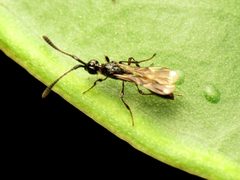
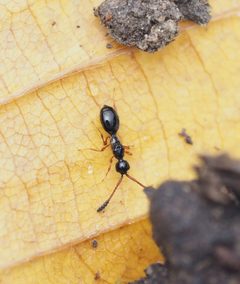
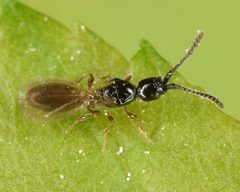
Pronunciation
How to pronounce Diapriidae: /daɪəˈpraɪɪdiː/
These audio files are automatically generated. While they are not always 100% accurate, they are a good starting point.
Identification
Most North American display a distinctive ledge-like facial extension above the , from which the originate. When wings are present, venation is characteristically reduced, with the greatest reduction in Ambositrinae and Diapriinae. The is and the body is generally smooth and polished. is nearly universal, with males and females often appearing so different they are mistaken for separate species. Aptery occurs frequently and may affect both sexes.
Images
Habitat
Moist woodland , particularly around fungi, leaf litter, and damp soil. Some occupy extreme habitats such as intertidal zones.
Distribution
Global distribution. North America contains more than 300 . Documented from Brazil, Norway, Russia (Murmansk Province, Republic of Karelia, Chelyabinsk Province), Slovenia, and throughout temperate and tropical regions worldwide.
Host Associations
- Mycetophilidae - of larvae/pupaeFungus gnats; common for basal diapriids
- Sciaridae - of larvae/pupaeFungus gnats; common for basal diapriids
- Sciomyzidae - of pupaeSnail-killing flies; Phaenopria and Trichopria reared from
- Drosophilidae - Including Drosophila suzukii; Trichopria drosophilae and T. anastrephae documented
- Sarcophagidae - of pupaeTrichopria sp. reared from Peckia chrysostoma pupae
- Staphylinidae - of larvaeSome Diapriinae
- Scarabaeidae - of larvaeSome Diapriinae
- Formicidae - associated/Some specialized Diapriinae ; Ecitovagus associated with army ant Neivamyrmex nigrescens
- Dryinidae - hyperparasitoidIsmarus parasitize Dryinidae, which are themselves of leafhoppers
Life Cycle
Internal development within larvae or pupae. Trichopria have been reared from host with occurring approximately 18 days after oviposition at 19–25°C. Some species are solitary ; at least a few are gregarious with multiple larvae feeding within a single host. has been reported in at least one species.
Ecological Role
agents for dipteran pests. Some used in biological control programs. Natural enemies of flies in agricultural and natural systems, including pests such as Drosophila suzukii.
Human Relevance
Potential for of agricultural pests, particularly spotted-wing drosophila (Drosophila suzukii). Research indicates some (abamectin, spinetoram, spinosad) show lower to certain diapriid , supporting strategies.
Similar Taxa
- PteromalidaeBoth contain small ; Diapriidae distinguished by reduced wing venation, facial ledge in many , and typically more pronounced
- FigitidaeBoth parasitize Diptera; Diapriidae separated by morphological features including and characteristic facial structure in many
- EucoilidaeBoth are of Drosophila; Diapriidae such as Trichopria drosophilae may co-occur with Trybliographa but differ in stage attacked (pupal vs. larval)
Sources and further reading
- BugGuide
- Wikipedia
- GBIF taxonomy match
- iNaturalist taxon
- NCBI Taxonomy
- Catalogue of Life
- Bug Eric: January 2012
- New Study Aims to Protect Parasitoids of Spotted-Wing Drosophila
- Description of the Diapriidae Family (Insecta: Hymenoptera)
- The Ambositriinae (Hymenoptera : Diapriidae) of Melanesia
- A New Flightless Phaenopria (Hymenoptera: Diapriidae)
- NOVO HABITAT PARA TRICHOPRIA SP. (HYMENOPTERA: DIAPRIIDAE) NO BRASIL
- Aportes al conocimiento de las especies del género Doliopria Kieffer, 1910 (Hymenoptera: Diapriidae) del Neotrópico, grupo de especies “cornibus”
- NOVO HABITAT E HOSPEDEIRO PARA TRICHOPRIA SP. (HYMENOPTERA: DIAPRIIDAE) NO BRASIL
- Biologia reprodutiva comparada de dois parasitoides de Drosophila: trybliographa brasiliense (HYMENOPTERA: EUCOLIDE) e Trichopria drosophilae (HYMENOPTERA : DIAPRIIDAE)
- Masnerosema is a new junior synonym of Acanopsilus (Hymenoptera: Diapriidae: Pantolytini)
- Revision of the genus Diphora (Diapriidae: Belytinae) of the West Palaearctic
- REVISION OFSPILOMICRUSWESTWOOD IN AMERICA NORTH OF MEXICO (HYMENOPTERA: PROCTOTRUPOIDEA, DIAPRIIDAE)
- A NEW GENUS OF ECITOPHILOUS DIAPRIID WASPS FROM ARIZONA (HYMENOPTERA: PROCTOTRUPOIDEA: DIAPRIIDAE)
- A REVISION OF THE ISMARINAE OF THE NEW WORLD (HYMENOPTERA, PROCTOTRUPOIDEA, DIAPRIIDAE)
- Phaenopria popei (Hymenoptera: Diapriidae) Reared from Puparia of Sciomyzid Flies
- Trichopria drosophilae (Diapriidae) and Leptopilina heterotoma (Figitidae), native parasitoids of Drosophila suzukii, confirmed in Slovenia
- Biology of Trichopria popei and T. atrichomelinae (Hymenoptera: Diapriidae), Parasitoids of the Sciomyzidae (Diptera)1,2
- Effects of cold storage on the growth and development of Trichopria drosophilae (Hymenoptera: Diapriidae).