
Diapriini
Genus Guides
7Diapriini is a tribe of within the Diapriidae. Members are small, slender wasps with reduced wing venation characteristic of the family. They are primarily known as parasitoids of Diptera larvae, particularly in soil and decaying organic matter . The tribe is in distribution with substantial representation in temperate regions.
Pronunciation
How to pronounce Diapriini: /daɪəˈpraɪˌaɪˌniː/
These audio files are automatically generated. While they are not always 100% accurate, they are a good starting point.
Identification
Distinguished from other Diapriidae tribes primarily by wing venation patterns and antennal structure. Differs from Belytinae in having less reduced wing venation and different antennal segmentation. Separation from other diapriine tribes (e.g., Spilomicrini, Pantoclis) requires examination of specific wing reduction patterns and genitalic characters. Identification to or level typically requires microscopic examination and keys.
Images
Appearance
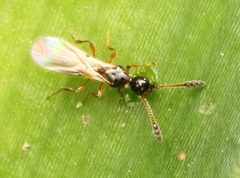
Small , typically 2–5 mm in length. Body slender and often dark-colored with reduced wing venation; forewings lack closed beyond the basal portion. long and multi-segmented, often with distinctive or structure. Petiole between and is elongated and thread-like. Wings often appear smoky or clear with minimal crossveins.
Habitat
Associated with moist soil, leaf litter, decaying wood, and other organic substrates where dipteran develop. Frequently collected in and soil . range from forest floors to grasslands and occasionally environments such as compost heaps.
Distribution
distribution with records from North America, Europe, Asia, Africa, Australia, and New Zealand. Most diverse in temperate regions of the Northern Hemisphere. Specific range boundaries for the tribe as a whole are poorly documented due to taxonomic challenges and undercollecting in tropical regions.
Seasonality
activity peaks during spring and summer in temperate regions, with some extending into autumn. Activity patterns correspond with availability of dipteran larvae in soil and decaying matter. Specific seasonal data varies considerably by geographic region and species.
Host Associations
- Diptera larvae - Primary are larvae of various Diptera developing in soil, decaying organic matter, and other substrates. Specific host records are scattered and often identified only to family level.
Life Cycle
Development is parasitoidal: females oviposit into dipteran larvae, with larvae feeding internally and eventually killing the host. typically occurs within the host or nearby substrate. duration varies with host and environmental conditions; multivoltine patterns are likely in temperate regions.
Behavior
are often observed running rapidly on soil surfaces or low vegetation. Many exhibit positive attraction to light or . -seeking involves locating dipteran larvae in concealed substrates; specific cues used for host location are poorly documented.
Ecological Role
Act as agents of dipteran , particularly in soil and detritus . Contribute to regulation of fly populations in natural and agricultural . Specific quantitative impacts on populations are largely unstudied.
Human Relevance
Potential utility in of pest Diptera, though not widely exploited commercially. Occasionally collected in agricultural settings but generally overlooked due to small size. No known negative impacts on humans; stinging apparatus reduced or absent.
Similar Taxa
- SpilomicriniAnother tribe within Diapriidae; distinguished by differences in antennal structure and wing venation reduction patterns, though definitive separation requires detailed morphological examination.
- Belytinae of Diapriidae with more extremely reduced wing venation and often different body proportions; historically confused with Diapriini but now recognized as distinct lineage.
More Details
Taxonomic challenges
The tribe Diapriini has undergone substantial taxonomic revision, with generic boundaries frequently redefined. Many remain undescribed, particularly in tropical regions. Molecular phylogenetic studies are ongoing and may substantially alter tribal and generic concepts within Diapriidae.
Collection methods
Best collected using , pan traps, and soil extraction techniques such as . are rarely observed without targeted collecting efforts due to small size and cryptic habits.