
Belytinae
Tribe Guides
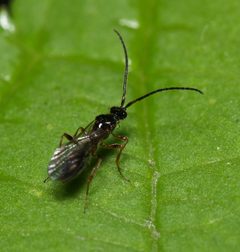
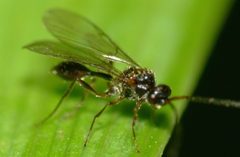
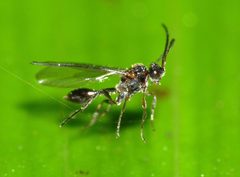
4Belytinae is a of small within the Diapriidae. These wasps are primarily known as parasitoids of fungus gnats (Mycetophilidae) and dark-winged fungus gnats (Sciaridae). The subfamily is distributed across multiple continents, with documented records from the Neotropics, Palaearctic, and Oriental regions. Taxonomic knowledge remains incomplete, with many yet to be described and biological data sparse for most .
Pronunciation
How to pronounce Belytinae: /ˌbɛlaɪˈtɪniː/
These audio files are automatically generated. While they are not always 100% accurate, they are a good starting point.
Identification
Belytinae can be distinguished from other Diapriidae by morphological characters of the , , and petiole structure, though specific diagnostic features vary by . Identification to genus level requires examination of wing venation, antennal segmentation, and propodeal sculpturing. The subfamily includes both winged and wingless forms, with some genera exhibiting reduced wing venation.
Images
Habitat
Occupies forested environments including Atlantic Dense Ombrophilous Forest in Brazil, temperate forests of northern Iran, and broadleaf and coniferous woodlands across the Palaearctic. Collections indicate association with moist, shaded where Diptera develop in decaying organic matter and fungal substrates.
Distribution
Documented from Brazil (Paraíba to Santa Catarina states), Iran (Alborz, Golestan, Gilan, Mazandaran, Qazvin Provinces), Norway, Russia (Murmansk Province, Republic of Karelia, Chelyabinsk Province), and Japan. Fossil evidence from Eocene Baltic amber indicates ancient presence in Europe. Global distribution is likely broader but undersampled.
Host Associations
- Mycetophilidae - Fungus gnats; primary
- Sciaridae - Dark-winged fungus gnats; primary
Behavior
have been collected using and yellow pan traps, suggesting active in forest understories. Sweeping of vegetation has yielded specimens, indicating presence on low vegetation. toward is presumed but direct observations of oviposition are not documented in available sources.
Ecological Role
Has been observed to play a role in natural regulation of Mycetophilidae and Sciaridae in forest . These dipteran are associated with decomposing organic matter and fungi; belytine likely contribute to nutrient cycling dynamics by limiting population growth.
Similar Taxa
- DiapriinaeOther of Diapriidae; distinguished by differences in capsule structure, mandibular form, and details of wing venation when present
- SpilomicrinaeDiapriidae with overlapping size range; separated by antennal structure and petiole
More Details
Taxonomic knowledge gaps
A single study in the Atlantic Forest of Brazil recorded 115 morphospecies across nine , suggesting substantial undescribed diversity. Many genera lack comprehensive -level revisions.
Fossil record
Eocene Baltic amber preserves at least two of Acropiesta, demonstrating the 's antiquity and morphological stability over approximately 34-56 million years.
Molecular tools
c oxidase subunit I (COI) has been used to confirm male-female associations in at least one (Synacra), suggesting utility for resolving taxonomic problems in this morphologically challenging group.
Sources and further reading
- BugGuide
- iNaturalist taxon
- NCBI Taxonomy
- Revision of the genus Diphora (Diapriidae: Belytinae) of the West Palaearctic
- New data on the genus Belyta Jurine, 1807 (Hymenoptera: Diapriidae, Belytinae) from Iran
- Genera of Belytinae (Hymenoptera: Diapriidae) recorded in the Atlantic Dense Ombrophilous Forest from Paraíba to Santa Catarina, Brazil
- Review of the genus Synacra Förster, 1856 (Hymenoptera: Diapriidae: Belytinae) of Japan, with description of a new species
- <p><strong>A new species of parasitoid wasps (Hymenoptera: Diapriidae: Belytinae) from Eocene Baltic amber</strong></p>