
Trichopria
Ashmead, 1893
Trichopria is a of in the Diapriidae distributed worldwide. in this genus are primarily pupal parasitoids of Diptera, with documented including drosophilid fruit flies, sarcophagid flies, muscids, and other fly families. Several species have been investigated for of pest flies, particularly the spotted-wing drosophila (Drosophila suzukii). The genus exhibits variation in reproductive strategies, with some species showing solitary development and others gregarious or polyembryonic development.
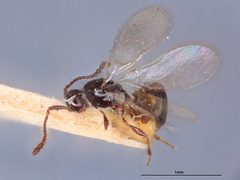
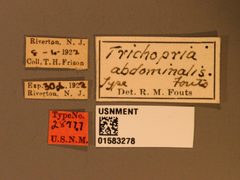
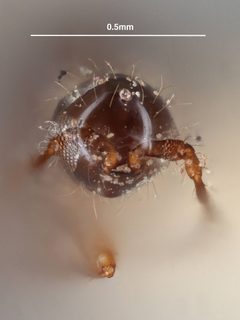
Pronunciation
How to pronounce Trichopria: /trɪˈkoʊpriə/
These audio files are automatically generated. While they are not always 100% accurate, they are a good starting point.
Images
Habitat
are diverse and -dependent, ranging from fruit orchards and berry crops to decomposing organic matter including cattle , buffalo , and carrion-baited traps. Some occupy aquatic or semi-aquatic environments associated with submersed vegetation.
Distribution
Worldwide distribution with records from North America, South America, Europe, and Asia. Documented occurrences include Brazil (Minas Gerais, Goiás, Rio Grande do Sul, Rio de Janeiro, São Paulo, Pará, Distrito Federal), United States, Italy, Slovenia, Denmark, Norway, and Sweden.
Host Associations
- Drosophila suzukii - pupal major target for ; documented in T. anastrephae and T. drosophilae
- Drosophila melanogaster - pupal laboratory rearing for T. drosophilae
- Drosophila immigrans - pupal for T. drosophilae
- Anastrepha fraterculus - pupal documented for T. anastrephae in Brazil
- Peckia chrysostoma - pupal gregarious development observed; new record from Brazil
- Sarcophagula occidua - pupal solitary from buffalo in Brazil
- Hydrellia pakistanae - pupal endoparasitoid; potentially limits of hydrilla
- Hydrellia balciunasi - pupal documented
- Brontaea quadristigma - pupal literature record
- Coproica sp. - pupal literature record
- Haematobia irritans - pupal literature record
- Palaeosepsis spp. - pupal literature record
Life Cycle
Endoparasitoid of dipteran pupae. Development occurs within , with emerging from pupal cases. Reproductive strategies vary: some exhibit solitary development (one per host), others gregarious development (multiple larvae per host), and has been documented in at least one species. Host switching can occur within a single , with parasitoids showing plasticity in host acceptance.
Behavior
Female use olfactory cues to locate , showing innate attraction to volatile organic compounds from infested fruits. In behavioral assays, females demonstrate preference for host-infested substrates over uninfested ones, and for overripe versus unripe fruits. Host preference is independent of rearing history in some , though can shift rapidly with host exposure. longevity increases substantially with access to floral resources such as buckwheat and sweet alyssum.
Ecological Role
agent of and agricultural pest Diptera. Contributes to natural of fruit flies, filth flies, and other dipteran pests. In some contexts, may act as a limiting factor on introduced biological control agents, creating trade-offs in pest management. Serves as a natural enemy in systems for crops such as strawberries, cherries, and blueberries.
Human Relevance
Investigated and used for of fruit pests, particularly Drosophila suzukii, which causes hundreds of millions of dollars in crop damage. Conservation of Trichopria through selective use is a focus of research. Some insecticides (abamectin, spinetoram, spinosad) show lower to certain , allowing compatibility of chemical and biological control methods. Mass rearing and release programs have been tested in orchard systems.
Similar Taxa
- Pachycrepoideus vindemmiaealso a pupal of Drosophila suzukii; distinguished by smaller body size and higher susceptibility to ; belongs to Pteromalidae rather than Diapriidae
- Leptopilina heterotomanative of Drosophila suzukii in some regions; larval parasitoid (not pupal) in Figitidae; can be distinguished by developmental stage attacked and family-level morphological characters
Sources and further reading
- BugGuide
- Wikipedia
- GBIF taxonomy match
- iNaturalist taxon
- NCBI Taxonomy
- Trichopria anastrephae - Entomology Today
- Trichopria anastrephae parasitizing Drosophila suzukii pupa - Entomology Today
- Trichopria anastrephae - social media - Entomology Today
- Trichopria anastrephae Archives - Entomology Today
- New Study Aims to Protect Parasitoids of Spotted-Wing Drosophila
- Hydrellia fly parasitic wasp Trichopria columbiana Ashmead (Insecta: Hymenoptera: Diapriidae)
- NOVO HABITAT PARA TRICHOPRIA SP. (HYMENOPTERA: DIAPRIIDAE) NO BRASIL
- NOVO HABITAT E HOSPEDEIRO PARA TRICHOPRIA SP. (HYMENOPTERA: DIAPRIIDAE) NO BRASIL
- Releases of Trichopria drosophilae on cherry, in three locations at different altitudes in South Tyrol (northeastern Italy) and its potential to parasitize Drosophila suzukii Rilasci di Trichopria drosophilae su ciliego in tre località a diverse altitudini in Alto Adige e poten-ziale di parassitizzazione nei confronti di Drosophila suzukii Freisetzungen von Trichopria drosophilae an Kirsche in drei Anlagen in verschiedenen Höhenlagen in Südtirol und Parasitierungspotenzial gegenüber Drosophila suzukii
- Effects of eight insecticides on Drosophila suzukii and its major pupal parasitoid Trichopria drosophilae
- Biologia reprodutiva comparada de dois parasitoides de Drosophila: trybliographa brasiliense (HYMENOPTERA: EUCOLIDE) e Trichopria drosophilae (HYMENOPTERA : DIAPRIIDAE)
- Effect of Drosophila suzukii on blueberry VOCs: chemical cues for a pupal parasitoid, Trichopria anastrephae
- Trichopria anastrephae as a biological control agent of Drosophila suzukii in strawberries
- Does host age affect progeny production and progeny fitness in Trichopria sp.?
- Biology of Trichopria popei and T. atrichomelinae (Hymenoptera: Diapriidae), Parasitoids of the Sciomyzidae (Diptera)1,2
- The preference of Trichopria drosophilae for pupae of Drosophila suzukii is independent of host size
- Influence of the Rearing Host on Biological Parameters of Trichopria drosophilae, a Potential Biological Control Agent of Drosophila suzukii
- More Power with Flower for the Pupal Parasitoid Trichopria drosophilae: A Candidate for Biological Control of the Spotted Wing Drosophila
- Trichopria drosophilae (Diapriidae) and Leptopilina heterotoma (Figitidae), native parasitoids of Drosophila suzukii, confirmed in Slovenia
- Primeiro registro de Trichopria anastrephae, parasitoide de moscas-das-frutas, no Rio Grande do Sul
- Effects of cold storage on the growth and development of Trichopria drosophilae (Hymenoptera: Diapriidae).