
Haematobia irritans
(Linnaeus, 1758)
Horn Fly
, the horn fly, is a small blood-feeding muscid fly native to Europe that has become a major livestock pest across North America, Latin America, and other regions. are obligate hematophages that remain continuously on cattle , feeding 20-40 times daily and causing significant economic losses through blood loss, stress, and reduced productivity. The exhibits remarkable plasticity, with times as short as 10-14 days under optimal conditions and multiple generations. strategies vary geographically: active adults persist year-round in tropical regions, while colder latitudes see adult dormancy beneath pats. The horn fly has developed extensive resistance, driving research into alternative control methods including , repellents, and -based strategies.
Pronunciation
How to pronounce Haematobia irritans: /ˌhiːməˈtoʊbiə ˈɪrɪtænz/
These audio files are automatically generated. While they are not always 100% accurate, they are a good starting point.
Identification
Distinguished from the similar stable fly (Stomoxys calcitrans) by smaller size, continuous association (stable flies rest off-host), and lack of thoracic stripes. House flies (Musca domestica) are larger, have sponging non-piercing mouthparts, and four dark thoracic stripes. Horn flies are further distinguished by their of remaining on cattle continuously, aggregating densely on the withers, back, and sides, and moving to the belly in hot weather. The ' piercing mouthparts and blood-feeding habit separate it from all non-biting muscids. Microscopically, the forward-projecting with raspy lower lip distinguishes it from other Haematobia species.
Images
Appearance
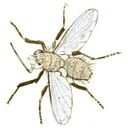
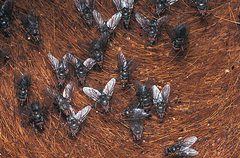
are small gray flies approximately 3.5-4.0 mm in length, roughly half the size of the common housefly. Both sexes possess slender, black, projecting forward from the surface. The body is uniformly gray without thoracic stripes. are typically dark reddish-brown, though a spontaneous white-eyed "albino" mutant has been documented in laboratory colonies. Wings are clear. is minimal; females are slightly larger and have higher feeding frequencies than males. When at rest on , flies characteristically orient with heads aligned to hair growth direction.
Habitat
are found exclusively on live cattle , preferentially positioning on the withers, back, and sides, relocating to the belly when ambient temperatures exceed 32°C. Larval development occurs in fresh cattle pats, where are deposited on or beneath the surface. stages occur beneath dung pats and in underlying soil in colder regions. The occupies diverse macroclimates from grasslands to tropical regions, showing microhabitat selection for temperatures of 23-27°C and relative humidity of 65-90% within the host's surface boundary layer.
Distribution
distribution spanning Europe (native range), North Africa, Asia Minor, and the Americas. Introduced established throughout North America from southern Canada to temperate South America, including Brazil, Argentina, and Uruguay. Present in the Caribbean. Specific documented locations include: Europe (southern France, Hungary), North America (southern Canada, USA south of approximately 29°N latitude, particularly Kansas-surrounding states, Texas, Florida), and South America (São Paulo and Santa Catarina states in Brazil, central Argentina, Uruguay). The continues expanding its range in suitable cattle-producing regions.
Seasonality
Activity period varies geographically. In the central United States, are active April through October, with peaks in June-July and August-September; warm falls may extend activity to mid-November. Tropical and subtropical are active year-round. dormancy induction begins June-August in Brazil, late September in Arkansas, October in most of the U.S., and August in Canada, with February-April depending on latitude. Multiple occur annually: 6-9 in cool temperate zones, 12-14 in warmer temperate and subtropical regions.
Diet
Obligate hematophage; both sexes feed exclusively on blood obtained by piercing skin with needle-like . feed 20-38 times daily, ingesting less than 2 mg per meal but consuming substantial cumulative volumes. Feeding is required for mating and production. Laboratory studies demonstrate highest survival and reproductive performance on cattle blood; pig, rabbit, sheep, and goat blood support intermediate survival, while chicken blood is inadequate for survival or ovarian development.
Host Associations
- cattle - primary Bos taurus and Bos indicus; obligate for and survival
- horses - secondary Fed upon but less suitable for
- water buffalo - secondary Documented in some regions
- sheep - occasional Poor suitability
- goats - occasional Poor suitability
- nondomesticated mammals - potential Wild ungulates may be exploited
Life Cycle
Complete with four stages. are deposited in clusters of 3-25 on fresh cattle , often before defecation is complete; hatch within 20-24 hours. Three larval instars develop in dung, feeding on bacteria and decomposition products; larval stage lasts 3-5 days under favorable conditions. occurs in drier portions of dung or just beneath in soil; pupal stage lasts 6-8 days. time is 10-14 days under ideal conditions, 14-18 days under less favorable conditions, and 20 days at 25°C in laboratory settings. Females begin oviposition at 2 days post-; maximum lifetime approximately 112 eggs, with mean production of 20 eggs per female entering the . are short-lived, with mean longevity of 3.5 days in laboratory conditions.
Behavior
display strong fidelity, rarely leaving cattle except for oviposition. Flies aggregate densely on hosts with oriented to hair growth direction. Thermoregulatory involves relocating from surfaces to belly when temperatures exceed 32°C. Host seeking occurs over distances up to 16 km, though most find hosts within 5 km. Feeding occurs in brief pulses throughout the day; when not feeding, adults rest on the host, historically concentrated around horns (hence ). Cattle exhibit characteristic avoidance behaviors including tail switching, skin twitching, head shaking, and kicking. Mating occurs on the host. positioning on hosts shifts to lower, more protected areas.
Ecological Role
Economic pest causing estimated losses of $1-2.5 billion in North America and Brazil combined through direct blood loss, stress-induced weight reduction (up to 0.5 lb/day), and decreased milk production (10-20% reduction). Heavy cause skin irritation and wounds that may secondary attract myiasis-producing flies. Documented as intermediate for the filarial Stephanofilaria stilesi causing stephanofilariasis skin in cattle. First confirmed report as mechanical for Trypanosoma vivax and T. evansi in Colombia, representing atypical in South America. Generally not considered a significant biological vector compared to other biting flies. Serves as prey for various including birds (tree swallows), predatory mites, beetles, and .
Human Relevance
Major veterinary pest of cattle with substantial agricultural economic impact. Control relies on combining cultural (manure management, composting), biological (dung beetles, , predatory birds), and chemical methods. Chemical control includes and , pour-ons, sprays, and ; resistance management requires of chemical classes. Economic treatment threshold is 200-250 flies per beef animal or 100 per dairy cow. Research interest in endosymbiont for potential biocontrol applications. repellents including neem oil, , and catnip show promise as alternatives to synthetic . The has developed extensive resistance to major insecticide classes, particularly pyrethroids (kdr and super-kdr sodium channel mutations documented) and organophosphates.
Similar Taxa
- Stomoxys calcitransSimilar size and blood-feeding habit, but distinguished by larger size, thoracic stripes, resting off- between blood meals, and more painful bite
- Musca domesticaSimilar gray coloration but larger, with four thoracic stripes, sponging non-piercing mouthparts, and non-continuous association
- Haematobia exiguaCongeneric buffalo fly of similar and ; distinguished by geographic distribution and preferences in Asia and Australia
More Details
Insecticide Resistance
Widespread resistance to (kdr and super-kdr mutations, up to 294-fold resistance documented) and necessitates resistance management through chemical class and integrated non-chemical methods.
Wolbachia Endosymbiont
Naturally infected with pipientis strain wHae (supergroup A); complete 1.3 Mb sequenced. Potential for reproductive manipulation and biocontrol applications under investigation, including transinfection with alternative Wolbachia strains.
Genomic Resources
Nuclear assembled at 1.14 Gb (2018); larger than related muscids Musca domestica (1.0 Gb) and Stomoxys calcitrans (1.1 Gb). Transcriptomic resources available for chemosensory gene including odorant binding proteins, odorant receptors, receptors, and ionotropic receptors.
White-eyed Mutant
Spontaneous autosomal recessive mutation with complete penetrance discovered in Kerrville, Texas laboratory colony; reduced dihydroxyxanthommatin pigment but normal viability and , useful for and behavioral studies.
Overwintering Plasticity
Remarkable geographic variation in dormancy strategy: year-round activity in tropics versus in temperate regions. Dormancy induction cued by temperature and , with substantial -level variation in response thresholds.
Sources and further reading
- BugGuide
- Wikipedia
- GBIF taxonomy match
- iNaturalist taxon
- NCBI Taxonomy
- Catalogue of Life
- Integrated Pest Management of Flies in Texas Dairies - AgriLife Extension Entomology
- Managing External Parasites of Texas Cattle - AgriLife Extension Entomology
- Horn Fly Biocontrol: In Search of Faster Fungus
- Could Catnip or Chrysanthemum Bring Cows Relief From Biting Flies?
- Counting Horn Flies: No Easy Task, Whether In Person or In a Photo
- Haematobia irritans Archives - Entomology Today
- Horn Fly, Haematobia irritans irritans (L.), Overwintering
- Physiological Age Composition and Reproductive Biology of Horn Fly Populations, Haematobia Irritans Irritans (Diptera: Muscidae), in Iowa, USA
- USE OF LIFE HISTORY PARAMETERS TO IMPROVE A REARING METHOD FOR HORN FLY, HAEMATOBIA IRRITANS IRRITANS (L.) (DIPTERA: MUSCIDAE), ON BOVINE HOSTS
- The role of semiochemicals in the behavior of the horn fly, Haematobia irritans (L.), (Diptera: Muscidae) / by Herbert Thomas Bolton.
- Complete genome assembly of the Wolbachia endosymbiont of the horn fly Haematobia irritans irritans: a supergroup A strain with multiple horizontally acquired cytoplasmic incompatibility genes
- Autecology of the Adult Horn Fly, Haematobia Irritans (L.), (Diptera: Muscidae)
- Survival, ovarian development and bloodmeal size for the horn fly Haematobia irritans irritans reared in vitro
- Wolbachia successfully replicate in a newly established horn fly, Haematobia irritans irritans (L.) (Diptera: Muscidae) cell line
- Tripanosomiasis bovina en ganadería lechera de trópico alto: primer informe de Haematobia irritans como principal vector de T. vivax y T. evansi en Colombia Bovine trypanosomiasis in dairy farming in the high tropics: First report of Haematobia irritans as the main vector for T. vivax and T. evansi in Colombia Tripanossomíase bovina em gado leiteiro de trópico alto: primeiro relatório de Haematobia irritans como principal vetor de T. vivax e T. evansi na Colômbia
- Dynamics and mechanisms of permethrin resistance in a field population of the horn fly, Haematobia irritans irritans
- Chemosensory-Related Gene Family Members of the Horn Fly, Haematobia irritans irritans (Diptera: Muscidae), Identified by Transcriptome Analysis
- Management Practices for the Control of Haematobia irritans, Dermatobia hominis, and Cochliomyia hominivorax in Cattle Across Latin America: A Sustainable, Collective Approach.
- First record of Haematobia irritans (L.) (Diptera: Muscidae) infesting cattle in Northeastern Algeria.