
Haematobia
Lepeletier & Serville, 1828
horn flies
Species Guides
1- Haematobia irritans(Horn Fly)
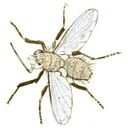
Haematobia is a of biting muscid flies commonly known as horn flies. are obligate blood-feeders on cattle and related bovids, with . The genus includes approximately 8 described , with being the most economically significant pest of cattle in North America. Larvae develop exclusively in fresh cattle manure. Heavy cause substantial economic losses through blood loss, reduced weight gain, and decreased milk production.
Pronunciation
How to pronounce Haematobia: /ˌhiːməˈtoʊbiə/
These audio files are automatically generated. While they are not always 100% accurate, they are a good starting point.
Images
Habitat
Pastures and confined cattle operations where fresh manure is available for larval development. Associated with bovine livestock housing and feeding areas.
Distribution
Widely distributed in cattle-raising regions globally. Documented in North America, South America (Colombia), Europe (Denmark, Norway, Sweden), and other regions with intensive cattle production.
Seasonality
increase from late spring through early fall, peaking in midsummer. Activity declines with cooler temperatures.
Diet
are obligate blood-feeders, taking multiple meals per day from cattle. Each fly feeds 20-40 times daily, consuming less than 2 milligrams per meal. Larvae feed on microorganisms in fresh cattle manure.
Host Associations
- Bos taurus - primary domestic cattle; principal blood source for
- Bubalus bubalis - water buffalo; H. exigua specifically associated
Life Cycle
Females deposit in groups of 3-7 on or under edges of fresh pats. Eggs hatch within 24 hours. Larvae develop rapidly, reaching maturity in 3-5 days, then crawl to drier portions of manure to pupate. Pupal stage lasts 6-8 days. Complete development from egg to takes 10-20 days depending on temperature. Adults emerge and immediately seek cattle , where they remain continuously except when females leave to oviposit.
Behavior
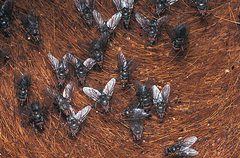
remain on animals nearly continuously, clustering on withers, back, and sides. When ambient temperature exceeds 32°C (90°F), flies move to the belly. Females leave hosts only to deposit on fresh manure. Adults feed repeatedly throughout the day, causing cattle to exhibit irritation : tail switching, skin twitching, shaking, and kicking at bellies.
Ecological Role
Blood-feeding of cattle. Documented mechanical of Trypanosoma vivax and T. evansi in Colombia. Serves as prey for various including predatory mites, beetles, and larvae of Hydrotaea and Muscina . (Muscidifurax and Spalangia spp.) attack pupae.
Human Relevance
Major economic pest of cattle industry, causing losses exceeding $1 billion in North America through reduced weight gain, decreased milk production, and hide damage. Threshold for economic intervention: 200-250 flies per animal. Controlled through , sprays, pour-ons, and emphasizing manure management. Documented insecticide resistance to (since 1984) and (since 1970s).
Similar Taxa
- Stomoxys calcitransBoth are blood-feeding muscids of similar size (~5 mm) and gray coloration. Stable flies have wider range (cattle, horses, humans, dogs), rest on nearby surfaces between feeds rather than remaining on host, and breed in decaying hay/straw mixtures rather than fresh manure alone. Stable flies have more prominent piercing projecting forward.
- Musca domesticaHouse flies are larger (~6 mm), have sponging non-piercing mouthparts, four dark thoracic stripes, and do not blood-feed. They breed in various decaying organic matter, not exclusively fresh manure.
More Details
Vector capacity
While traditionally considered an annoyance pest, H. irritans has been identified as the main potential of bovine (Trypanosoma vivax and T. evansi) in high-tropical dairy regions of Colombia, representing an atypical transmission pattern compared to Tabanidae-dominated systems elsewhere in South America.
Botanical control research
including nepetalactone (catnip), (chrysanthemum), and neem show promise as alternative repellents and , potentially avoiding rapid resistance development due to multiple bioactive compounds with varied .
Sources and further reading
- BugGuide
- Wikipedia
- GBIF taxonomy match
- iNaturalist taxon
- NCBI Taxonomy
- Catalogue of Life
- Integrated Pest Management of Flies in Texas Dairies - AgriLife Extension Entomology
- Managing External Parasites of Texas Cattle - AgriLife Extension Entomology
- Haematobia irritans Archives - Entomology Today
- Could Catnip or Chrysanthemum Bring Cows Relief From Biting Flies?
- Horn Fly Biocontrol: In Search of Faster Fungus
- Counting Horn Flies: No Easy Task, Whether In Person or In a Photo
- Biology of the Buffalo Fly, Haematobia exigua De Mejere (Diptera: Muscidae)
- The role of semiochemicals in the behavior of the horn fly, Haematobia irritans (L.), (Diptera: Muscidae) / by Herbert Thomas Bolton.
- Tripanosomiasis bovina en ganadería lechera de trópico alto: primer informe de Haematobia irritans como principal vector de T. vivax y T. evansi en Colombia Bovine trypanosomiasis in dairy farming in the high tropics: First report of Haematobia irritans as the main vector for T. vivax and T. evansi in Colombia Tripanossomíase bovina em gado leiteiro de trópico alto: primeiro relatório de Haematobia irritans como principal vetor de T. vivax e T. evansi na Colômbia