
Drosophila immigrans
Sturtevant, 1921
Drosophila immigrans is a vinegar fly in the Drosophilidae, belonging to the Immigrans-tripunctata radiation within the subgenus Drosophila. It has been used in evolutionary studies to understand virus- . The exhibits seasonal patterns in response to temperature extremes and shows altitudinal variation in body melanization correlated with traits. It has a close ecological association with Penicillium moulds on citrus fruit.
Pronunciation
How to pronounce Drosophila immigrans: /droʊˈsɒfɪlə ɪˈmɪɡrænz/
These audio files are automatically generated. While they are not always 100% accurate, they are a good starting point.
Identification
Larvae can be distinguished from Drosophila suzukii using analysis with XmnI restriction : D. immigrans produces two bands at 270bp and 310bp, while D. suzukii produces three bands at 120bp, 210bp, and 250bp. Distinguished from D. melanogaster by stronger association with Penicillium-infected citrus fruit and greater larval survival on mouldy citrus.
Images
Appearance
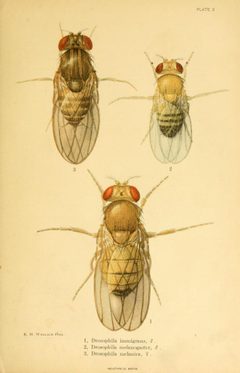
are typical small vinegar flies. are white, elliptical, approximately 0.5 mm in length, with two chorionic filaments. Larvae have three instars: first instar 2.0-2.5 mm, second instar 4.0-4.5 mm, third instar 6.0-6.5 mm. Pupae are 3.5 mm, tan to dark brown in color. Body melanization varies clinally with altitude in montane .
Habitat
Associated with citrus fruits, particularly those infected with Penicillium italicum or P. digitatum moulds. In montane , found at altitudes from 600 to 2202 meters. Unable to overwinter outdoors in temperate regions at altitudes of 500m or higher in central Japan; in these areas maintained by from warmer areas.
Distribution
Native to tropical/subtropical regions; in temperate montane areas (central Japan, alt. 500-2000m) maintained by seasonal . Present in the Philippines (Los Baños, Laguna). Records from Flores, Pico, São Miguel, Terceira (Azores), and Galápagos Islands.
Seasonality
In central Japan, present at lowlands (500-1200m) in spring and autumn, absent in summer due to heat intolerance; present at highlands (1500-2000m) only in summer. Seasonal occurs to escape temperature extremes; no photoperiodic .
Diet
Larvae feed on standard Drosophila medium (banana-agar) in laboratory conditions. In nature, strongly associated with citrus fruits infected with Penicillium italicum or P. digitatum moulds; larvae survive better than D. melanogaster on Penicillium-infected citrus.
Host Associations
- Penicillium italicum - associated with mould of citrus; D. immigrans larvae survive well on infected fruit
- Penicillium digitatum - associated with mould of citrus; D. immigrans larvae survive well on infected fruit
- Citrus - breeding substratePrimary breeding site, especially when infected with Penicillium moulds
Life Cycle
Complete with , three larval instars, , pupa, and stages. Total developmental period from egg to adult averages 10 days (range 9-11 days) at 25±1°C: egg stage 1 day, larval stage 4 days (1st instar 1 day, 2nd instar 1 day, 3rd instar 2 days), prepupal stage 1 day, pupal stage 4 days. Adult lifespan averages 30 days. Egg production averages 50 eggs per female.
Behavior
Larvae exhibit negative and positive geotaxis. exhibit positive phototaxis and negative geotaxis. Males follow females and mount for mating. Undergoes seasonal between lowland and highland areas to escape temperature extremes; less cold-hardy but more heat-tolerant than D. curviceps.
Human Relevance
Used as a model organism in evolutionary studies to understand how viruses evolve with their . Potential pest of citrus fruits, particularly in commercial settings where Penicillium occur. May have evolved as a citrus and become domesticated as citrus exploitation expanded commercially.
Similar Taxa
- Drosophila suzukiiBoth occur in similar and can be confused in field collections; distinguished by banding patterns and larval survival on different substrates
- Drosophila melanogasterBoth common vinegar flies associated with fruit; D. immigrans more specialized on Penicillium-infected citrus with better larval survival on mouldy fruit, while D. melanogaster more common on uninfected fruit
- Drosophila curvicepsMember of same group; D. immigrans is less cold-hardy but more heat-tolerant, with different seasonal patterns
More Details
Cytogenetics
Somatic number is 2n=12 with acrocentric chromosomes.
Thermal Adaptation
show genetic-based variation in abdominal melanization correlated with altitude; darker flies at higher altitudes have 1.5-1.9 fold greater desiccation resistance, 35-40% longer copulation duration, and higher .
Evolutionary Studies
Has been used in research on virus- .
Sources and further reading
- BugGuide
- Wikipedia
- GBIF taxonomy match
- iNaturalist taxon
- NCBI Taxonomy
- Catalogue of Life
- Christine Tabuloc's Seminar: Inside Her Intricate Research World of Drosophila | Bug Squad
- UC Davis Seminars: From Spotted Wing Drosophila to Spider Glue to Wild Bees | Bug Squad
- African Fig Fly Meets Spotted-Wing Drosophila in the U.S.
- Dry, Red Sticky Trap Improves Spotted-Wing Drosophila Monitoring
- New Study Aims to Protect Parasitoids of Spotted-Wing Drosophila
- Spotted-Wing Drosophila: New Seasonal Activity Model Will Aid IPM Efforts
- Morphology, Life History and Somatic Chromosomes of Drosophila immigrans Sturtevant
- Simple and Rapid PCR-RFLP based species identification in Drosophila suzukii and Drosophila immigrans larvae
- Climatic adaptations in the Drosophila immigrans species group: seasonal migration and thermal tolerance
- An ecological interaction between citrus fruit, Penicillium moulds and Drosophila immigrans Sturtevant (Diptera: Drosophilidae)
- Fitness consequences of body melanization inDrosophila immigransfrom montane habitats